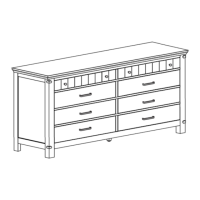
This document provides assembly instructions for the Coaster Fine Furniture dresser, model number 204393. It includes details on parts identification, hardware, assembly steps, and an anti-tipping restraint installation guide, along with dimensional information.
Function Description:
The Coaster Fine Furniture dresser (model 204393) is designed as a storage unit for residential use, featuring multiple drawers for organizing clothing and other items. It is intended to be a stable and functional piece of furniture for various stages of life, as indicated by the "Fine Furniture for every stage of life" tagline. The dresser requires assembly, and the provided instructions guide users through the process to ensure proper construction and safety. A key safety feature is the anti-tipping restraint, which is crucial for preventing accidental tipping and potential injury, especially in households with children.
Important Technical Specifications:
- Model Number: 204393
- Product Type: Dresser
- Revisions:
- Revision 0: 10/30/2015
- Revision 1: 01/21/2020
- Assembly Time: Approximately 20 minutes (as indicated on the "Parts Identification" page).
- Dimensions (Overall):
- Width: 59.05 inches
- Height: 36.77 inches
- Depth: 16.53 inches
- Drawer Inner Dimensions: 5.27 inches (height) x 12.67 inches (depth) x 24.01 inches (width).
- Bottom Clearance: 3.46 inches.
- Leg Height: 9.26 inches.
- Top Thickness: 0.74 inches.
- Dimension Tolerance: ±5%
- Materials: The hardware includes bolts (M6 x 30mm - BLK), lock washers (1/4" - BLK), flat washers (1/4" x 20mm - BLK), and an Allen wrench (M4 x 65mm - BLK). The main components are the dresser body, front legs (right and left), back legs (right and left), and a support leg.
- Safety Feature: Anti-tipping restraint system, requiring attachment to a wall stud.
Usage Features:
- Assembly: The dresser is a ready-to-assemble (RTA) furniture piece. Users need to follow a step-by-step guide to put it together. The instructions emphasize sorting hardware by size, checking for all parts, and following the numbered sequence for efficient assembly.
- Tools Required: An Allen wrench is provided. A Philips head screwdriver is also required for assembly but is not included by the manufacturer.
- Drawer Storage: The dresser features multiple drawers, providing ample storage space for various items. The inner dimensions of the drawers are specified to help users understand their capacity.
- Stability: The design includes specific front, back, and support legs to ensure the dresser's stability. The anti-tipping restraint is a critical safety feature that must be installed to prevent the dresser from tipping over, especially when drawers are open or if children attempt to climb on it.
- Placement: The anti-tipping restraint requires the dresser to be placed near a wall with a stud for secure attachment. The wall bracket should be positioned two inches below the dresser's mounting bracket.
Maintenance Features:
- Repair/Modification Warning: Users are explicitly warned not to attempt to repair or modify broken or defective parts. Instead, they should contact the store immediately for assistance. This suggests that specialized parts or knowledge might be required for repairs, and unauthorized modifications could compromise the dresser's structural integrity or safety.
- Intended Use: The product is intended for home use only and is not designed for commercial establishments. This implies that the dresser's construction and materials are suited for typical household wear and tear, and commercial use might lead to premature damage or failure.
- Anti-Tipping Restraint Care: The anti-tipping restraint must be securely laced and locked. It is crucial to confirm that all slack is removed from the strap. Users are also warned to detach the restraint before moving the furniture to prevent injury or damage. This highlights the importance of proper installation and careful handling of the safety mechanism.
- Cleaning: While not explicitly detailed in the provided pages, general furniture maintenance practices would apply, such as regular dusting and cleaning with appropriate furniture cleaners, avoiding harsh chemicals that could damage the finish.
- Inspection: Although not stated, periodic inspection of all assembled connections (bolts, screws) for tightness would be a good practice to ensure the dresser remains sturdy over time.

 Need help?
 General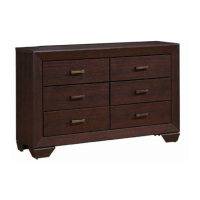

 To Next Page