.-----------------------------------------------------------------------------
,
IMPORT ANT
NOTE
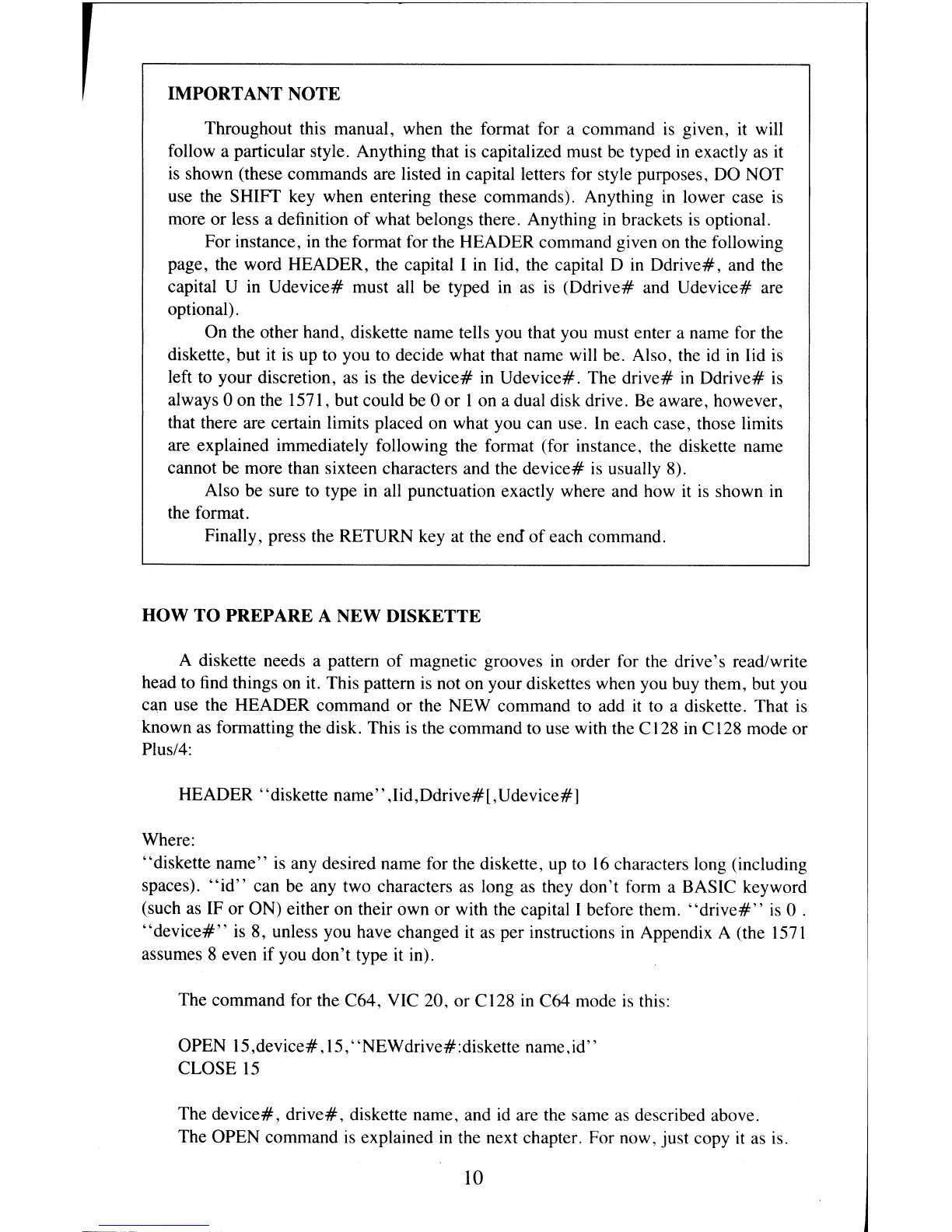
Throughout this manual, when the format for a command
is
given,
it
will
follow a particular style. Anything that
is
capitalized must bc typcd
in
exactly
as
it
is
shown (these commands are listed
in
capital letters for style purposes,
DO
NOT
use the SHIFT key when entering these commands). Anything
in
lower case
is
more or less a definition
of
what belongs there. Anything
in
brackets
is
optional.
For instance,
in
the format for the HEADER command given on the following
page, the word HEADER, the capital I
in
lid, the capital 0
in
Ddrive#, and the
capital U
in
Udevice# must
all
be
typed
in
as
is
(Ddrive# and Udevice# are
optional).
On the other hand, diskette name tells you that you must enter a name for the
diskette, but it
is
up to you to decide what that name will be. Also, the
id
in
lid
is
left to your discretion,
as
is
the
device#
in
Udevice#. Thc
drive#
in
Ddrive#
is
always 0 on the 1571, but could be 0 or I on a dual disk drive.
Be
aware, however,
that there are certain limits placed on what you can use.
In
each casc, those limits
are explained immediately following the format (for instance, the diskette name
cannot be more than sixteen characters and the device#
is
usually 8).
Also be sure to type
in
all punctuation exactly where and how
it
is
shown
in
the format.
Finally, press the RETURN key at the
end
of
each command.
HOW TO PREPARE A
NEW
DISKETTE
A diskette needs a pattern of magnetic grooves
in
order for the drive's read/write
head to
find
things on
it.
This pattern
is
not on your diskettes when you buy them, but you
can use the HEADER command or the NEW command
to
add
it
to a diskette. That
is
known
as
formatting the disk. This
is
the command to use with the C
128
in
C I
28
mode or
Plus/4:
HEADER "diskette
name"
,lid, Ddri
ve#
[, U device# J
Where:
"diskette
name"
is
any desired name for the diskette,
up
to
16
characters long (including
spaces).
"id"
can be any two characters
as
long
as
they don't form a BASIC keyword
(such
as
IF or ON) either on their own or with the capital I bcfore them.
"drive#"
is
0 .
"device#"
is
8, unless you have changed
it
as
per instructions
in
Appendix A (the
1571
assumes 8 even if you don't type
it
in).
The command for the C64, VIC 20, or CI28
in
C64 mode
is
this:
OPEN 15,device#,
15,
"NEWdrive#:diskette name,id"
CLOSE
15
The device#,
drive#,
diskette name, and
id
are the same
as
described above.
The OPEN command
is
explained
in
the next chapter. For now, just copy
it
as
is.
10


 To Next Page
 Loading...