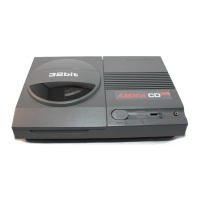
The CD4000 isn't available yet. It's a card that fits into one of the A4000's Zorro 3 slots and a CD drive
that slides into a drive bay, has Akiko, has Kickstart 3.1, boots straight from CD-ROM, and has FMV
capability. (Anyone have any dirt on this drive? Bet it never shipped. -Ed.)
The Squirrel uses the PCMICA slot, doesn't appear to emulate Akiko, needs you to install the CD-ROM
file system to your Workbench before you can use the drive, needs a utility (supplied) to boot CD32
CDs, and doesn't have FMV capability. It's also a full SCSI interface. If you'd like to add other SCSI
devices (such as tape storage, scanners, etc...) then it could be a better choice than the Archos. Also
software updates are regularly uploaded to Aminet (unlike Archos' where you have to try to convince
your dealer to give you a free copy).
Q: What's good/bad about a CD drive using the PCMICA or trapdoor slots?
A: If your CD drive uses the PCMICA slot, you've got a RAM board in the trapdoor slot, it's got more
than 4 meg of fast RAM, and it doesn't Autoconfig properly, then the drive may refuse to work or you
could lose all memory above the 4 meg barrier because the PCMCIA slot and the memory both try to use
the same address space. You could only use 4 meg or you could ask your dealer for an upgrade.
Some trapdoor accelerators don't Autoconfig properly either. Notably Amitek, Blizzard, and GVP ones.
Amitek offer a free upgrade to fix this problem. The Blizzard 1230III and the GVP 1230 '030 boards
work fine, don't know about other Blizzard and GVP boards. All of the Microbotics boards work.
If your CD drive uses the trapdoor slot then you can kiss goodbye to RAM expansions and accelerators.
Q: What do I need to do to run a CD32 game if I don't have the Archos, CD1200, CD4000, or the
Squirrel CD drive?
A: If you have a SCSI CD drive then you can assign CD0: to the CD drive (if it isn't already), assign the
standard directories (C:, DEVS:, ENVARC:, FONTS:, L:, LIBS:, S:, SYS:) across to the CD-ROM and
execute S:Startup-Sequence.
Or if you have a Parnet or Sernet link to a CD32 or CDTV, you can assign CD0: to NET:CD0, assign the
CD-ROM's name to NET:, assign the standard directories, then execute S:Startup-Sequence. It's slow,
though, so if you have a big hard drive, it's probably better to go for the next option...
Or it should be possible to copy all of the CD-ROM to your hard drive by using a Parnet, Sernet, or Twin
Express link to a CD32 or CDTV, assign CD0: and the CD-ROM's name to the directory that you copied
to, assign the standard directories to the equivalent place on the hard drive, and execute
S:Startup-Sequence.
The game may have an icon to double click to run it. In that case you don't need to assign or execute
anything.
Alternatively, there's a program called Cache-CDFS that's distributed in Germany. It works on the A1200
or A4000. It sits between the CD32 game and the Amiga's SCSI, IDE, or PCMCIA CD-ROM drive.
Most CD32 games should work once it's installed, but there have been some problems reported with
file:///C|/sites/amigaemulation/cd32/CD32FAQ/CD32_FAQ_2000.htm (30 of 39) [3/9/2000 1:55:14 PM]


 To Next Page
 Loading...