EasyManua.ls Logo

Commodore PC - Command

Commodore PC
414 pages
Print Icon
To Next Page IconTo Next Page
To Previous Page IconTo Previous Page
Loading...
n
n
n
n
n
n
n
n
n
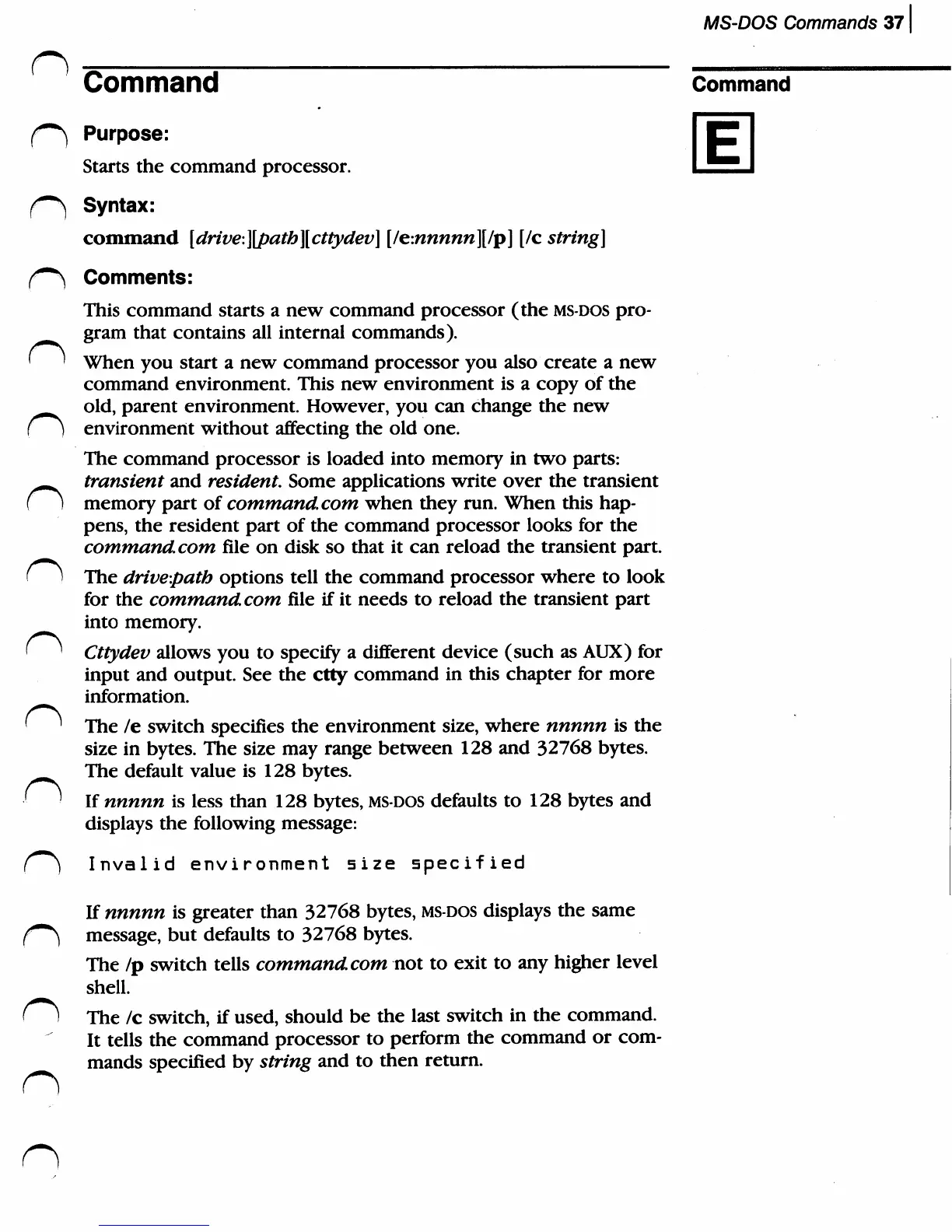
Command
Purpose:
Starts
the
command
processor.
Syntax:
command
[drive:][path][cttydev]
[/c-.nnnnn][/p]
[/c
string]
Comments:
This
command
starts
a
new
command
processor
(the
ms-dos
pro
gram
that
contains
all
internal
commands).
When
you
start
a
new
command
processor
you
also
create
a
new
command
environment.
This
new
environment
is
a
copy
of
the
old,
parent
environment.
However,
you
can
change
the
new
environment
without
affecting
the
old
one.
The
command
processor
is
loaded
into
memory
in
two
parts:
transient
and
resident.
Some
applications
write
over
the
transient
memory
part
of
command
com
when
they
run.
When
this
hap
pens,
the
resident
part
of
the
command
processor
looks
for
the
command
com
file
on
disk
so
that
it
can
reload
the
transient
part.
The
drive-path
options
tell
the
command
processor
where
to
look
for
the
command
com
file
if
it
needs
to
reload
the
transient
part
into
memory.
Cttydev
allows
you
to
specify a
different
device
(such
as
AUX)
for
input
and
output.
See
the
ctty
command
in
this
chapter
for
more
information.
The
/e
switch
specifies
the
environment
size,
where
nnnnn
is
the
size
in
bytes.
The
size
may
range
between
128 and
32768
bytes.
The
default
value
is
128
bytes.
If
nnnnn
is
less
than
128
bytes,
ms-dos
defaults
to
128
bytes
and
displays
the
following
message:
D
(*"*)
Invalid
environment
size
specified
If
nnnnn
is
greater
than
32768
bytes,
ms-dos
displays
the
same
message,
but
defaults
to
32768
bytes.
The
/p
switch
tells
command
com
not
to
exit
to
any
higher
level
shell.
The
/c
switch,
if
used,
should
be
the
last
switch
in
the
command.
It
tells
the
command
processor
to
perform
the
command
or
com
mands
specified
by
string
and
to
then
return.
MS-DOS
Commands
37
Command

Related product manuals