EasyManua.ls Logo

Commodore PC - Page 272

Commodore PC
414 pages
Print Icon
To Next Page IconTo Next Page
To Previous Page IconTo Previous Page
Loading...
200
MS-DOS
User's
Reference
The
/nogroup-
association option
The
/overlay-
interrupt
option
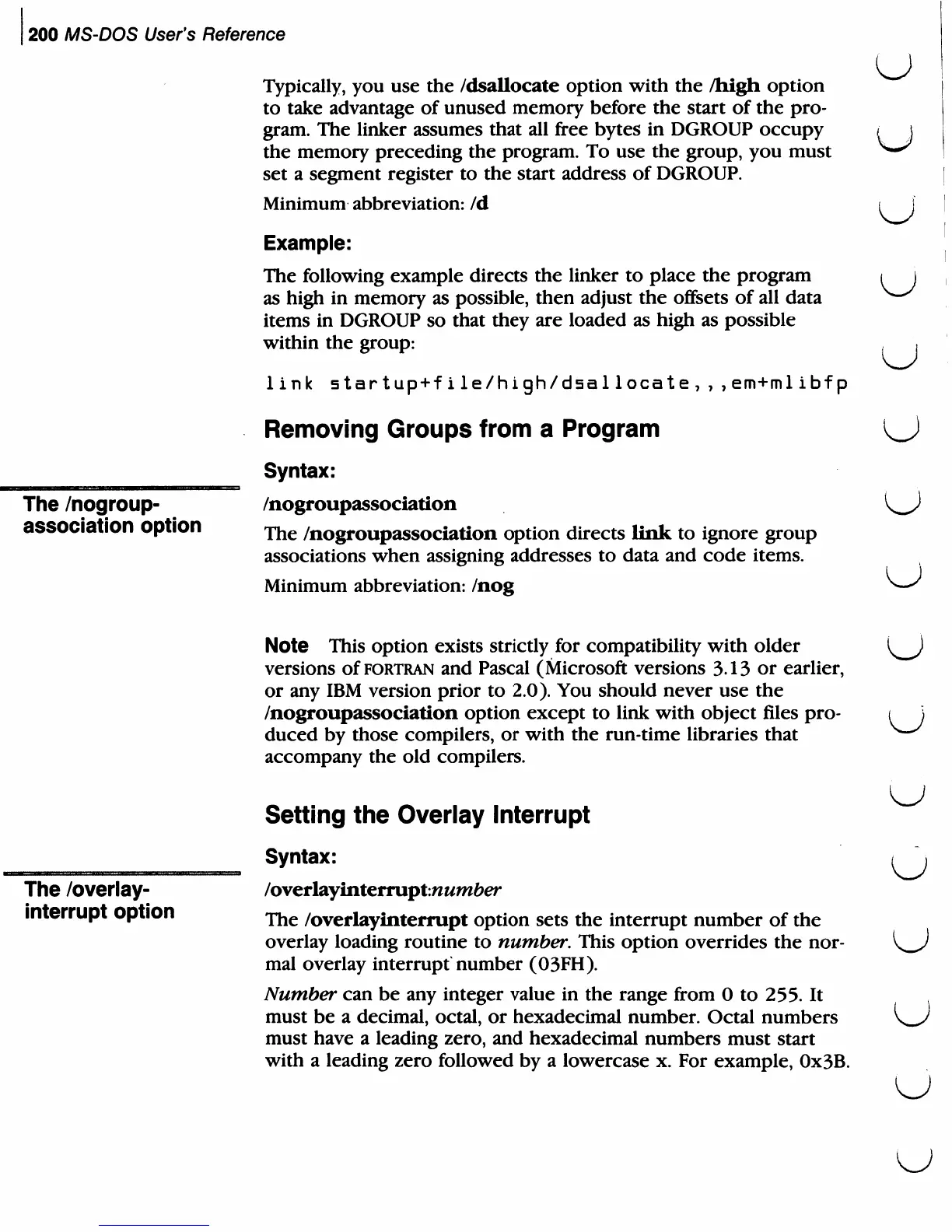
Typically,
you
use
the
/dsallocate
option
with
the
/high
option
to
take
advantage
of
unused
memory
before
the
start
of
the
pro
gram.
The
linker
assumes
that
all
free
bytes
in
DGROUP
occupy
the
memory
preceding
the
program.
To
use
the
group,
you
must
set
a
segment
register
to
the
start
address
of
DGROUP.
Minimum
abbreviation:
/d
Example:
The
following
example
directs
the
linker
to
place
the
program
as
high
in
memory
as
possible,
then
adjust
the
offsets
of
all
data
items
in
DGROUP
so
that
they
are
loaded
as
high
as
possible
within
the
group:
link
startup+file/high/dsallocate,,,em+mlibfp
Removing
Groups
from
a
Program
Syntax:
/nogroupassociation
The
/nogroupassociation
option
directs
link
to
ignore
group
associations
when
assigning
addresses
to
data
and
code
items.
Minimum
abbreviation:
/nog
Note
This
option
exists
strictly
for
compatibility
with
older
versions
of
Fortran
and
Pascal
(Microsoft
versions
3.13
or
earlier,
or
any
IBM
version
prior
to
2.0).
You
should
never
use
the
/nogroupassociation
option
except
to
link
with
object
files
pro
duced
by
those
compilers,
or
with
the
run-time
libraries
that
accompany
the
old
compilers.
Setting
the
Overlay
Interrupt
Syntax:
/overlayinterruptnumber
The
/overlayinterrupt
option
sets
the
interrupt
number
of
the
overlay loading
routine
to
number.
This
option
overrides
the
nor
mal
overlay
interrupt
number
(03FH).
Number
can
be
any
integer
value
in
the
range
from
0
to
255.
It
must
be
a
decimal,
octal,
or
hexadecimal
number.
Octal
numbers
must
have
a
leading
zero,
and
hexadecimal
numbers
must
start
with
a
leading
zero
followed
by
a
lowercase
x.
For
example,
0x3B.
U
U
u
u
u
u

Related product manuals