EasyManua.ls Logo

Commodore PC - Write

Commodore PC
414 pages
Print Icon
To Next Page IconTo Next Page
To Previous Page IconTo Previous Page
Loading...
n
n
n
n
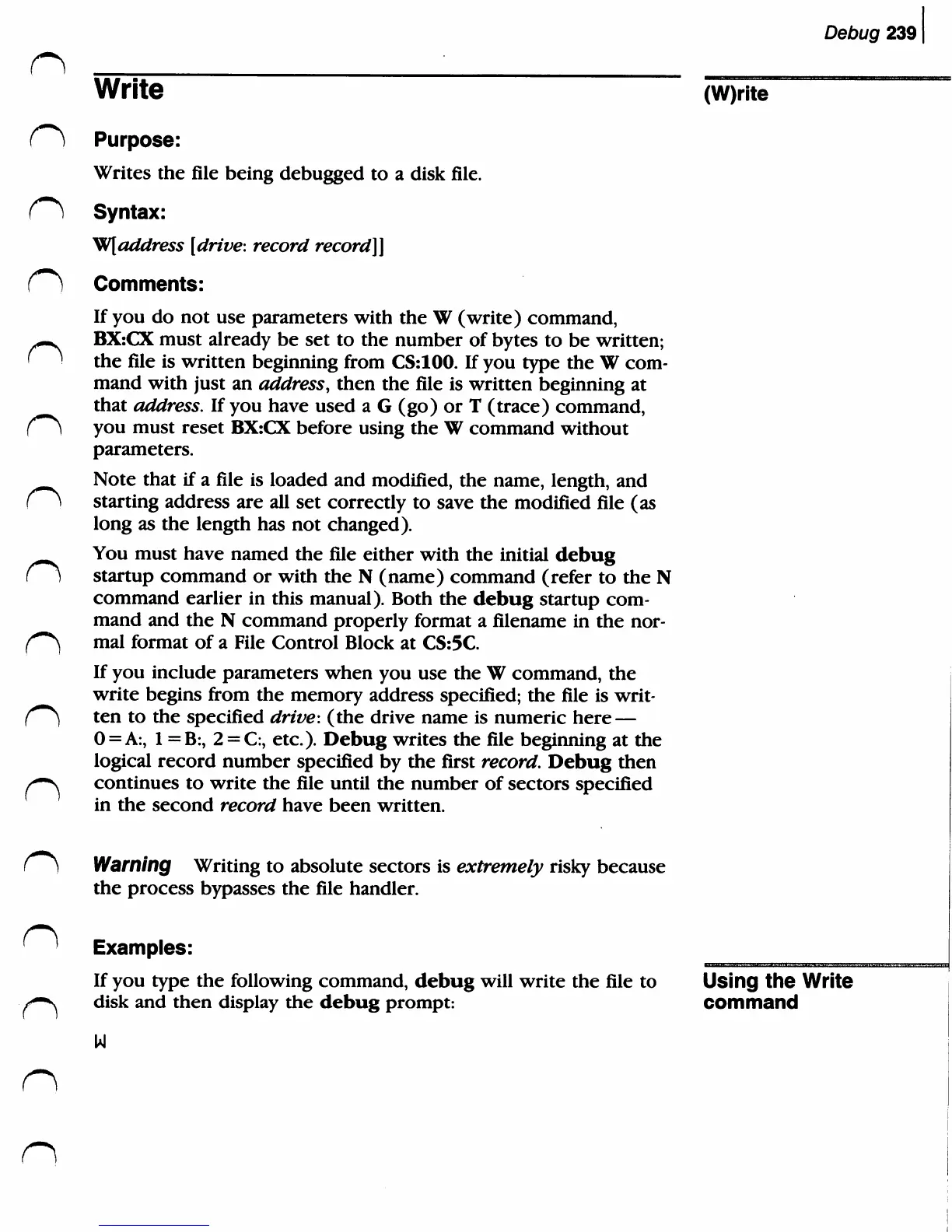
Write
Purpose:
Writes
the
file
being
debugged
to a
disk
file.
Syntax:
W[address
[drive:
record
record]]
r*)
Comments:
If
you
do
not use
parameters
with
the
W
(write)
command,
BX:CX
must
already
be
set
to
the
number
of bytes
to
be
written;
the
file
is
written
beginning
from
CS:100.
If
you
type
the
W
com
mand
with
just
an
address,
then
the
file
is
written
beginning
at
that
address.
If
you
have
used
a
G
(go)
or
T
(trace)
command,
you
must
reset
BX:CX
before
using
the
W
command
without
parameters.
Note
that
if
a
file
is
loaded
and
modified,
the
name,
length,
and
starting
address
are
all
set
correctly
to
save
the
modified
file
(as
long
as
the length has
not
changed).
You
must
have
named
the
file
either
with
the
initial
debug
startup
command
or
with
the
N
(name)
command
(refer
to
the
N
command
earlier
in
this
manual).
Both
the
debug
startup
com
mand
and
the
N
command
properly
format
a
filename
in
the
nor
mal
format
of
a
File
Control
Block
at
CS:5C.
If
you
include
parameters
when
you
use
the
W
command,
the
write
begins
from
the
memory
address
specified;
the
file
is
writ
ten
to
the
specified
drive:
(the
drive
name
is
numeric
here
0
=
A:,
1
=B:,
2
=
C:,
etc.).
Debug
writes the
file
beginning
at
the
logical
record
number
specified
by
the
first
record.
Debug
then
continues
to
write
the
file
until
the
number
of
sectors
specified
in
the
second
record
have
been
written.
Debug
239
(W)rite
Warning
Writing
to
absolute
sectors
is
extremely
risky
because
the
process
bypasses
the
file
handler.
Examples:
If
you
type
the
following
command,
debug
will
write
the
file
to
disk
and
then
display
the
debug
prompt:
Using
the
Write
command
N

Related product manuals