EasyManua.ls Logo

Commodore PC - Page 87

Commodore PC
414 pages
Print Icon
To Next Page IconTo Next Page
To Previous Page IconTo Previous Page
Loading...
About
Commands
15
n
n
Afote
If
you
have
more
than
one
external
command
with
the
same
name,
ms-dos
will
run
only
one
of
them, according
to
the
following
order
of
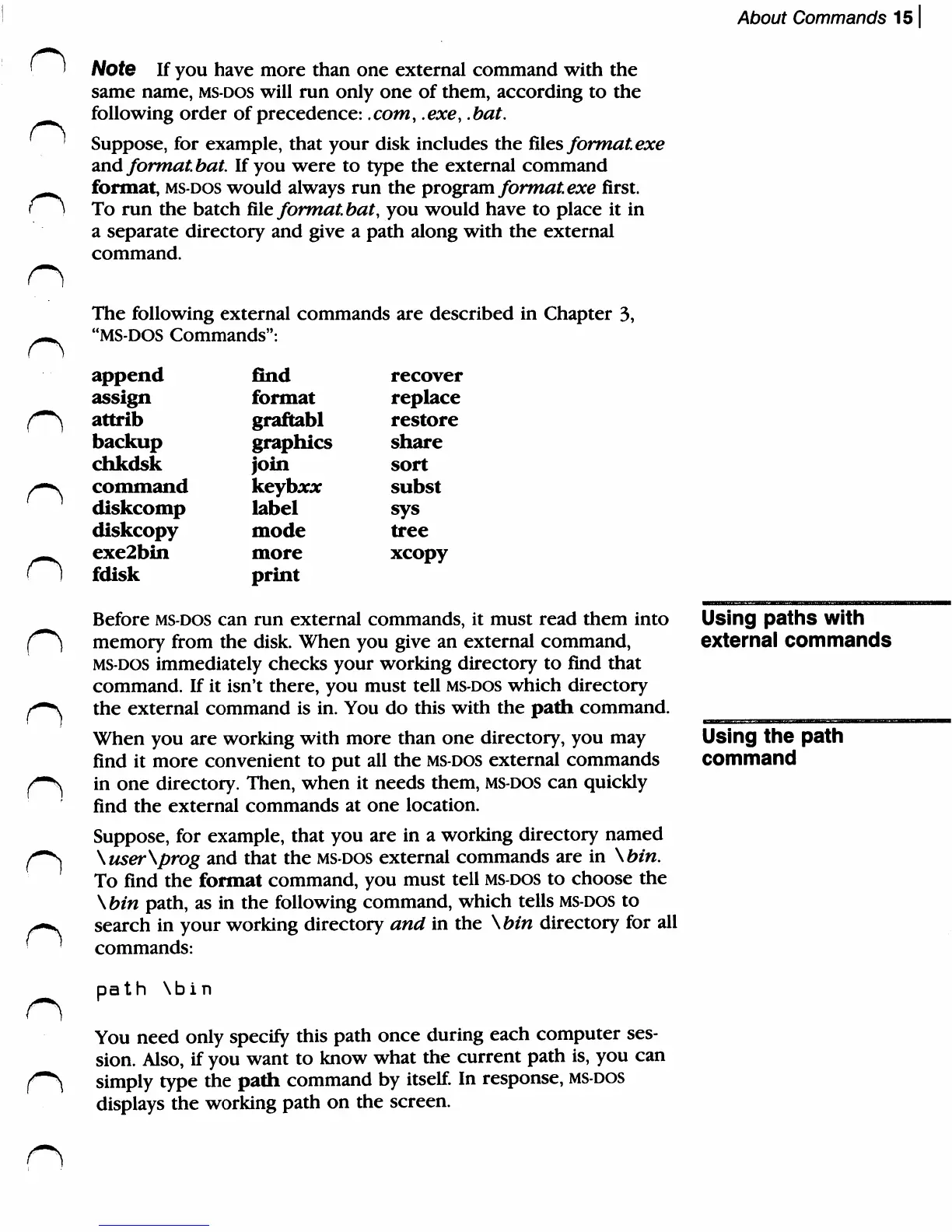
precedence:
.com,
.exe,
.bat.
Suppose,
for
example,
that
your
disk
includes
the
files
format,
exe
and
format,
bat.
If
you
were
to
type
the
external
command
format,
ms-dos
would
always
run
the
program
format,
exe
first.
To
run
the
batch
file
format,
bat,
you
would
have
to
place
it
in
a
separate
directory
and
give
a
path
along
with
the
external
command.
The
following
external
commands
are
described
in
Chapter
3,
"MS-DOS
Commands":
n
n
n
n
n
append
assign
attrib
backup
chkdsk
command
diskcomp
diskcopy
exe2bin
fdisk
find
format
graftabl
graphics
join
keybxx
label
mode
more
print
recover
replace
restore
share
sort
subst
sys
tree
xcopy
Before
ms-dos
can
run
external
commands,
it
must
read
them
into
memory
from
the
disk.
When
you
give
an
external
command,
ms-dos
immediately
checks
your
working
directory
to
find
that
command.
If
it
isn't
there,
you
must
tell
ms-dos
which
directory
the
external
command
is
in.
You
do
this
with
the
path
command.
When
you
are
working
with
more
than
one
directory,
you
may
find
it
more
convenient
to
put
all
the
ms-dos
external
commands
in
one
directory.
Then,
when
it
needs
them,
ms-dos
can
quickly
find
the
external
commands
at
one
location.
Suppose,
for
example,
that
you
are
in
a
working
directory
named
\user\prog
and
that
the
ms-dos
external
commands
are
in
\bin.
To
find
the
format
command,
you
must
tell
ms-dos
to
choose
the
\bin
path,
as
in
the
following
command,
which
tells
ms-dos
to
search
in
your
working
directory
and
in
the
\bin
directory
for
all
commands:
path
\bin
You
need
only
specify
this
path
once
during
each
computer
ses
sion.
Also,
if
you
want
to
know
what
the
current
path
is,
you
can
simply
type
the
path
command
by
itself.
In
response,
ms-dos
displays
the
working
path
on
the
screen.
Using
paths
with
external
commands
Using
the
path
command

Related product manuals