EasyManua.ls Logo

Commodore Plus 4 - CHAPTER 8 Making Sound and Music on the Plus;4

Commodore Plus 4
464 pages
Print Icon
To Next Page IconTo Next Page
To Previous Page IconTo Previous Page
Loading...
Section
1.
Word
Processor
Commands
101
Drawing
Point
Graphs
The
graph
generator
creates
only
bar
graphs,
but
you
can
edit
the
graphs
to
make
them
point
graphs.
Point
graphs
show
only
the
top
value
from
each
graph
column
whereas
bar
graphs
show
a
solid
bar
for
each
column.
You
can
create
point
graphs
simply
by
erasing
all
the
#
signs
in
the
bar
graph
except
for
the
top
one.
After
you
edit
the
graph
to
erase
all
but
the
top
#
sign,
you
may
want
to
change
the
#
signs
to
some
other
symbol,
such
as
the
*
sign
or
the
%
sign.
To
do
this,
use
the
RE
(search
and
replace)
command
to
substitute
other
symbols
for
the
#
sign.
Section
1.
Word
Processor
Commands
You
can
use
the
word
processor
to
write
any
type
of
document.
You
can
transfer
data
from
any
of
the
other
programs
and
print
this
information
as
part
of
a
word
processor
document.
The
word
processor
contains
a
variety
of
useful,
time-saving
features.
The
word
processor
work
area
is
77
columns
across
and
99
lines
long.
If
you
are
writing
a
document
longer
than
99
lines,
you
can
link
files
together
with
the
LINKFILE
instruction
and
print
the
linked
files
as
though
they
were
one
contin
uous
file.
The
following
commands
let
you
control
the
word
processor
work
area
and
manipulate
the
text
to
suit
your
needs.
Commands
for
formatting
printed
output
are
explained
in
Section
2.
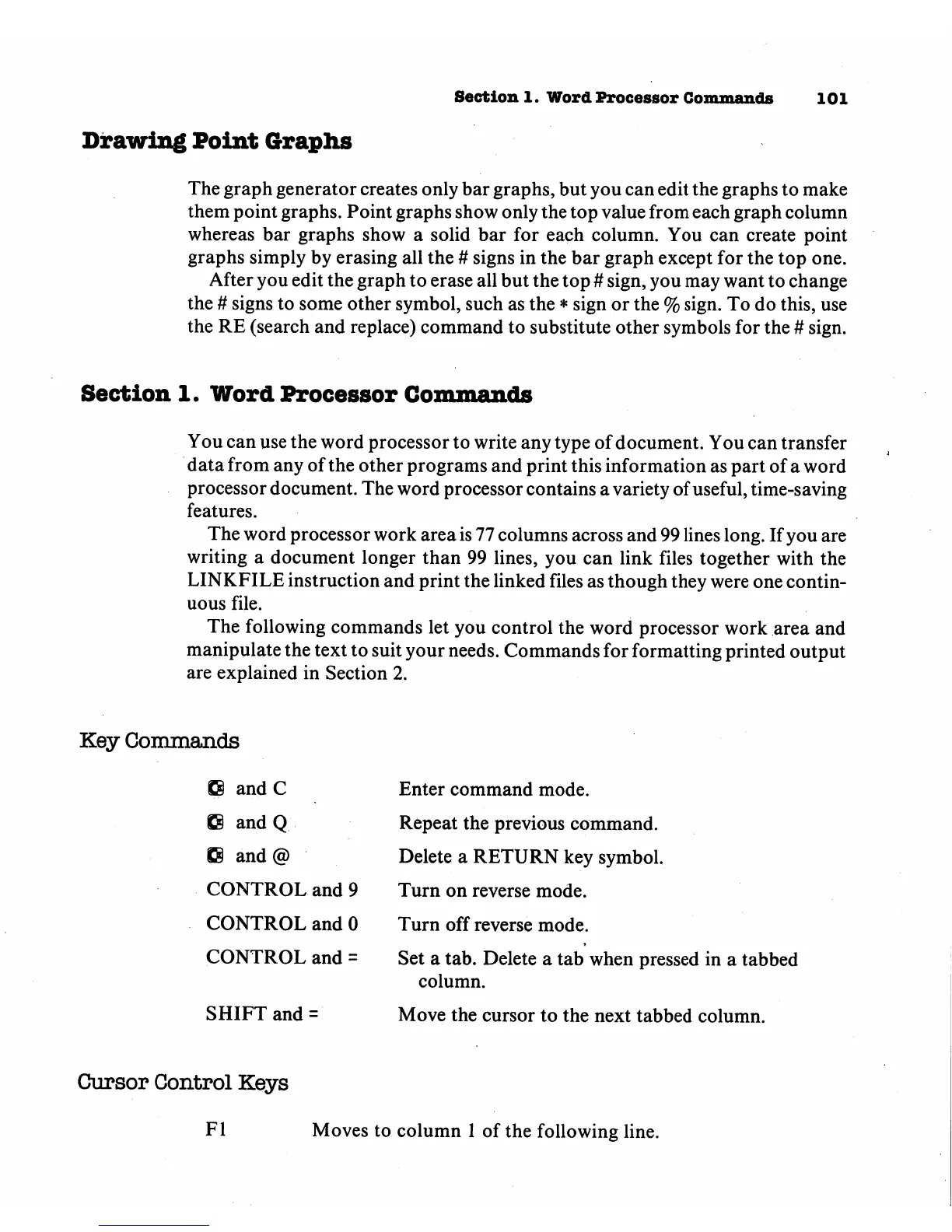
Key
Commands
£§
and
C
Enter
command
mode.
Q'
and
Q
Repeat
the
previous
command.
IS
and
@
Delete
a
RETURN
key
symbol.
CONTROL
and
9
Turn
on
reverse
mode.
CONTROL
and
0
Turn
off
reverse
mode.
CONTROL
and
= Set
a
tab.
Delete
a
tab
when
pressed
in
a
tabbed
column.
SHIFT
and
=
Move
the
cursor
to
the
next
tabbed
column.
Cursor
Control
Keys
Fl
Moves
to
column
1
of
the
following
line.

Other manuals for Commodore Plus 4

Related product manuals