EasyManua.ls Logo

Commodore Plus 4 - Page 192

Commodore Plus 4
464 pages
Print Icon
To Next Page IconTo Next Page
To Previous Page IconTo Previous Page
Loading...
180
Some
Programming
Techniques
9^
2045
2046
2048
204A
E8
E0
90
00
33
BD
INX
CPX
BOG
BRK
———--o
#$33
$2007
Compare
to
position
following
last datum.
If
not
done,
continue.
Stop
processing.
Here
is
some
example
data:
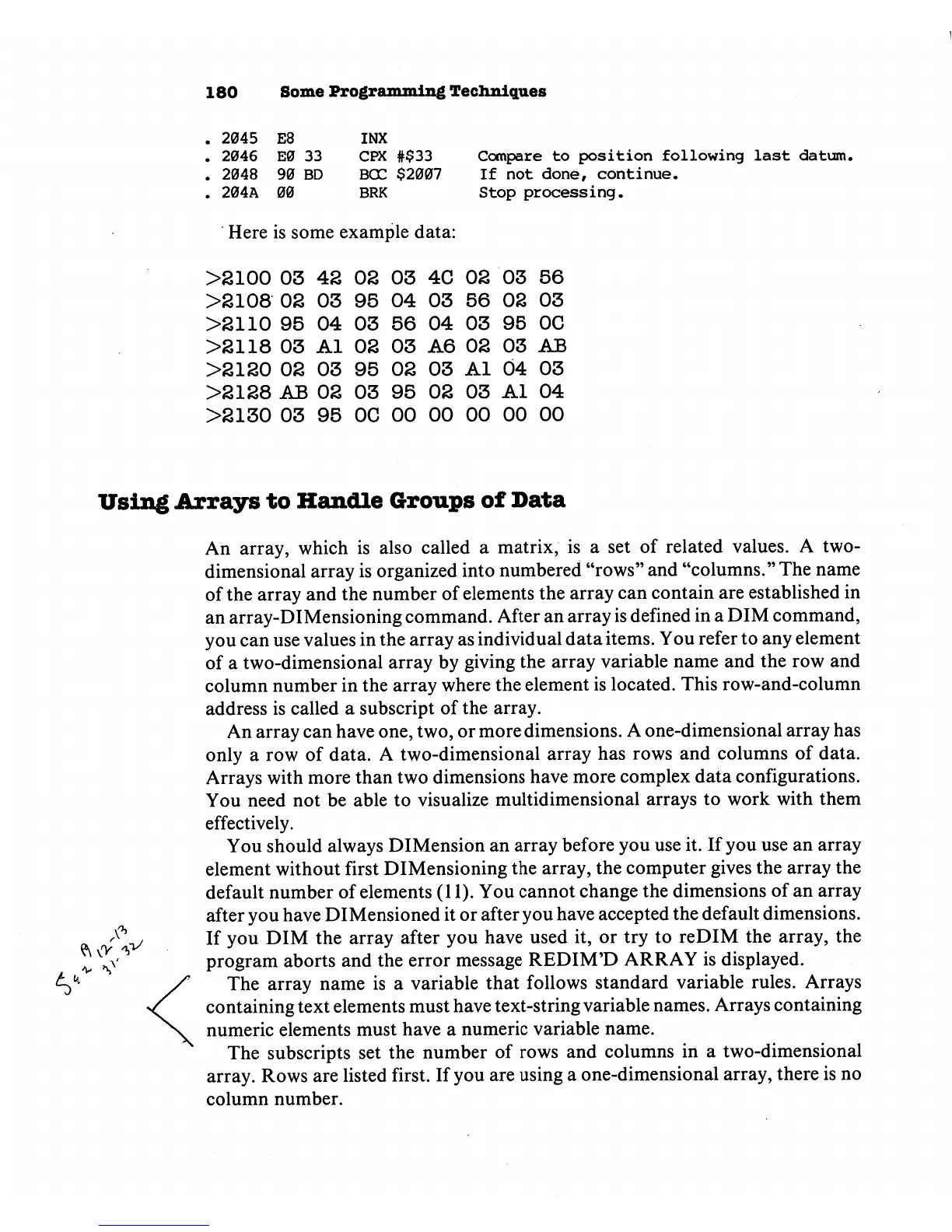
>2100
03
42
OS
03
4C
02 03
56
>2108
02
03
95
04
03
56
02
03
>2110
95
04
03
56 04
03 95
00
>2118
03
Al
02
03
A6
02 03
AB
>2120
02 03
95
02 03
Al
04
03
>2128
AB
02 03
95
02
03
Al
04
>2130
03 95
00
00
00 00
00 00
Using
Arrays
to
Handle
Groups
of
Data
An
array,
which
is
also
called
a
matrix,
is
a
set
of
related
values.
A
two-
dimensional
array
is
organized
into
numbered
"rows"
and
"columns."
The
name
of
the
array
and
the
number
of
elements
the
array
can
contain
are
established
in
an
array-DIMensioning
command.
After
an
array
is
defined
in
a
DIM
command,
you
can
use
values
in
the
array
as
individual
data
items.
You
refer
to
any
element
of
a
two-dimensional
array
by
giving the
array
variable
name
and
the
row
and
column
number
in
the
array
where
the
element
is
located.
This
row-and-column
address
is
called
a
subscript
of
the
array.
An
array
can
have
one,
two,
or
more
dimensions.
A
one-dimensional
array
has
only
a
row
of
data.
A
two-dimensional
array
has
rows
and
columns
of
data.
Arrays
with
more
than
two
dimensions
have
more
complex
data
configurations.
You
need
not
be
able
to
visualize
multidimensional
arrays
to
work
with
them
effectively.
You
should always
DIMension
an
array
before
you
use
it.
If
you
use
an
array
element
without
first
DIMensioning
the
array,
the
computer
gives
the
array
the
default
number
of
elements
(11).
You
cannot
change
the
dimensions
of
an
array
after
you
have
DIMensioned
it
or
after
you
have
accepted
the
default
dimensions.
A0^
If
you
DIM
the
array
after
you
have
used
it,
or
try
to
reDIM
the
array,
the
v
\y^
program
aborts
and
the
error
message
REDIM'D
ARRAY
is
displayed.
The
array
name
is
a
variable
that
follows
standard
variable
rules.
Arrays
containing
text
elements
must
have
text-string
variable
names.
Arrays
containing
numeric
elements
must
have
a
numeric
variable
name.
The
subscripts
set
the
number
of
rows
and
columns
in
a
two-dimensional
array.
Rows
are
listed
first.
If
you
are
using
a
one-dimensional
array,
there
is
no
column
number.

Other manuals for Commodore Plus 4

Related product manuals