EasyManua.ls Logo

Commodore Plus 4 - Page 315

Commodore Plus 4
464 pages
Print Icon
To Next Page IconTo Next Page
To Previous Page IconTo Previous Page
Loading...
The
Operating
System
SOS
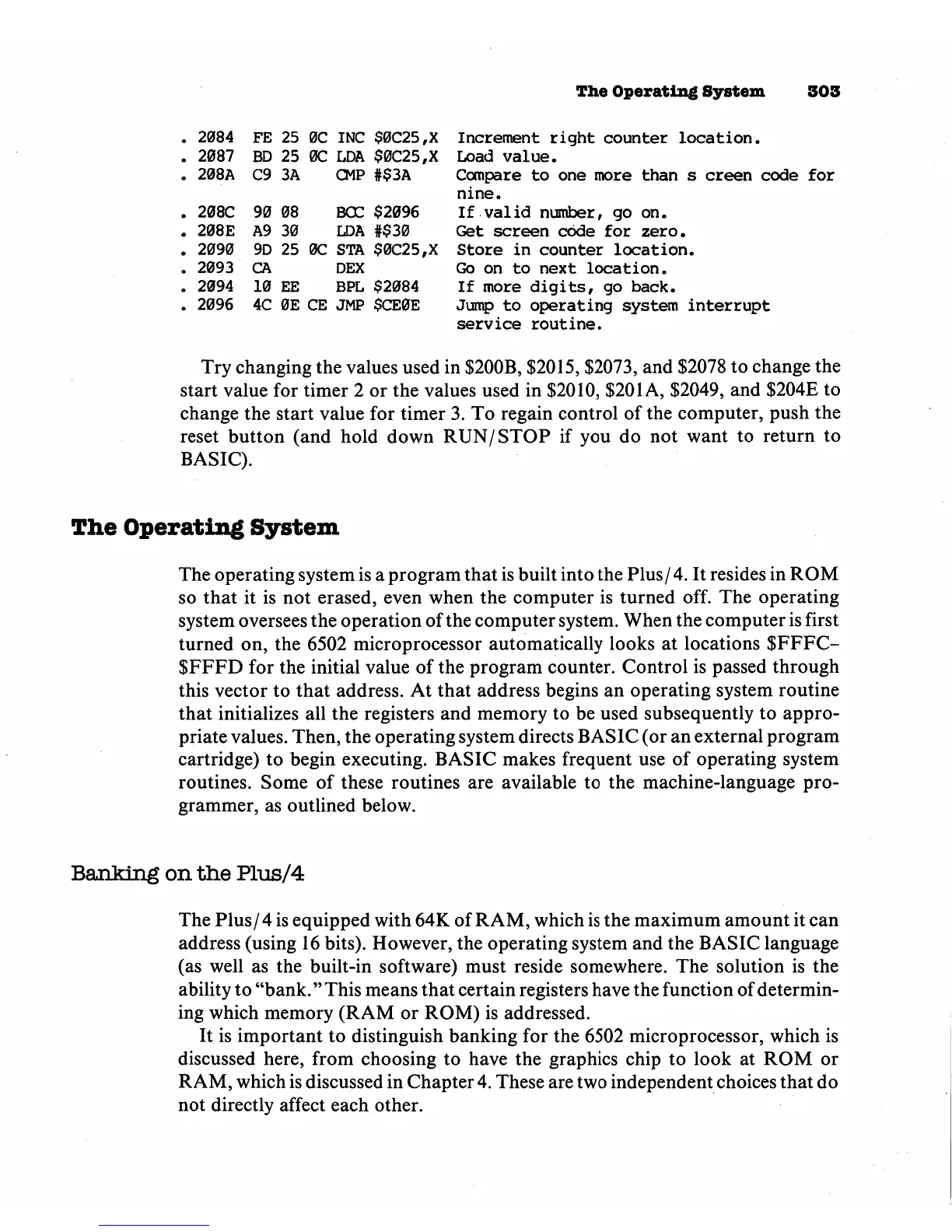
2084
FE
25
0C
INC
$0C25,X Increment
right
counter
location.
Load
value.
Compare
to
one
more
than
s
creen
code
for
nine.
If
valid
number,
go
on.
Get
screen
code
for
zero.
Store
in
counter
location.
Go
on
to
next
location.
If
more
digits,
go
back.
Jump
to
operating
system
interrupt
service
routine.
Try
changing
the
values
used
in
S200B,
$2015,
$2073,
and
$2078
to
change
the
start
value
for
timer 2
or
the
values
used
in
$2010,
$201
A,
$2049,
and
$204E
to
change
the
start
value
for
timer
3.
To
regain
control
of
the
computer,
push
the
reset
button
(and
hold
down
RUN/STOP
if
you
do
not
want
to
return
to
BASIC).
2087
208A
208C
208E
2090
2093
2094
2096
BD
C9
90
A9
9D
CA
10
4C
25
3A
08
30
25
EE
0E
0C
0C
CE
LDA
CMP
BOC
LDA
STA
DEX
BPL
JMP
?0C25,X
#$3A
$2096
#$30
$0C25,X
$2084
$CE0E
The
Operating
System
The
operating
system
is
a
program
that
is
built
into
the
Plus/
4.
It
resides
in
ROM
so
that
it
is
not
erased,
even
when
the
computer
is
turned
off.
The
operating
system
oversees
the
operation
of
the
computer
system.
When
the
computer
is
first
turned
on,
the
6502
microprocessor
automatically
looks
at
locations
$FFFC-
$FFFD
for the
initial
value
of
the
program
counter.
Control
is
passed
through
this
vector
to
that
address.
At
that
address
begins
an
operating
system
routine
that
initializes
all
the
registers
and
memory
to
be
used
subsequently
to
appro
priate
values.
Then,
the
operating
system
directs
BASIC
(or
an
external
program
cartridge)
to
begin
executing.
BASIC
makes
frequent
use
of
operating
system
routines.
Some
of
these
routines
are
available
to
the
machine-language
pro
grammer,
as
outlined
below.
Banking
on
the
Plus/4
The
Plus/4
is
equipped
with
64K
of
RAM,
which
is
the
maximum
amount
it
can
address
(using
16
bits).
However,
the
operating
system
and
the
BASIC
language
(as
well
as
the
built-in
software)
must
reside
somewhere.
The
solution
is
the
ability
to
"bank.
"This
means
that
certain
registers
have
the
function
of
determin
ing
which
memory
(RAM
or
ROM)
is
addressed.
It
is
important
to
distinguish
banking
for
the
6502
microprocessor,
which
is
discussed
here,
from
choosing
to
have
the
graphics
chip
to
look
at
ROM
or
RAM,
which
is
discussed
in
Chapter
4.
These
are
two
independent
choices
that
do
not
directly
affect
each
other.