EasyManua.ls Logo

Commodore Plus 4 - Page 373

Commodore Plus 4
464 pages
Print Icon
To Next Page IconTo Next Page
To Previous Page IconTo Previous Page
Loading...
The
Datassette
Tape
Recorder
361
Usually,
it
is
best
to
simply
give
every
file
a
name
and
always
access
a
file
using
its
name.
Then,
always
rewind
the
tape
completely
before
you
ask
for
a
file.
It
may
sometimes
be
convenient
to
use
the
tape
counter
on
the
Datassette
to
position
the
tape.
Remember
to
reset
the
counter
to
000
after
you
rewind
the
tape.
Remember,
too,
that
the
counter
is
only
approximate.
Fast
forward
to
a
position
before
the
exact
position
where
the
file
is
expected
to
start
and
then
access
the
file
by
name.
Whenever
the
Datassette
is
being
accessed,
the
screen
is
blanked. This
is
done
to
speed
up
tape
access
by
eliminating
the
time
taken
by
the
computer
to
manage
the
screen
display.
Using
a
Datassette
with
BASIC
The
Datassette
can
be
used
to
save
BASIC
programs
or
to
create
and
retrieve
data
files
through
BASIC.
Errors,
end-of-files,
and
end-of-tape
marks
can
be
detected
by
examining
the
status
variable,
ST.
The
status
variable
does
NOT
detect
hardware
problems
such
as
failure
to
press
the
record
button
when
you
attempt
to
create
a
file,
reaching
the
physical
end
of
a
tape
prior
to
completing
the
file,
and
so
on.
For
this
reason,
it
is
a
good
idea
to
check
that
programs
are
saved
properly
by
using
the
VERIFY
command
and
to
include
verifying
code
in
programs
that
create
data
files.
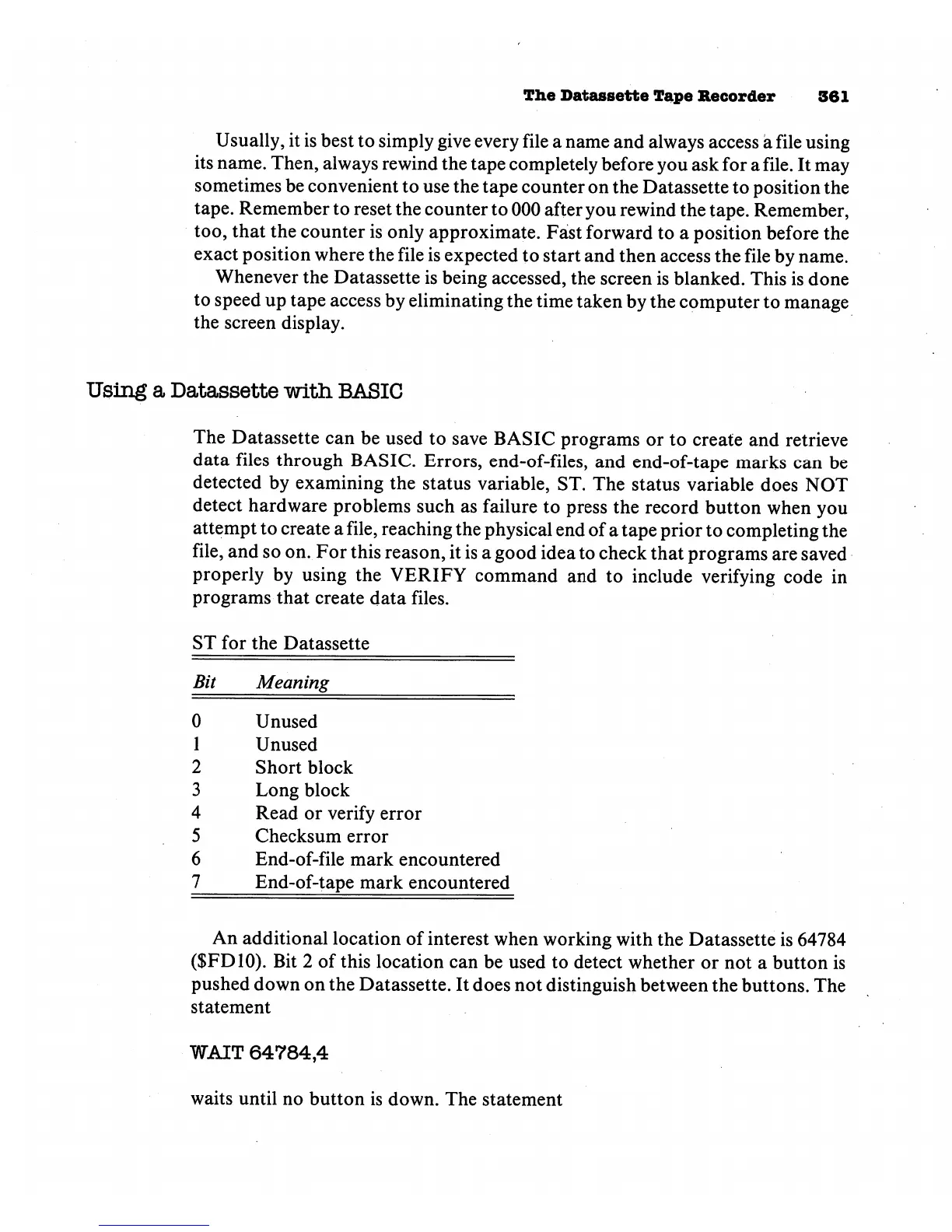
ST
for
the
Datassette
Bit
0
1
2
3
4
5
6
7
Meaning
Unused
Unused
Short
block
Long
block
Read
or
verify
error
Checksum
error
End-of-file
mark
encountered
End-of-tape
mark
encountered
An
additional
location
of
interest
when
working
with
the
Datassette
is
64784
($FD10).
Bit
2
of
this
location
can
be
used
to
detect
whether
or
not
a
button
is
pushed
down
on
the
Datassette.
It
does
not
distinguish
between
the
buttons.
The
statement
WAIT
64784,4
waits
until
no
button
is
down.
The
statement