EasyManua.ls Logo

Commodore Plus 4 - Page 395

Commodore Plus 4
464 pages
Print Icon
To Next Page IconTo Next Page
To Previous Page IconTo Previous Page
Loading...
The
Modem
and
Other
RS232
Devices
383
011=
even
parity
receive
and
transmit
101
=
mark
parity
bit
transmit/no
parity
check
111=
space
parity
bit
transmit/no
parity
check
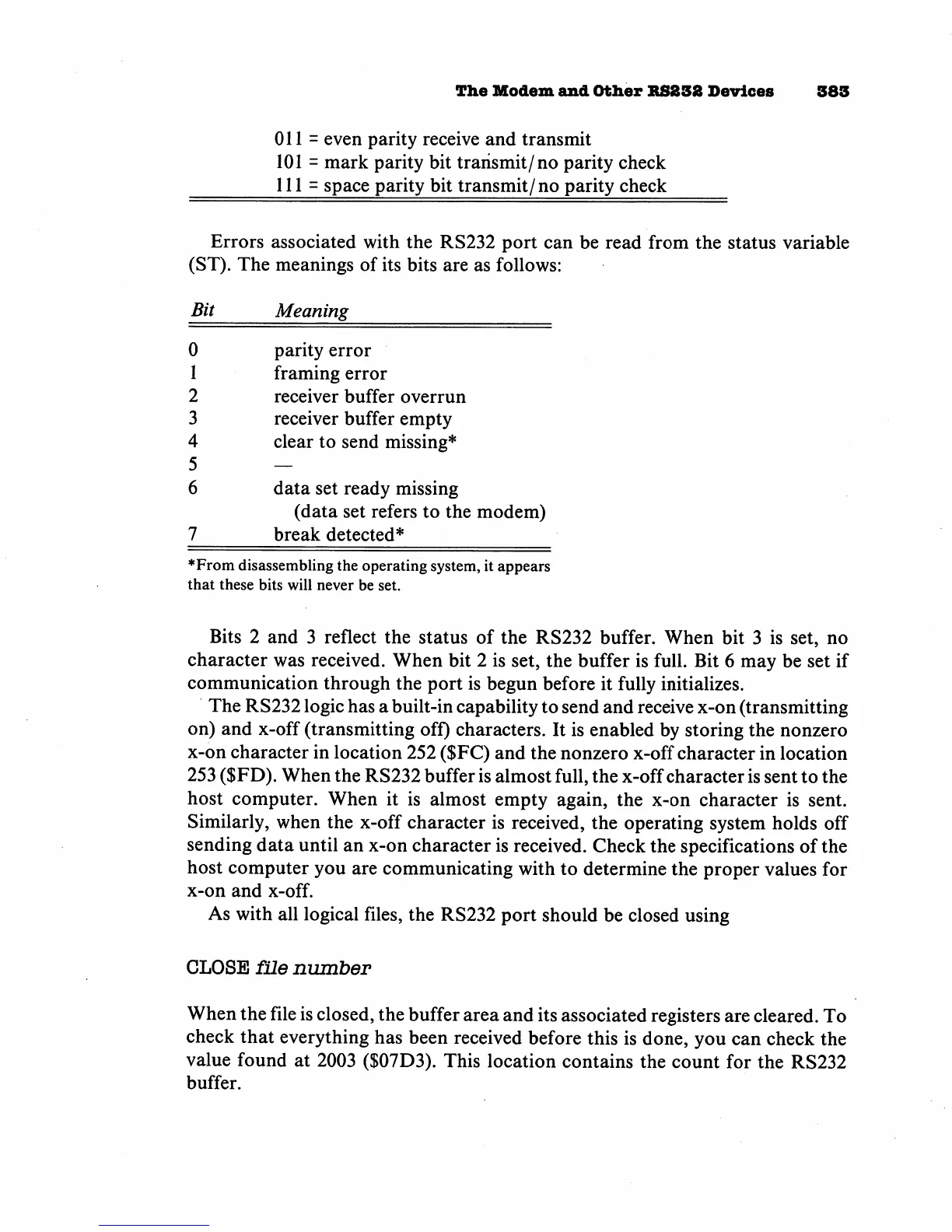
Errors
associated
with
the
RS232
port
can
be
read
from
the
status
variable
(ST).
The
meanings
of
its
bits
are
as
follows:
Bit
Meaning
0
1
2
3
4
5
6
7
parity
error
framing
error
receiver
buffer
overrun
receiver
buffer
empty
clear
to
send
missing*
data
set
ready
missing
(data
set
refers
to
the
modem)
break
detected*
♦From
disassembling
the
operating
system,
it
appears
that
these
bits
will
never
be
set.
Bits
2
and
3
reflect
the
status
of
the
RS232
buffer.
When
bit
3
is
set,
no
character
was
received.
When
bit
2
is
set,
the
buffer
is
full.
Bit
6
may
be
set
if
communication
through
the
port
is
begun
before
it
fully
initializes.
The
RS232
logic
has
a
built-in
capability
to
send
and
receive
x-on
(transmitting
on)
and
x-off
(transmitting
off)
characters.
It
is
enabled
by
storing
the
nonzero
x-on
character
in
location
252
($FC)
and
the
nonzero
x-off
character
in
location
253
($FD).
When
the
RS232
buffer
is
almost
full,
the
x-off
character
is
sent
to
the
host
computer.
When
it
is
almost
empty
again,
the
x-on
character
is
sent.
Similarly,
when
the
x-off
character
is
received,
the
operating
system
holds
off
sending
data
until
an
x-on
character
is
received.
Check
the
specifications
of
the
host
computer
you
are
communicating
with
to
determine
the
proper
values
for
x-on
and
x-off.
As
with
all
logical
files,
the
RS232
port
should
be
closed
using
CLOSE
file
number
When
the
file
is
closed,
the buffer
area
and
its
associated
registers
are
cleared.
To
check
that
everything
has
been
received
before
this
is
done,
you
can
check
the
value
found
at
2003
(S07D3).
This
location
contains
the
count
for
the
RS232
buffer.