EasyManua.ls Logo

Commodore Plus 4 - Page 84

Commodore Plus 4
464 pages
Print Icon
To Next Page IconTo Next Page
To Previous Page IconTo Previous Page
Loading...
72
The
BASIC
Language
number,
place
a
#
before
the
$
in
the
format.
Otherwise,
the
$
does
not
"float"
to
a
position
next
to
the
number
(e.g.,
$
3.50
instead
of
$3.50).
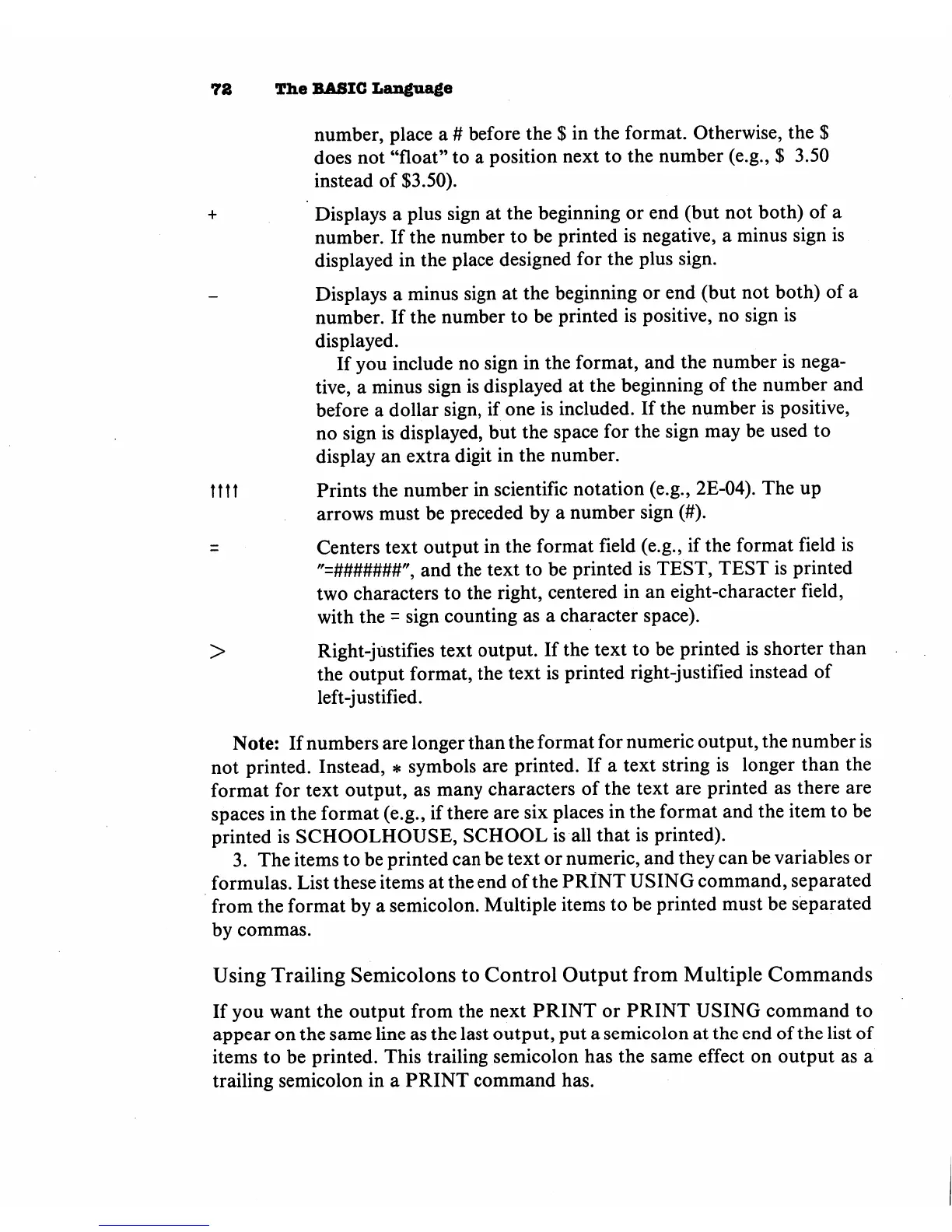
+
Displays a
plus
sign
at
the
beginning
or
end
(but
not
both) of a
number.
If
the
number
to
be
printed
is
negative,
a
minus
sign
is
displayed
in
the
place
designed
for
the
plus
sign.
Displays
a
minus
sign
at
the
beginning
or
end
(but
not
both)
of
a
number.
If
the
number
to
be
printed
is
positive,
no
sign
is
displayed.
If
you
include
no
sign
in
the
format,
and
the
number
is
nega
tive,
a
minus
sign
is
displayed
at
the
beginning
of
the
number
and
before
a
dollar
sign,
if
one
is
included.
If
the
number
is
positive,
no
sign
is
displayed,
but
the
space
for
the
sign
may
be
used
to
display
an
extra
digit
in
the
number.
tttt
Prints
the
number
in
scientific
notation
(e.g.,
2E-04).
The
up
arrows
must
be
preceded
by
a
number
sign
(#).
=
Centers
text
output
in
the
format
field
(e.g.,
if
the
format
field
is
"-#######",
and
the
text
to
be
printed
is
TEST,
TEST
is
printed
two
characters
to
the
right,
centered
in
an
eight-character
field,
with
the
=
sign
counting
as
a
character
space).
>
Right-justifies
text
output.
If
the
text
to
be
printed
is
shorter
than
the
output
format,
the
text
is
printed
right-justified
instead
of
left-justified.
Note:
If
numbers
are
longer
than
the
format
for
numeric
output,
the
number
is
not
printed.
Instead,
*
symbols
are
printed.
If
a
text
string
is
longer
than
the
format
for
text
output,
as
many
characters
of
the
text
are
printed
as
there
are
spaces
in
the
format
(e.g.,
if
there
are
six
places
in
the
format
and
the
item
to
be
printed
is
SCHOOLHOUSE,
SCHOOL
is
all
that
is
printed).
3.
The
items
to
be
printed
can
be
text
or
numeric,
and
they
can
be
variables
or
formulas.
List
these
items
at
the
end
of
the
PRINT
USING
command,
separated
from
the
format
by
a
semicolon.
Multiple
items
to
be
printed
must
be
separated
by
commas.
Using
Trailing
Semicolons
to
Control
Output
from
Multiple
Commands
If
you
want
the
output
from
the
next
PRINT
or
PRINT
USING
command
to
appear
on
the
same
line
as
the
last
output,
put a
semicolon
at
the
end
of
the
list
of
items
to
be
printed.
This
trailing
semicolon
has
the
same
effect
on
output
as
a
trailing
semicolon
in
a
PRINT
command
has.

Other manuals for Commodore Plus 4

Related product manuals