EasyManua.ls Logo

Commodore Plus 4 - Page 164

Commodore Plus 4
234 pages
Print Icon
To Next Page IconTo Next Page
To Previous Page IconTo Previous Page
Loading...
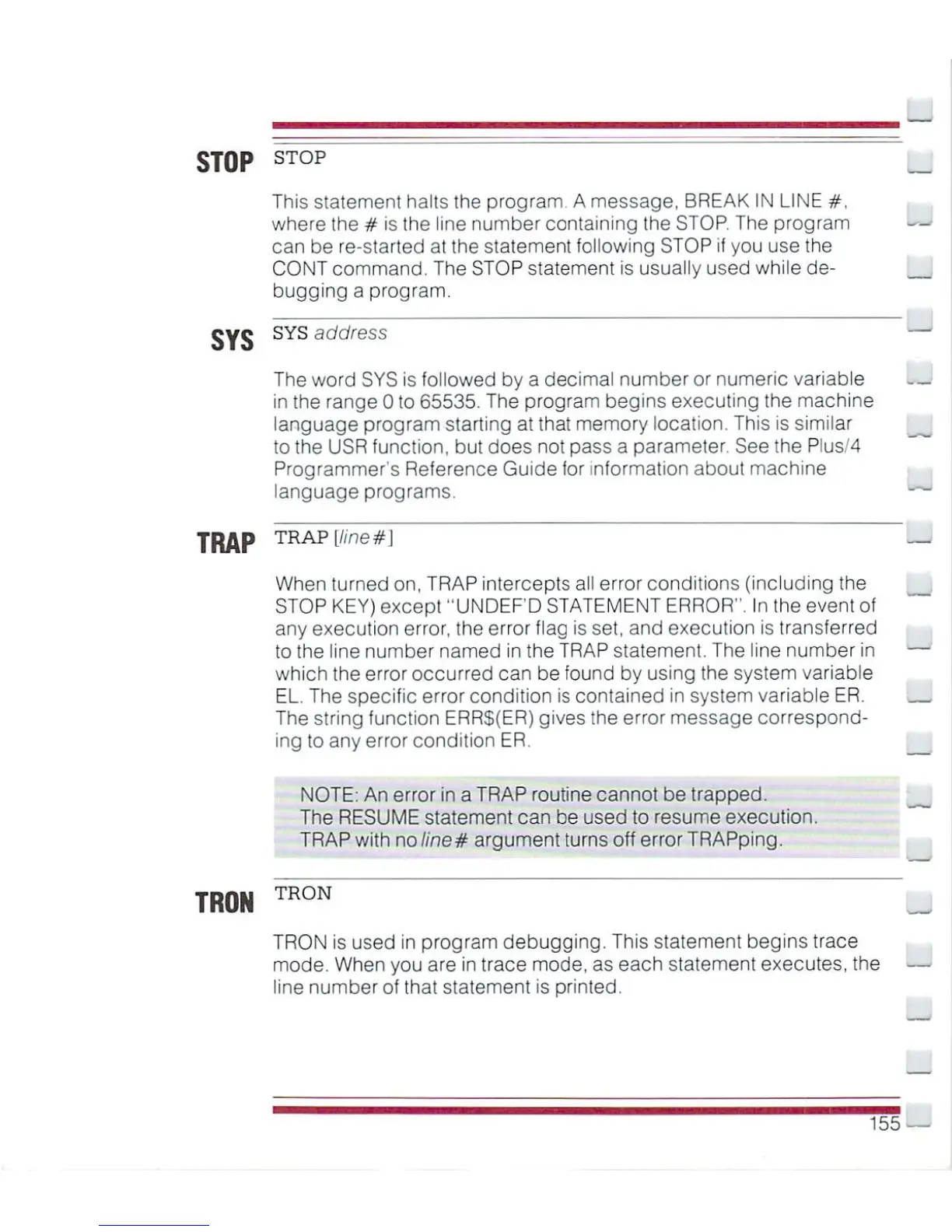
STOP
ST0P
This
statement
halls
the
program.
A
message,
BREAK
IN
LINE
#,
where
the
#
is
the
line
number
containing
the
STOR
The
program
can
be
re-started
at
the
statement
following
STOP
if
you use
the
CONT
command.
The
STOP
statement
is
usually
used
while
de
bugging
a
program.
SYS
address
The
word
SYS
is
followed
by
a
decimal
number
or
numeric
variable
in
the
range
0
to
65535.
The
program
begins
executing
the
machine
language
program
starting
at
that
memory
location.
This
is
similar
to
the
USR
function,
but
does
not
pass
a
parameter.
See
the
Plus/4
Programmer's
Reference
Guide
for
information
about
machine
language
programs.
TRAP
TRApl'/ne#|
When
turned
on.
TRAP
intercepts
all
error
conditions
(including
the
STOP
KEY)
except
"UNDEF'D
STATEMENT
ERROR".
In
Ihe
event
of
any
execution
error,
the
error
flag
is
set,
and
execution
is
transferred
to
the
line
number
named
in
the
TRAP
statement.
The
line
number
in
which
the
error
occurred
can
be
found
by
using
the
system
variable
EL.
The
specific
error
condition
is
contained
in
system
variable
ER.
The
string
function
ERRS(ER)
gives
the
error
message
correspond
ing
to
any
error
condition
ER.
NOTE:
An
error
in
a
TRAP
routine
cannot
be
trapped.
The
RESUME
statement
can
be
used
to
resume
execution.
TRAP
with
no
iine#
argument
turns
off
error
TRAPping.
_
TRON
TR0N
TRON
is
used
in
program
debugging.
This
statement
begins
trace
mode.
When
you
are
in
trace
mode,
as
each
statement
executes,
the
line
number
of
that
statement
is
printed.
155

Other manuals for Commodore Plus 4

Related product manuals