EasyManua.ls Logo

Commodore Plus 4 - Using Variables

Commodore Plus 4
234 pages
Print Icon
To Next Page IconTo Next Page
To Previous Page IconTo Previous Page
Loading...
USING
The
example
36*(12+(AZ3))
shows
one
of
the
most
powerful
features
VARIABLES
of
a
comPuter
When
we
used
a
letter
instead
of
a
number
in
a
mathe
matical
problem,
we
used
a
VARIABLE.
A
variable
represents
a
value.
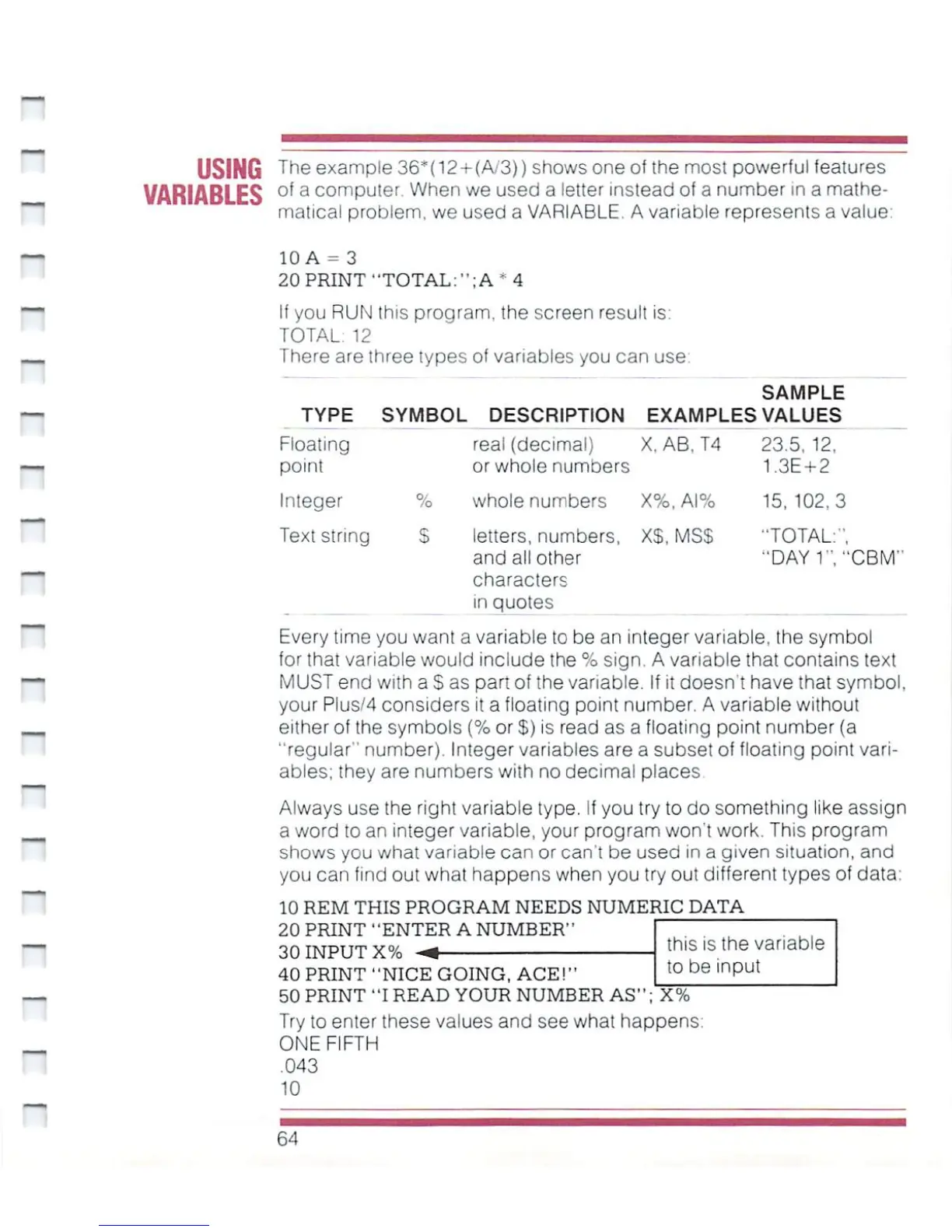
10A
=
3
20
PRINT
"TOTAL:";A
*
4
If
you
RUN
this
program,
the
screen
result
is:
TOTAL
12
There
are
three
types
of
variables
you
can
use
TYPE
Floating
point
Integer
Text
string
SYMBOL
7o
s
DESCRIPTION
real
(decimal)
or
whole
numbers
whole
numbers
letters,
numbers,
and
all
olher
characters
in
quotes
SAMPLE
EXAMPLES
VALUES
X.
AB.
T4
X%,
Al%
X$,
MS$
23.5,
12,
1.3E
+
2
15,
102.3
'TOTAL:-.
"DAYIVCBM"
Every
time
you
want
a
variable
to
be an
integer
variable,
the
symbol
for
that
variable
would
include
the
%
sign.
A
variable
that
contains
text
p^
MUST
end
with
a
S as
part
of
the
variable.
If
it
doesn't
have
that
symbol,
your
Plus/4
considers
it
a
floating
point
number.
A
variable
without
_
either
of
the
symbols
(%
or $)
is
read
as
a
floating
point
number
(a
"regular"
number).
Integer variables
are
a
subset
of
floating
point
vari
ables;
they
are
numbers
with
no
decimal
places
Always
use
the
right
variable
type.
If
you
try
to
do
something
like
assign
___
a
word
to
an
integer
variable,
your
program
won't
work.
This
program
shows
you
what
variable
can
or
can't
be
used
in
a
given
situation,
and
you
can
find
out
what
happens
when
you
try
out
different
types
of
data.
10
REM
THIS
PROGRAM
NEEDS
NUMERIC
DATA
20
PRINT
"ENTER
A
NUMBER"
30
INPUT
x%
I
this
is
the variable
40
PRINT
"NICE
GOING,
ACE!
"
to
be
input
50
PRINT
"I
READ
YOUR
NUMBER
AS";
X%
Try
to
enter
these
values
and
see
what
happens:
ONE
FIFTH
.043
10
64™

Other manuals for Commodore Plus 4

Related product manuals