Chapter
8:
Peripheral Devices 263
data. To avoid this, format your diskettes with different
ID
numbers when-
ever possible.
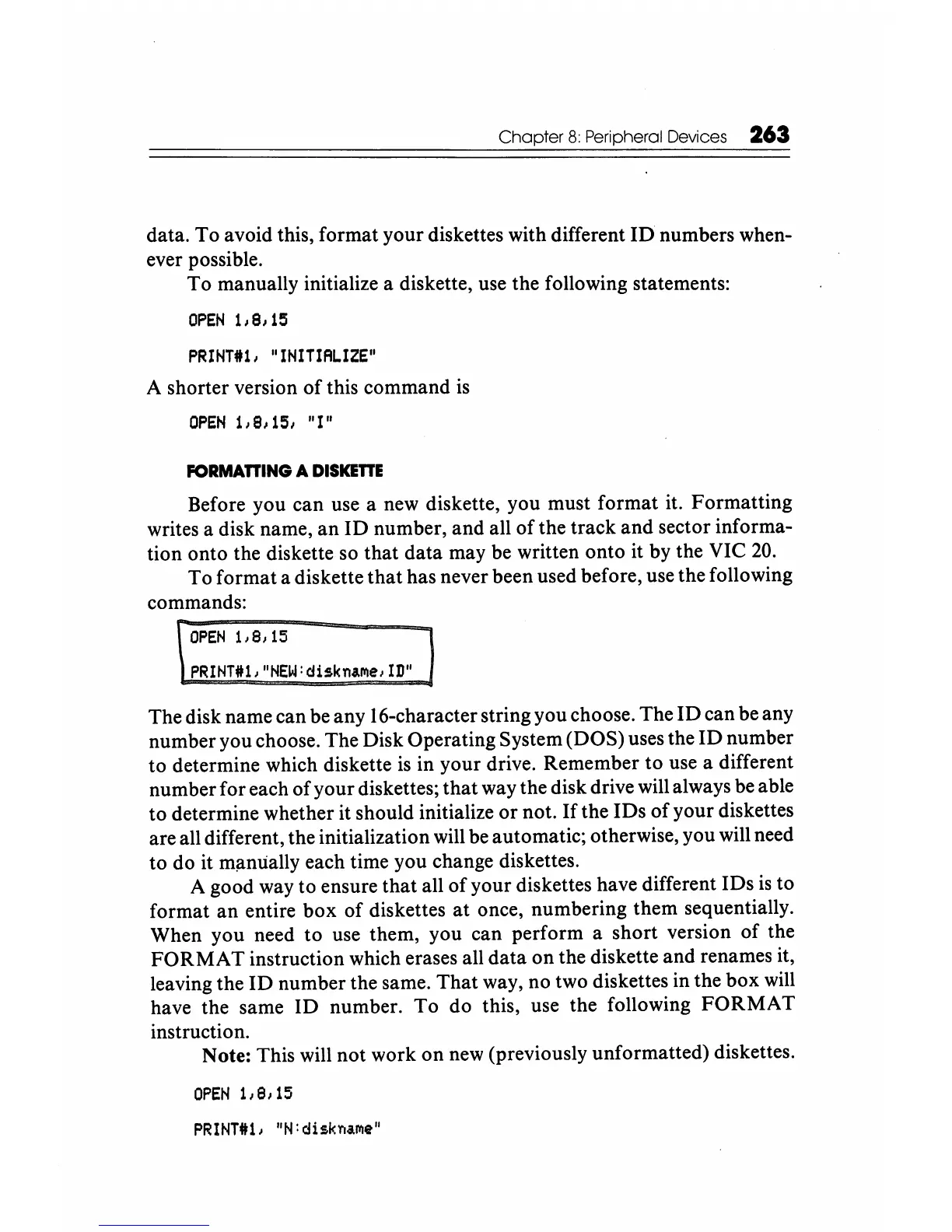
To manually initialize a diskette, use the following statements:
OPEN
1,8,15
PRINnt1,
"INITIALIZE"
A shorter version
of
this command
is
FORMAnlNG A
DISKEnE
Before you can use a new diskette, you must format it. Formatting
writes a disk name,
an
10
number, and all
of
the track and sector informa-
tion onto the diskette so that data may be written onto it by the VIC
20.
To format a diskette
that
has never been used before, use the following
commands:
OPEN
1,8,15
The disk name can be any 16-character string you choose. The
10
can be any
number you choose. The Disk Operating System (DOS) uses the
10
number
to determine which diskette
is
in your drive. Remember
to
use a different
number for each
of
your diskettes; that way the disk drive will always be able
to determine whether it should initialize
or
not.
If
the IDs
of
your diskettes
are all different, the initialization will be automatic; otherwise, you will need
to do it
m~mially
each time you change diskettes.
A good way to ensure that all
of
your diskettes have different IDs
is
to
format an entire box
of
diskettes
at
once, numbering them sequentially.
When you need to use them, you can perform a short version
of
the
FORMAT
instruction which erases all
data
on the diskette and renames it,
leaving the
10
number the same. That way, no two diskettes in the box will
have the same
10
number.
To
do this, use the following
FORMAT
instruction.
Note: This will not work
on
new (previously unformatted) diskettes.
OPEN
1,8,15
PRINTI1,
"N:disknafl'le"




 To Next Page