Need help?
Do you have a question about the Community SLS and is the answer not in the manual?
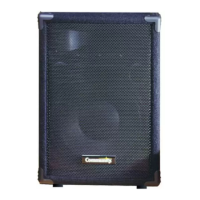
Overview of Community Solutions Series loudspeaker systems and their components.
Important note on plugging mounting/rigging holes to maintain low frequency performance.
Details on mounting and rigging points, including captive internal nuts and T-nuts.
Description of input panels, Neutrik Speakons, and dual banana jacks.
Covers handles, pole sockets, and logos on the loudspeakers.
Overview of the SLS and SBS systems' drivers, including high, mid, and low frequency types.
Explanation of Ferrofluid cooling benefits for drivers, improving efficiency and heat dissipation.
Description of Wavefront Coherent technology for synchronized driver wavefronts and acoustic alignment.
Details on Pattern Control Horn designs ensuring tight, consistent coverage patterns.
Information on the internal crossover components and their function in integrating driver outputs.
Explanation of Passive and Biamplified modes and electronic control requirements.
Details on the PowerSense Dynamic Driver Protection circuitry for SLS models.
Description of enclosures, mounting points, handles, and feet for installation and portability.
Details on the front grille, its finish, and available enclosure finishes.
List of available Community and third-party accessories like mounting brackets and stands.
Discussion of electronic controllers required for optimizing loudspeaker performance and protection.
Comparison of Passive and Biamplified modes, highlighting complexity and cost considerations.
Factors to consider when selecting an amplifier, focusing on loudspeaker output rather than just loudness.
Guidelines for selecting amplifier power to work with electronic controllers and maintain protection.
Operating requirements for SLS loudspeakers in Passive mode, including amplifier and high-pass filter needs.
Requirements for SLS in Biamplified mode, needing separate LF/HF amplifiers and electronic crossover.
Requirements for SBS subwoofers, needing an amplifier, crossover, and high-pass filter.
Requirements for using SLS full-range and SBS subwoofers together, needing two amplifier channels and an electronic crossover.
Guidelines for selecting proper speaker wire gauge and connectors for optimal performance and minimal resistance.
Description of input connectors, including Neutrik Speakon and dual banana jacks.
Instructions for paralleling or daisy-chaining loudspeakers using Speakon or banana connectors.
Diagrams and instructions for wiring SLS and SBS loudspeakers, emphasizing polarity.
Importance of plugging mounting/rigging holes to prevent air leaks and maintain low-frequency performance.
Procedure for installing rubber feet and using them for stabilizing stacked enclosures.
Steps for removing, installing, and customizing the front grille, including grille cloth.
Details on the standard acrylic and optional weather-resistant fiberglass enclosure finishes.
Crucial safety warnings and precautions for mounting and rigging loudspeakers, requiring professional installation.
Guidance on using only two mounting points and the resulting down-angle.
Explanation of how angling mounting points de-rates their Working Load Limit (WLL).
Information on using pull-back rigging to achieve desired down-angles for coverage.
Details on threaded inserts for stand and bracket mounting on specific models.
Description of the pole socket on the SBS25 for mounting full-range speakers.
Information on the SLS920H's rotated horn for horizontal mounting and coverage.
Procedures for initial system testing to prevent loudspeaker damage during setup.
Key considerations for final system tuning, including gain structure and level balancing.
Guidelines for setting up the electronic gain structure to optimize dynamic range and minimize noise.
Process for adjusting levels between drivers, subwoofers, or arrays for optimal system sound.
Guidelines for using equalization to fine-tune frequency response and eliminate feedback.
Expected outcome after proper setup and adjustments: clean, balanced audio with no audible noise.
Precautions regarding PowerSense DDP circuitry, its function, and limitations in protecting drivers.
Warning against operating without an electronic controller, impacting performance and voiding warranty.
Precautions when using amplifiers with power ratings below recommendations to avoid clipping and damage.
Possibility of using non-Community signal processors, but with limitations in protection features.
Advice on using external equalizers, recommending cuts over boosts for better results.
Information on safe acoustic level exposure times to prevent hearing damage.
Precautions for using test signals, noting their potential to damage drivers and reduce limiter effectiveness.
Identification and mitigation strategies for microphone feedback, a potentially damaging signal.
Procedures for removing and servicing SLS drivers, referencing specific models and fasteners.
Steps for removing and servicing SBS drivers, involving grille removal and retaining bolts.
Method for removing SLS input panel and crossover for service, involving rear panel screws.
Procedure for servicing the SBS input panel, accessed from the front after removing a driver.
Detailed technical specifications for SLS full-range loudspeaker models, including frequency response and power handling.
Detailed technical specifications for SBS subwoofer models, covering frequency response and power handling.
Information on where to find performance data, directing users to the website or TAG group.
Troubleshooting guide for SLS loudspeakers, listing symptoms, probable causes, and solutions.
Troubleshooting guide for SBS subwoofers, detailing issues with volume, bass, and signal.
Instructions on how to obtain warranty service, including factory and field service center contacts.
Guidance on obtaining warranty information and service for regions outside the United States.
 General
| Brand | Community |
|---|---|
| Model | SLS |
| Category | Speaker System |
| Language | English |

 To Next Page