EasyManua.ls Logo

Compact Radial Engines MZ201 - User Manual

Compact Radial Engines MZ201
25 pages
Print Icon
To Next Page IconTo Next Page
Loading...
INSTRUCTION AND MAINTENANCE MANUAL
MZ201
We recommend reading this manual before installing or using the engine.
Compact Radial Engines Inc.
#3-8473 124
th
Street
Surrey, B.C.
Canada. V3W 9G4
Question and Answer IconNeed help?

Do you have a question about the Compact Radial Engines MZ201 and is the answer not in the manual?

Overview

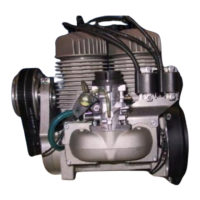
The MZ201 is a two-stroke, two-cylinder, lamellar engine designed for use in paramotors, ULMs, or airplanes where engine failure will not produce serious consequences. It is a lightweight, sturdy, and reliable propulsion system, weighing 31 kg complete with a starter motor, manual starter, speed reducer, and silencer. The engine is air-cooled, either by forced air (fan) or a propeller, depending on the installation type.

Technical Specifications:

  • Model: MZ201
  • Type: Two-stroke, two-cylinder, lamellar engine
  • Cooling system: Air cooling system, by means of forced air (fan) or a propeller, depending on the type of installation
  • Direction of rotation: Anti-clockwise seen from the PTO
  • Capacity: 626cc (Nikasil cylinder)
  • Bore x stroke: 76 mm x 69 mm
  • Compression ratio: 9.6 / 1
  • Power output: 44.4 hp at 4700 rpm
  • Peak torque: 67 Nm at 4700 rpm
  • Lubrication: Fuel / oil blend 50 : 1
  • Fuel type: Super 95 RON minimum
  • Ignition: Magneto flywheel with electronic transducer with variable timing. Electric regulator and battery charger output: 180W 14.5 Volt
  • Carburettor: Tillotson HR197A with diaphragm pump
  • Spark plug: NGK-CR8HAS, Spark gap: 0.7mm
  • Operating cylinder head temperature: CHT max. 260° C (500°F)
  • Operating exhaust gas temperature (EGT): EGT max. 680°C (1250 °F)
  • Starting: By hand, by means of an automatic re-winder and 450 W electric starter motor
  • Weight: 31 kg (engine complete with starter motor, manual starter, speed reducer and silencer)

Usage Features:

The MZ201 incorporates avant-garde technology, featuring a light alloy cylinder treated with Nikasil for durability and a virtually endless lifespan. The crankshaft is made of nickel-chrome-molybdenum steel, built to high standards of resistance. Numerical control equipment and CAD-CAM technology have enabled the construction of an ultra-light crankcase and radial elastic mounting without compromising resistance. The crankcase also integrates silent-block engine mountings and an electric starter motor. A 12 volt, 180 Watt alternator powers the ignition system and recharges the starter battery. Electronic ignition with variable automatic timing ensures reliability, safety, and optimum engine performance.

Fuel and Oil:

The engine requires a suitable fuel and a good blend of synthetic oil for two-stroke engines with a 50:1 ratio. It is crucial to use clean fuel and blend it immediately before use. Stored or sunlight-exposed blends should be avoided as liquids can separate. Users should stick to the same type and brand of oil to better assess its suitability for the engine. Switching between synthetic and traditional oil is strongly discouraged, as they are not always compatible and can cause problems. If the engine is installed with the spark plug pointing downwards, an oil that leaves few carbon deposits should be chosen to prevent fouling and self-ignition. Fuel octane rating should be a minimum of R.O.N. 93.

Starting Procedure:

Before starting for the first time, a general inspection is required, including checking the carburettor, fuel feed circuit, suction pressure piping, decompression valve, electric cables, spark plug lead, engine shut-off control connections, silent-block mountings, reducer, belt tension, and propeller condition. The engine should never be run without the propeller, especially models without forced air cooling.

For a cold engine, press the primer bulb 3-4 times to induce fuel into the carburettor. Ensure the throttle is in the starting position and the contact is on "start."

  • Manual start: Pull the manual recoil starter handle slowly until resistance is felt, then pull hard.
  • Electric start: Press the start button (no more than 4-5 times to avoid overheating the starter motor) until the engine starts. After starting, gradually reduce the intake and disengage the starter as soon as possible. If the engine fails to start, check spark plug caps, switch position, and spark plugs. If spark plugs are damp (flooded engine), remove them, turn off ignition, open the throttle, crank the engine to expel excess fuel, dry and replace spark plugs, then repeat.

Running-in:

For the first 15-20 seconds, run the engine at 2000-2500 rpm, then at 1500 rpm for a few seconds, before increasing to 3000-3500 rpm. The running-in process can be done on the ground (ensure the engine is securely bolted) or in flight. A detailed running-in schedule involves varying RPMs and durations, ensuring the cylinder head temperature does not exceed 260°C (500°F). Avoid excessive oil during running-in, especially with Castrol TTS. Full power should not be applied for prolonged periods during the first few hours. The engine will reach full power after approximately five hours.

Carburettor Adjustment:

Refer to the separate "Tillotson manual" for high and low-speed carburettor adjustment. The throttle cable freeplay between the carburettor and throttle lever should be adjusted using the tensioning device, ensuring less than 1 mm of freeplay when the throttle lever is set to minimum.

Speed Reducer:

Two-stroke engines generate full power at high RPMs (5000 rpm or higher). A speed reducer is fitted between the engine and propeller to reduce noise and boost performance, as a small diameter propeller at high speeds would be unsatisfactory. The MZ201 uses a belt-driven reducer for simplicity, weight, and cost efficiency, offering quieter operation than metal gearing.

Belt Tension Adjustment:

The belt tension is pre-adjusted at the factory. However, it will settle and loosen slightly during the first few minutes of use. Re-adjust the tension after the first half an hour of operation when belts are new, and as necessary. A pressure of 5 kg applied to the belt should not cause it to move by more than 2 mm.

Pulley Alignment:

When replacing pulleys to change the reduction ratio, ensure the two pulleys are perfectly aligned. A misalignment exceeding 0.5 mm can shorten belt lifespan. If the secondary pulley is misaligned, adjust by tightening or loosening the supporting shaft. The eccentric shaft has a left-hand screw thread; rotating the propeller axis clockwise will move the pulley outwards. A 12 mm Allen wrench in the hexagonal cavity in front of the driven pulley axis is used for adjustment, with each turn advancing the pulley by 1.25 mm.

Maintenance Features:

Regular servicing is essential to prevent engine failure. A maintenance schedule is provided, detailing checks and work to be carried out at specific hour intervals (1, 9, 12, 25, 50, 75, 100, 125, 150, 175, 200, 225, 250, 275 hours).

Key maintenance tasks include:

  • Tightening cylinder head screw nuts (every 50 hours).
  • Checking starter cable, starter motor starting ring, and spark plug (initial check at 1 hour, then every 25 hours for the starting ring).
  • Replacing spark plug (every 25 hours).
  • Checking and cleaning spark plug cap (every 1 hour).
  • Checking ignition alternator (every 75 hours).
  • Checking reducer belt tension (every 1 hour).
  • Replacing belts and exhaust springs (every 100 hours).
  • Greasing control cables (every 50 hours).
  • Checking propeller balance and tracking (every 50 hours).
  • Replacing propeller fastening screws (every 100 hours).
  • Cleaning air and petrol filters, lubricating air filter (every 50 hours).
  • Replacing petrol filter (every 100 hours).
  • Checking carburettor, adjusting idle setting and cable tension (every 1 hour, then every 50 hours).
  • Cleaning carburettor and checking idle pipe (every 75 hours).
  • Replacing float pointer (every 125 hours).
  • Cleaning and checking petrol pump (every 125 hours).
  • Checking cylinder head and piston (removing encrustation if thicker than 0.5 mm), replacing gaskets (every 150 hours).
  • Checking wear and freeplay of components (every 150 hours).

A complete engine overhaul is recommended every 500 hours.

Daily Checks (Preliminary Flight Inspection):

  • Ensure electrical contact is on "stop."
  • Remove any water from the fuel tank.
  • Check inlet manifold and carburettor for secure fit (a cracked inlet manifold can perforate the piston).
  • Check air filter condition, secureness, and cleanliness.
  • Check cylinder head and housing for leakages.
  • Ensure fixing components for ignition coil and electrical connections are secure.
  • Check electric starter motor for security (cracks, screws, connections).
  • Check engine attachment to the frame (silent block mountings and screws).
  • Check drive and driven pulleys (fastening screws of starter motor ring).
  • Check spindle of driven pulley and reducer plate for security.
  • Check belt condition.
  • Check fuel lines for cracks/abrasions.
  • Turn the engine manually and listen for unusual noises (with electrical contact switched off).
  • Check driven pulley bearings by rotating the propeller by hand (with electrical contact switched off).

Pre-Flight Inspection (Before Every Flight):

  • Check ignition switch is off.
  • Check fuel level.
  • Check spark plug cap fit.
  • Ensure no screws, nuts, or components are missing from the engine and speed reducer.
  • Check propeller (repair or replace if cracked or chipped) and fastening screws.
  • Check choke and contact block controls are locked.
  • Check exhaust and muffler system for security (cracks, bolts, springs, brackets).
  • Start the engine only after checking the vicinity for people.
  • Check idle contact.
  • If two ignitions, check each individually.
  • Check instruments while the engine warms up.
  • Inspect engine and exhaust for vibrations while warming up (indicates an unbalanced propeller).

An engine repairs logbook is provided to record all repairs carried out, including the date and a report of the work done.

Compact Radial Engines MZ201 Specifications

General IconGeneral
BrandCompact Radial Engines
ModelMZ201
CategoryEngine
LanguageEnglish