Need help?
Do you have a question about the Conductive Labs MRCC 880 and is the answer not in the manual?
Connecting power, USB cable, and MIDI devices to the MRCC 880.
Setting up your Digital Audio Workstation for MIDI communication.
Identification of all buttons, ports, and indicators on the MRCC 880 front panel.
Details on the implementation and adapters for 3.5mm TRS MIDI Type A ports.
Configuring signal flow between DIN ports and USB virtual ports.
Sending MIDI from DIN inputs to your DAW via USB virtual outputs.
Methods to confirm active MIDI connections and signal paths.
How to save and recall custom routing and filter configurations.
Using the Panic button for 'All Sound Off' and splitting MIDI channels.
Filtering MIDI clock and Start/Stop/Continue messages.
Using LEDs to monitor MIDI data activity on the MRCC 880.
Using the MRCC 880 to expand MRCC functionality.
Connecting MRCC 880 inputs/outputs to MRCC USB host ports.
Managing multiple MRCC 880 devices by changing their IDs.
Understanding and handling SysEx data with the MRCC 880.
Procedures for updating the MRCC 880 firmware.
Information regarding the disposal of electronic waste.
Compliance with FCC rules for radio frequency interference.
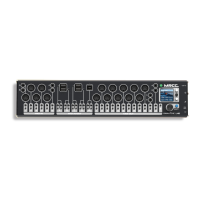
The Conductive Labs MRCC 880 is a versatile MIDI router designed to streamline MIDI studio setups, offering both standalone and computer-integrated functionality. It serves as a central hub for managing MIDI data flow between various instruments and a Digital Audio Workstation (DAW). The device aims to simplify complex MIDI routing, merging, and filtering tasks, enhancing the creative workflow for musicians and producers.
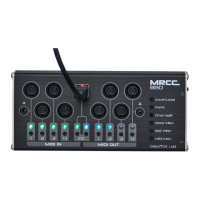
At its core, the MRCC 880 functions as a MIDI router, allowing users to connect multiple MIDI input devices, such as keyboards and sequencers, and route their MIDI data to various MIDI output devices, like synthesizers and sound modules. The routing process is intuitive: users select an input, whose LED lights green, and then select one or more outputs, whose LEDs light blue, to establish a MIDI connection. This visual feedback makes it easy to confirm active routings. A key feature of the MRCC 880 is its automatic MIDI merging capability. When multiple inputs are routed to a single output, the device seamlessly merges the MIDI data from all selected inputs into that common output, preventing data collisions and ensuring a smooth performance.
Beyond basic DIN connections, the MRCC 880 integrates with computers via a USB Type B port, which also serves as its power source. This USB connection enables the creation of virtual MIDI inputs and outputs, expanding the routing possibilities significantly. Users can route MIDI data from their DAW to DIN outputs, effectively using their computer as a MIDI source for hardware instruments. Conversely, MIDI data from DIN inputs can be routed to USB virtual outputs, allowing hardware instruments to control software instruments or be recorded within the DAW. The device presents itself to the operating system as multiple virtual MIDI ports, which can be selected within a DAW or MIDI application for flexible integration.
The MRCC 880 offers several advanced features to refine MIDI data flow. The MIDI Channel Split Mode is particularly useful for sequencers, allowing users to distribute multiple tracks from a single input across the four DIN outputs based on MIDI channels. For instance, input channels 1, 5, 9, and 13 might go to output 1, while channels 2, 6, 10, and 14 go to output 2, and so on. This prevents all MIDI channels from being sent to every port, offering more granular control over instrument assignments.
Filtering capabilities are another significant aspect of the MRCC 880. The Clock Filter allows users to block MIDI clock messages on specific inputs. This is crucial for maintaining stable MIDI timing, as having multiple clock sources can lead to performance issues. By filtering unwanted clocks, users can ensure that their MIDI devices are synchronized to a single, preferred clock source. Similarly, the SSC (Start/Stop/Continue) Filter enables users to block MIDI Start, Stop, and Continue messages from specific inputs. This is beneficial for preventing built-in sequencers on synthesizers from inadvertently starting when an external sequencer is initiated, providing greater control over playback.
For troubleshooting and monitoring, the MRCC 880 includes a MIDI Monitor Mode. When activated, the LEDs blink in response to MIDI data (with the exception of System Exclusive messages), providing a visual indication of MIDI activity. This mode is invaluable for diagnosing connectivity issues or understanding the flow of MIDI data within the setup. The monitor mode blinks at a slow rate for MIDI clock messages, making it easier to observe other MIDI events.
The device also supports saving and loading presets, allowing users to store up to four complete sets of routing and filter settings. This feature is highly convenient for quickly switching between different studio configurations or performance setups. There's also a "working preset" slot that saves the current configuration upon power cycle but can be overwritten by loading another preset, offering a temporary save option without affecting the main four slots. A dedicated MIDI Panic Button is included to address stuck notes on synthesizers by sending a "All Sound Off" MIDI CC message to all outputs, a common and welcome feature for live performance and studio work.
While primarily designed as a standalone router, the MRCC 880 can also function as an expansion for the Conductive Labs MRCC MIDI Router Control Center. Although this configuration is noted as more complex than using dedicated XpandR units, it provides additional ports for users who require them. The process involves routing inputs from the MRCC 880 to the MRCC USB host input and then distributing those signals to the desired MRCC outputs.
For setups involving multiple MRCC 880 units or a combination of MRCC 880 and MRCC XpandR 4x1 devices, the MRCC 880 offers a feature to change its device ID. This allows each unit to have a unique identity to the operating system, making it easier to differentiate between ports belonging to different devices within a DAW or MIDI application. The device ID can be changed by accessing a virtual "disk drive" that appears when the unit is powered on while holding a recessed firmware update button, and then editing a plain-text file.
The MRCC 880 is designed to handle MIDI System Exclusive (SysEx) messages, which are used for various purposes, including firmware updates and patch dumps. The device intelligently merges small SysEx messages (up to 128 bytes) with other MIDI data to minimize delays. However, for larger SysEx transfers, the MRCC 880 prioritizes SysEx data, which might temporarily block other MIDI data on merged inputs. Users are advised to avoid sending other MIDI data during large SysEx transfers and, if necessary, temporarily un-merge output ports to ensure successful data transmission.
Maintenance and updates are also considered. Conductive Labs periodically releases firmware updates to address issues and introduce new features. These updates are made available on their website, with instructions provided on the download page. Users are encouraged to opt-in to the newsletter for product update news.
In summary, the Conductive Labs MRCC 880 is a comprehensive MIDI routing solution that combines ease of use with advanced features. Its ability to handle both DIN and USB MIDI connections, coupled with intelligent merging and filtering, makes it a powerful tool for managing complex MIDI environments. The inclusion of presets, a panic button, and monitoring capabilities further enhances its utility, providing a robust and flexible platform for MIDI control and creativity.
 General
| Computer Connectivity | USB |
|---|---|
| USB Device Port | 1 |
| Dimensions | 19" x 1.75" x 6" |
| Operating System Compatibility | Windows, macOS, Linux |
| MIDI Ports | 8x MIDI In, 8x MIDI Out |

 To Next Page