Need help?
Do you have a question about the CONTEC MEDICAL SYSTEMS CMS50DL and is the answer not in the manual?
Critical safety warnings for device usage, including hazardous environments and patient conditions.
Important operational and regulatory cautions for user, including medical advice and federal law restrictions.
Guidelines for safe operation and regular inspection of the oximeter to ensure patient safety.
Critical hazards, explosive risks, and allergy considerations for device usage.
Key points for proper device handling, environmental factors, and specific patient considerations.
Specifies the intended use of the fingertip pulse oximeter for spot-checks of SpO2 and pulse rate.
Device classification according to medical directives (MDD93/42/EEC IX Rule 10).
Highlights portability, low power consumption, convenient operation, and automatic power-off.
Details suitable environments and limitations for pulse oximeter use, including specific patient conditions.
Specifies the required storage and operating temperature, humidity, and atmospheric pressure.
Explains the photoelectric oxyhemoglobin inspection technology and Lambert Beer Law.
Lists important cautions for accurate measurement, including finger placement and ambient light.
Discusses patient conditions and substances affecting measurement accuracy, such as weak pulse or drug interference.
Details display format, SpO2, and pulse rate measuring ranges and resolution.
Specifies the power source requirements for the device using AAA batteries or rechargeable batteries.
States the accuracy for SpO2 and pulse rate measurements within specified ranges.
Lists the items included with the pulse oximeter package, such as hanging rope and batteries.
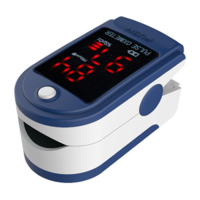
Identifies the components and controls on the front panel of the device, including the display and power switch.
Step-by-step instructions for installing the batteries correctly into the device.
Steps to attach the hanging rope to the device for portability and convenient use.
Procedures for cleaning, disinfecting, and maintaining the device for optimal use and preventing cross-infection.
Common issues with possible reasons and solutions for device operation, such as no display or unstable readings.
Explains the meaning of various symbols used on the device and its display for user understanding.
Details the measuring range, accuracy, and optical sensor specifications for SpO2 measurement.
Details the measuring range, accuracy, and display specifications for pulse rate measurement.
Provides information on the battery's operational lifespan and requirements for continuous use.
The CMS50DL Pulse Oximeter is a non-invasive medical device designed for spot-checking oxygen saturation of arterial hemoglobin (SpO2) and pulse rate in both adult and pediatric patients. It is suitable for use in home and hospital environments, including clinical settings such as internist/surgery, anesthesia, and intensive care. This device is not intended for continuous monitoring.
The Pulse Oximeter operates based on the Lambert-Beer Law, utilizing photoelectric oxyhemoglobin inspection technology. It employs two beams of light with different wavelengths (red light at 660nm and infrared light at 880nm) focused onto the human nail tip through a clamp finger-type sensor. A photosensitive element then receives the measured signal, which is processed by electronic circuits and a microprocessor to display the hemoglobin saturation and pulse rate. The device also indicates pulse intensity via a bar-display.
The oximeter features simple and convenient operation. It is small in volume and light in weight, with a total weight of approximately 50g including batteries, making it highly portable. It has low power consumption, allowing two AAA batteries to operate continuously for 24 hours. The device includes a low-battery indicator, which flashes as a battery icon when the energy is used out. It also has an automatic power-off function, activating when no signal is detected within 5 seconds.
To use the device, two AAA batteries must be inserted correctly. A hanging rope, made from non-allergy material, is provided for convenience; users sensitive to the material should avoid using it. When measuring, the patient's finger should be placed properly and deeply enough into the rubber cushions of the clip, ensuring the fingernail and the luminescent tube are on the same side. After clipping the finger, the switch button on the front panel is pressed once to begin measurement. During the process, the finger should remain still, and the patient should be at ease, as strenuous action or extreme electrosurgical interference can affect accuracy. The device is not suitable for infants or neonatal patients but is appropriate for children above four years old and adults weighing between 15kg to 110kg.
Several cautions are important for accurate measurement. The SpO2 sensor and photoelectric receiving tube should be aligned with the subject's arteriole. The device should not be used on a location or limb tied with an arterial canal, blood pressure cuff, or receiving intravenous injection. The optical path must be free from obstacles like rubberized fabric. Excessive ambient light, such as from fluorescent lamps, dual ruby lights, infrared heaters, or direct sunlight, can affect results. Testees should not use nail polish or other makeup, and fingernails should not be too long.
Clinical restrictions also apply. The measurement relies on substantial pulsating blood flow; weak pulse due to shock, low ambient/body temperature, major bleeding, or vascular contracting drugs can make the measurement more sensitive to interference. Certain staining dilution drugs (e.g., methylene blue, indigo green), carbon monoxide hemoglobin, or methionine can lead to inaccurate SpO2 determinations. Drugs like dopamine, procaine, and lidocaine may also cause significant errors. While SpO2 values serve as a reference for judging anemic and toxic anoxia, patients with severe anemia may still show good SpO2 measurements. The device is not recommended for patients suffering from carbon monoxide toxicosis, as it may overrate the SpO2 value.
The device requires periodic checks of the main unit and all accessories for visible damage that could affect patient safety or monitoring performance. It is recommended to inspect the device at least once a week. If obvious damage is found, discontinue use. Necessary maintenance should only be performed by qualified service engineers; users are not permitted to perform maintenance themselves. Only accessories specified or recommended by the manufacturer should be used with this device.
For cleaning and disinfection, the device's surface should be wiped with medical alcohol using a soft material, then allowed to air dry or cleaned with a dry, clean fabric. High-temperature or high-pressure steam disinfection is not permitted, nor should the oximeter be immersed in liquid. When cleaning with water, the temperature should be below 60°C. After each use, disinfecting the product with medical alcohol helps prevent cross-infection.
Batteries should be changed when the low-voltage indicator appears on the screen. If the device is to be stored for more than one month, batteries must be removed to prevent leakage. The device should be kept away from dust, vibration, corrosive substances, explosive materials, high temperatures, and moisture. If it gets wet, operation should cease immediately. When moved from a cold to a warm or humid environment, it should not be used immediately. The device should not be operated with sharp materials on the front panel keys. The device is calibrated before leaving the factory and needs to be calibrated once a year, or according to hospital programs, by a state-appointed agent or the manufacturer. The useful life of the device is three years from the first electrified use.
 General
| Device Type | Pulse Oximeter |
|---|---|
| Model | CMS50DL |
| SpO2 Measurement Range | 0% - 100% |
| SpO2 Accuracy | ±2% (70%-100%) |
| PR Measurement Range | 30 bpm - 250 bpm |
| Power Source | 2 x AAA batteries |
| Probe Type | Finger Probe |
| Data Storage | No |
| Weight | 50g (including batteries) |
| Measurement Parameters | SpO2, Pulse Rate (PR) |
| PR Accuracy | ±2 bpm or ±2% (whichever is greater) |
| Display Type | OLED |
| Automatic Power-off | Yes |

 To Next Page