This document describes the Contoure 3.3 cu. ft. Refrigerator, model RD-335BK, a compact appliance designed for household use. It emphasizes safety, proper installation, operation, and maintenance to ensure longevity and optimal performance.
Function Description
The Contoure 3.3 cu. ft. Refrigerator is a cooling appliance primarily intended for indoor, household use. Its main function is to preserve food and beverages by maintaining a controlled low-temperature environment. The refrigerator features a single door design with internal shelving for organized storage. It utilizes a refrigeration circuit with isobutane (R600a) as the refrigerant, a natural gas known for its environmental compatibility. The appliance is designed to operate within a room temperature range of 55°F (13°C) to 110°F (43°C), with an optimal range of 60°F (15°C) to 90°F (32°C) for reduced electricity usage and superior cooling.
Usage Features
The refrigerator is designed for straightforward operation and user convenience.
- Temperature Control: The appliance features a temperature control knob located on the right side of the fridge. Users can turn the knob clockwise to initiate cooling. The "MAX" position represents the coldest setting, while the "MIN" position provides the warmest setting. The "MID" setting is recommended for optimal performance. Turning the knob to the "OFF" position stops the cooling cycle but does not cut off power to the refrigerator. If the unit is unplugged, loses power, or is turned off, a waiting period of 3-5 minutes is required before restarting to prevent malfunction.
- Food Storage: For best results, it is advised not to store warm food or evaporating liquids directly in the refrigerator. Foods with strong flavors and odors should be covered. Cooked foods and cold dishes should be covered before being placed on shelves. Fruits and vegetables should be thoroughly cleaned and placed in crisper drawers. Butter and cheeses should be stored in airtight containers or wrapped in aluminum foil or polythene bags to minimize air exposure.
- Door Reversibility: A notable feature of this refrigerator is its reversible door. The manual provides detailed instructions on how to change the door's opening direction from right-hand to left-hand swing. This process involves removing the top hinge cover, the top hinge, the screw hole cover, the door itself, the leveling foot, and the bottom hinge, then reassembling them on the opposite side. This flexibility allows the refrigerator to fit various kitchen layouts and preferences.
- Leveling: The refrigerator is equipped with leveling feet that allow users to adjust its stability and ensure it is perfectly level. Proper leveling is crucial for the door to close and seal correctly, preventing cooling, frost, or moisture problems. Adjusting the leveling feet involves turning them clockwise to raise a side or counter-clockwise to lower it. Having assistance to push against the top of the refrigerator can make this adjustment easier.
- New Product Preparation: Before initial use, it is recommended to remove all exterior and interior packaging. The refrigerator should stand upright for approximately 4 hours before being connected to the power source to allow the cooling system to stabilize after transportation. The interior surfaces and accessories should be washed with lukewarm water and a soft cloth to remove any "new product smell" and then thoroughly dried.
Maintenance Features
Regular maintenance is essential for the refrigerator's hygienic operation and longevity.
- Cleaning: The appliance interior and its accessories should be cleaned regularly for hygienic reasons. Before cleaning, the appliance must be unplugged to avoid the risk of electrical shock. It is crucial NOT to use steam cleaners, as moisture can accumulate in electrical components, posing a shock hazard, and hot vapors can damage plastic parts. Ethereal oils and organic solvents should also be avoided as they can damage plastic parts. Abrasive cleaners are not recommended. The cleaning process involves removing all food, switching off and unplugging the appliance, cleaning the interior and accessories with a cloth and lukewarm water, wiping with fresh water, drying thoroughly, and then plugging it back in.
- Defrosting: The refrigerator is designed to manage frost build-up. However, if frost accumulates to more than ¼ inch thickness, manual defrosting is recommended using a plastic scraper. It is critical NOT to use sharp or metallic instruments, electrical devices, or boiling water for defrosting, as these can damage the cooling coils, void the warranty, cause burns, or damage plastic parts.
- Vacation Preparation: For extended periods of non-use, such as during a vacation, specific steps are recommended. All food should be removed, and the refrigerator should be cleaned. The door should be left slightly open to prevent mold and odor formation. The main power supply should be disconnected by unplugging the unit, removing the refrigerator circuit fuse, or turning off the circuit breaker. The control should be moved to the "OFF" position, and the interior should be cleaned. If children are present, extreme caution is advised to ensure the unit is not accessible for play.
- Relocation: When relocating the refrigerator, all food should be removed, and the unit should be cleaned. The power supply should be disconnected. Shelves and drawers should be secured with tape to prevent damage. Both doors should be taped shut. It is important to keep the refrigerator in an upright position during transportation to avoid damage to the coolant system.
- Energy Saving Tips: To optimize energy consumption, the refrigerator should be located in a cool area, away from direct sunlight and heat-producing appliances. Hot foods should be allowed to cool to room temperature before being placed inside. Keeping the refrigerator organized helps reduce the time the door is open. When retrieving items, it is advisable to remove as many as possible at once and close the door quickly. Wiping down containers before placing them in the refrigerator can help reduce frost build-up.

 Need help?
 General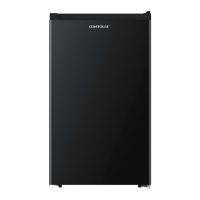

 To Next Page