This document describes the Cooke & Lewis CLFNBK60 Built-in Electric Oven, a versatile appliance designed for domestic use.
Function Description
The CLFNBK60 is a multifunction oven that combines traditional convection cooking with modern fan-assisted models. It offers a range of cooking modes to suit various culinary needs, including:
- Oven lamp: Illuminates the oven interior, allowing the user to observe the cooking process without opening the door.
- Defrost: Utilizes air circulation at room temperature to enable quicker thawing of frozen food. This mode is gentle and suitable for speeding up the defrosting time of ready-made dishes and cream-filled products. Thawing times vary depending on the quantity and type of food. This mode also offers the advantage of defrosting at room temperature, which does not alter the taste and appearance of the food.
- Convection: Activates a heating element around the convection fan, providing an additional source of heat. The fan automatically comes on to improve air circulation within the oven and creates an even heat for cooking. This mode is suitable for cakes and pastry, and for roasting joints when even cooking is desired on the outside and tender results in the middle. This mode does not require pre-heating.
- Grill with fan: Activates the top grill heating element and the fan for an even distribution of heat. This mode is recommended for quick browning on the outside while keeping the food juicy inside, ideal for chops and burgers.
- Grill: The top grill heating element switches on and off to maintain the required temperature, cooking food through radiation heat. For grilling, food should be located in the center of the oven cavity, and the height of the grill pan should be adjusted to control browning. The top shelf is advised for small items, and lower shelves for larger items.
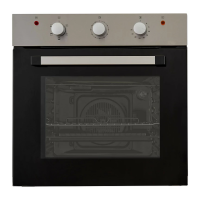
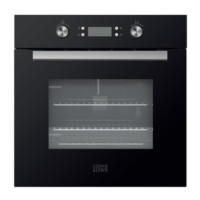
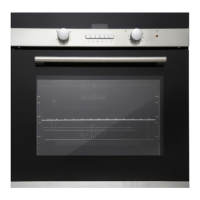
The oven features a control panel with a cooking mode control and a temperature control. The cooking mode control selects the desired cooking function, while the temperature control sets the temperature between 50 °C and 250 °C. An operating indicator light illuminates when the oven is heating to the set temperature.
Important Technical Specifications
- Power supply: 220 - 240 V~, 50/60 Hz
- Output power: Max. 2100 W
- Type of oven: Built-in electric oven
- Mass of the appliance: M (30 kg)
- Number of cavities: 1
- Heat source per cavity: Electricity
- Volume per cavity: V (70 L)
- Energy consumption (electricity) required to heat a standardised load in a cavity of an electric heated oven during a cycle in conventional mode per cavity (electric final energy): EC_electric cavity (kWh/cycle)
- Energy consumption required to heat a standardised load in a cavity of an electric heated oven during a cycle in fan-forced mode per cavity (electric final energy): EC_electric cavity (0.89 kWh/cycle)
- Energy Efficiency Index per cavity: EEI_cavity (92.9)
- Protection class: Class I (must be connected to a protective ground/Earth)
- Barcode: 5052931668960
Usage Features
- Installation: The appliance must be installed by a competent person or qualified electrician according to the provided installation instructions and dimensions. It is designed to be fitted under a work surface or in a tall oven housing unit. Adequate ventilation is crucial, requiring a slot in the plinth if fitted. Adjacent cabinets must be made of heat-resistant material (up to 120 °C).
- Shelf levels: The oven has five shelf levels, numbered from the bottom up. Levels 4 and 5 are primarily used for the grill function.
- Accessories: The oven comes with a main unit with side rails, an oven shelf, a metal pan (grill pan) for cooking and collecting fats, a grill trivet to support food on the pan, a handle for removing hot grill and pans, and screws for installation.
- Safety during operation: During use, the appliance becomes hot, and care should be taken to avoid touching heating elements. Accessible parts may also become hot, so children should be kept away. If the door or door seals are damaged, the oven must not be operated until repaired. Do not lean on the door or place objects on it, as this can damage hinges. Never cover the bottom of the oven with aluminium foil or other objects, as this can cause fire and damage the enamel. Do not allow aluminium foil, plastic, paper, or fabric to contact heating elements. Never leave the appliance unattended during use, especially when cooking with flammable substances (e.g., hot oil, fat). Do not store or use harsh chemicals, sprays, flammable or non-food items in or near the oven.
- Switching on/off: To operate, connect the appliance to the power source, rotate the cooking mode control to select a function, and rotate the temperature control to set the desired temperature. The oven switches on automatically and starts heating, indicated by the operating indicator light. After cooking, set the temperature control to 0 and disconnect the appliance from the power source. The appliance will not switch off automatically; it must be turned off manually.
- Reducing environmental impact: To reduce energy consumption, avoid opening the oven door frequently, keep the oven door clean, defrost frozen food in advance, and note that cooking food with a large surface area to volume ratio takes less time.
- Adjusting shelf position: To minimize the risk of burns, always ensure the pan and grill are correctly placed between the side rails. When placing the grill trivet or pan, slide it onto the side rails slowly and stably.
Maintenance Features
- General cleaning: Always switch off the electricity supply before performing maintenance. The enamelled and stainless steel parts should be wiped clean using a damp cloth with a minimum amount of soap and lukewarm water. Avoid abrasive powders or corrosive substances. Stainless steel cleaners are available for stubborn stains.
- Oven interior cleaning: The inside of the oven should ideally be cleaned after every use when it is still warm, using a damp cloth and a minimum amount of soap and hot water. For deeper cleaning, use a specialist oven cleaner. Avoid abrasive powders, cleaners, sponges, or acids, as these can damage the enamel. Do not use harsh abrasive cleaners or sharp metal scrapers on the oven door glass, as this can scratch the surface and lead to shattering. A steam cleaner is not to be used.
- Removing side rails: For easier cleaning of the oven interior, the side rails can be removed by loosening the screws. After cleaning, dry the oven and side rails well, then refix the side rails with the screws.
- Replacing the oven light bulb: Always disconnect the appliance from the electricity supply before replacing the lamp. The oven lamp is a special bulb with high temperature resistance (G9 halogen lamp, T 300 °C, 220-240 V~, 25 W). To replace, remove all pans and grills, unscrew the glass cover, unplug the old light bulb, insert a new bulb of the same type, and screw the glass cover back into place.
- Power cord: Regularly check the power cord for damage. If damaged, it must be replaced by the manufacturer, its service agent, or similarly qualified persons to avoid danger or injury.
- Disposal: Waste electrical products should not be disposed of with household waste. This product must be handed over to an electric and electronic equipment collection point for recycling. Contact local authorities or retailers for recycling advice.

 Need help?
 General



 To Next Page