EasyManua.ls Logo

CORONA RP8D1 - User Manual

CORONA RP8D1
3 pages
Print Icon
To Next Page IconTo Next Page
Loading...
RP8D1 Manual
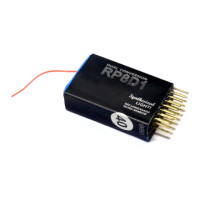
Receiver RP8D1
Thank you for purchasing the RP8D1 receiver – a small and light dual conversion 8 CH synthesizedreceiver!
With high performance using the latest receiver technology.
Why a Synthesized Receiver?
Synthesized receivers get rid of the inconvenience of using a crystal. Receivers with a crystal still use the
technology of the 1970’s where the user has to change the crystal to switch to a different frequency. Users
are either stuck to one frequency or have to bring more (expensive) crystals to the flying field. In addition,
every time the crystal is changed there is a chance of damaging the receiver. With a synthesized receiver, all
you need to do is push the button to switch to any channel you are transmitting at. With Corona’s technology
in developing and manufacturing of R/C products, the RP8D1 8 CH Dual Conversion receiver becomes the
smallest in the world. But do not only focus on its small size. Its high performance will also surprise you!
RP8D1’s Features
1. You can switch the frequency freely with the RP8D1 8 CH dual conversion synthesized receiver.
2. The 'one button' function makes it extremely easy to change frequency.
3. Despite the small size, the receiving range reaches as far as 1 mile!
4. The dual ceramic IF filters ensure ultra narrow selectivity, and can reject adjacent channel interference
effectively.
5. The RP8D1 can identify the shift polarity of the transmitter (FUTABA, JR) automatically.
6. DSP technology filters noise intelligently and eliminates glitches effectively.
7. Failsafe function to put servos in a predetermined position in case of lost signal reception.
Specifications
Size 1.8”x0.9”x0.5” (49x24x14mm)
Weight 0.32oz (9.2g)(with shrink wrap)
Sensitivity better than 2.0μV
Selectivity ±8kHz at 65dB down
Nr. of channels 8
RF technology Dual tuned RF circuitry
Analog filtering Dual 4 pole ceramic filter
Digital filtering DSP filtering with mild algorithm
Modulation FM/PPM
Shift polarity Positive or Negative (auto detect)
Case Shrink wrap
Operating Voltage 4.8V~6.0VDC
Operating Current 24mA.
Question and Answer IconNeed help?

Do you have a question about the CORONA RP8D1 and is the answer not in the manual?

Summary

RP8 D1 Receiver Overview

Why a Synthesized Receiver

Explains the benefits of synthesized receivers over crystal-based ones, highlighting convenience and performance.

RP8 D1 Key Features

Lists the main features: free frequency switching, one-button operation, long range, dual ceramic filters, auto polarity detection, DSP filtering, and failsafe.

RP8 D1 Specifications

Details the receiver's physical dimensions, weight, sensitivity, selectivity, channels, RF technology, filtering, modulation, voltage, and current.

Setting Up the RP8 D1 Receiver

Setup Process and Modes

Outlines the general setup procedure and introduces three operational modes: locking frequency, disabling failsafe, and enabling failsafe.

Mode I: Lock Receiver Frequency

Step-by-step guide to lock the receiver to the transmitter frequency, including LED indications and cautions.

Mode II: Disable Failsafe

Instructions for disabling the failsafe function, detailing the process and LED feedback.

Mode III: Enable Failsafe

Procedure for enabling the failsafe function, including setting servo positions and transmitter synchronization.

Installing the RP8 D1 Receiver

Connecting Servos and Power

Guidance on connecting servos/ESC, paying attention to polarity, and connecting a battery if BEC is not used.

Mounting and Antenna Setup

Recommendations for isolating the receiver from vibration and properly positioning the antenna.
Summary

RP8 D1 Receiver Overview

Why a Synthesized Receiver

Explains the benefits of synthesized receivers over crystal-based ones, highlighting convenience and performance.

RP8 D1 Key Features

Lists the main features: free frequency switching, one-button operation, long range, dual ceramic filters, auto polarity detection, DSP filtering, and failsafe.

RP8 D1 Specifications

Details the receiver's physical dimensions, weight, sensitivity, selectivity, channels, RF technology, filtering, modulation, voltage, and current.

Setting Up the RP8 D1 Receiver

Setup Process and Modes

Outlines the general setup procedure and introduces three operational modes: locking frequency, disabling failsafe, and enabling failsafe.

Mode I: Lock Receiver Frequency

Step-by-step guide to lock the receiver to the transmitter frequency, including LED indications and cautions.

Mode II: Disable Failsafe

Instructions for disabling the failsafe function, detailing the process and LED feedback.

Mode III: Enable Failsafe

Procedure for enabling the failsafe function, including setting servo positions and transmitter synchronization.

Installing the RP8 D1 Receiver

Connecting Servos and Power

Guidance on connecting servos/ESC, paying attention to polarity, and connecting a battery if BEC is not used.

Mounting and Antenna Setup

Recommendations for isolating the receiver from vibration and properly positioning the antenna.

CORONA RP8D1 Specifications

General IconGeneral
BrandCORONA
ModelRP8D1
CategoryReceiver
LanguageEnglish

Related product manuals