EasyManua.ls Logo

Cors-Air M 25 Y/Black Devil - User Manual

Default Icon
21 pages
Print Icon
To Next Page IconTo Next Page
Loading...
1
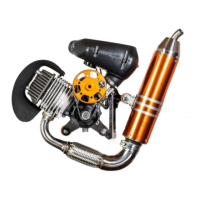
CORS-AIR M 25 Y / Black Devil
INTRODUCTION
Thank you for choosing our engine the CORS-AIR M 25 Y/Black Devil.
Your engine has many superior features that have been developed, tested and introduced by JPX
Italia over the few years this engine has been used in the ultralight industry. The high quality Cors-Air
M25Y/Black Devil is the most copied engine of its kind in the World. Fly with confidence, you own the
superior original.
We invite you to spend some time reading this manual, which will let you discover all the features
of your engine. Advice on maintenance and operation will help you to have a reliable engine and to
preserve your investment providing you years of reliable use. Furthermore, we invite you to deliver this
manual together with the engine should you decide to sell it, so it can be useful for the next owner as well.
The manufacturer and the resellers are ready to answer your questions and if necessary to solve every
problem because THE SAFTEY OF YOURSELF AND OTHERS IS THE MOST IMPORTANT THING
FOR US.
Welcome to the Cors-Air World!
IDENTIFICATION OF THE OWNER
Owner
Address
Engine serial number
Reseller
Address
Owner’s signature
Reseller’s signature and stamp
Date of sale
Question and Answer IconNeed help?

Do you have a question about the Cors-Air M 25 Y/Black Devil and is the answer not in the manual?

Summary

Introduction and Identification

Introduction to the CORS-AIR Engine

Welcome and overview of the engine.

Owner Identification Details

Fields for identifying the engine owner and details.

Operation, Assembly, and Safety

Important Safety Notes

Crucial safety warnings and guidelines.

Engine Assembly and Installation

Instructions for engine assembly and installation.

Engine Operation and Tuning

Guidance on operating, tuning, and breaking in the engine.

Troubleshooting and Adjustments

Starting and Fuel System Troubleshooting

Diagnosing problems with starting and fuel delivery.

Performance, Idle, and Carburetor Issues

Addressing engine performance, idle, and carburetor problems.

Carburetor Pop-Off Pressure Adjustments

Testing and adjusting carburetor pop-off pressure.

Maintenance, Parts, Specifications, and Warranty

Preventive Maintenance and Belt Tension

Routine checks and drive belt adjustment procedures.

Engine Parts, Schematics, and Specifications

Lists of parts, diagrams, and technical specifications.

Warranty Information and Conditions

Details on warranty coverage and conditions.

Overview

This document describes the CORS-AIR M 25 Y / Black Devil engine, a 2-stroke engine designed for ultralight aircraft, specifically paramotors. It emphasizes the engine's quality, performance, and the importance of proper usage and maintenance for longevity and safety.

Function Description:

The CORS-AIR M 25 Y / Black Devil is a 2-stroke internal combustion engine that uses a mixture of gasoline and 2-cycle oil for lubrication and cooling. It is designed to provide power for ultralight aircraft, with a focus on reliability and performance. The engine features a reduction drive system (belt-driven) to optimize propeller speed. It can be started either manually (hand start) or electrically, depending on the version. The engine's design incorporates features to minimize vibrations and ensure even power distribution across the frame when properly mounted.

Important Technical Specifications:

  • Engine Type: 2-stroke
  • Total Displacement: 172.5 c.c.
  • Bore: 65 mm
  • Stroke: 52 mm
  • Compression Ratio: 11:1
  • Peak RPM: 7,500 rpm
  • Cooling: Air-cooled
  • Piston: Light alloy with 2 cast iron S10 Chromium plated piston rings.
  • Cylinder: Nickasil Coated lining.
  • Cylinder Head: Die-casted light alloy with high percentage of silicon.
  • Crankcase: Molten in alloy G-Al Si 9 UNI 3051.
  • Connecting Rod: Steel 18 Ni Cr Mo 5 forged and copper-plated with rolls fit for high speed.
  • Carburetor: Diaphragm type.
  • Fuel Feeding: Reed valve with 4 petals on the crankcase.
  • Ignition Type: Electronic CDI (electric version) / TCI (manual version).
  • Spark Advance Regulation: 18° at 7000rpm.
  • Spark Plug: NGK B9ES.
  • Reduction: Belt Poly-V, ratio from 1:2.2 to 1:2.6.
  • Cylinder Head Temperature Max: 200°C / 392°F.
  • Fuel Mixture: Premium petrol 98 octane OR AVGAS 100LL and oil at 2% (synthetic top-quality oil for 2-strokes engines).
  • Fuel Consumption: 2.5 to 4.5 liters/hour (depending on load and speed).
  • Mounting: 5 rubber anti-vibration mounts to the frame.
  • Propeller Rotation: Counterclockwise (in front of the propeller).

Main Torques (Kg.M / NM):

  • Decompressor (hand start): 2.0 / 20
  • Nuts to fix the head: 2.2 / 22
  • Nuts to fix half-crankcase: 2.5 / 25
  • Bolts to fix the back flange to the crankcase: 2.0 / 20
  • Nuts to fix the pinion to the front part of the drive shaft: 4.5 / 45
  • Nuts to fix back part of drive shaft to ignition handwheel (manual version): 3.5 / 35
  • Nuts to fix back part of drive shaft to ignition handwheel (electric version): 1.2 / 12
  • Gap between coil and handwheel: 0.4mm

Usage Features:

  • Fuel/Mixing: Requires a mixture of premium 98 octane gasoline (or AVGAS 100LL) and 2-cycle synthetic oil at a 2% ratio (50:1), or 2.2% (40:1) in very hot climates. It is crucial not to use pre-mixed fuel from petrol pumps or alternate between AVGAS and auto gas.
  • Running-In: A proper run-in period of approximately 20 hours is recommended to prolong engine life. This involves a gradual increase in RPMs over several stages, starting from idle (CHT 200°F / 93.33°C) and progressing to 4500 rpm. During run-in, varying power and avoiding extreme loads are important.
  • Carburetor Tuning: The engine comes with factory default carburetor settings (LO: 1/2 to 3/4 turns counterclockwise; HI: 1 1/2 to 2 turns counterclockwise). Tuning should be done with a warmed-up engine, using a tachometer and CHT/EGT gauge for precision. Adjustments are made in 1/8 diameter turns of the LO and HI screws. Spark plug color can also be used as a guide (black/sooty = rich, grey/white = lean, coffee brown = optimum). A too-lean mixture can cause piston seizure.
  • Starting Sequence: The engine should be easy to start with 2-3 pulls if primed correctly. Priming involves either blowing into the gas tank vent hose (with relief valve pressed) until fuel reaches the carburetor, or using a small primer bulb. The relief valve on the carburetor should be pressed during priming.
  • Safety Notes: Never start the engine without the propeller, with people near the propeller, or with loose bolts/parts. Always run with an air filter. Avoid keeping the engine at peak RPM after takeoff unless necessary for emergencies. Small security cables are advised for the tuned exhaust pipe and air filter.

Maintenance Features:

  • Preventive Maintenance (Every 20 hours):
    • Check spark plug condition and gap (0.7 mm).
    • Clean air filter, carburetor filter, and fuel tank filter.
    • Check torque of all bolts, especially head nuts (2.2 Kg.m / 22Nm).
    • Check reduction belt tension and condition.
    • Check fuel lines and wiring.
    • Check starter cord for wear.
    • Grease the link-sphere between the manifold and exhaust pipe with high-temperature copper-grease.
  • Preventive Maintenance (Every 50 hours):
    • Repeat 20-hour maintenance.
    • Check torque of crankcase nuts.
    • Change spark plugs.
    • Change reed valve petals.
    • Check reduction belt and pulley play; change if needed.
    • Check starter gears (electric start version).
  • Annual Maintenance: Change carburetor diaphragm (independent of flight hours).
  • Reduction Belt Drive Tension Adjustment: Important for belt life, starting ease, and engine power. Requires loosening safety bolts, turning the cam with a 27mm wrench in 1mm increments, and re-tightening. Over-tensioning can damage bearings.
  • Ignition Coil / Handwheel (Hand Start): Replacement requires returning the engine to a dealer or trained repairman. Timing setting distance between coil and flywheel magnet is 0.35 to 0.40 mm.
  • Storage: For proper storage/winterization, empty the fuel tank, lines, and carburetor. Disassemble the battery (electric start). Unscrew the spark plug, pour a teaspoon of oil into the hole, re-install the spark plug (wire disconnected), and rotate the propeller slowly 2-3 times. Remove the propeller, loosen the reduction belt, plug the exhaust pipe, cover the engine, and store horizontally in a controlled environment. Charge the battery and turn the drive shaft pinion monthly.
  • Troubleshooting: Provides guidance for common issues like engine not starting (electrical, fuel system, decompressor), irregular idle, or inability to reach max RPM. Includes detailed steps for checking components, cleaning the carburetor, and adjusting pop-off pressure.
  • Pop-off Pressure Testing and Adjustment: A critical carburetor setting. Too high pressure leads to fuel starvation and overheating; too low causes flooding. A custom-built pressure tester can be used. Adjustment involves carefully shortening the spring (to decrease pressure) or expanding it (to increase pressure) in small increments.
  • EGT Placement: The EGT probe should be installed 80-100 mm from the piston, which translates to measuring 45mm from the manifold where the exhaust bolts to the cylinder head, and installing the probe into the center of the exhaust pipe.

Cors-Air M 25 Y/Black Devil Specifications

General IconGeneral
BrandCors-Air
ModelM 25 Y/Black Devil
CategoryEngine
LanguageEnglish

Related product manuals