38
9
You’re ready to ride.
But rst...
7. Remember that you will need to
brake sooner and more smoothly in
wet conditions as stopping distances
increase.
8. Adjust your total payload to stay
within the 88lb (140kg) limits of your
bike (including accessories, rider and
the cargo). Note that the rear rack has a
weight limit of 50.7 lbs (23kg).
Before every ride
1. Make sure that the battery is fully
clicked into the frame.
2. We recommend always riding with
your bike lights turned on for maximum
visibility on the road. Check that both sets
of lights are working before setting off.
3. Tires deflate during shipping and
storage. Inflate them to a pressure of
2.5 bars (36.3 psi) for heavier payload
and less for a lighter payload. We don’t
recommend a tire pressure below 1.5
bars (21.8psi) or at the max pressure of
4 bars (58 psi) as this will make your ride
less comfortable.
4. Squeeze the brakes to check they are
working perfectly.
5. Check the belt tension by pressing
firmly down in the middle of the belt
with your index finger. The deflection
of the belt should be between 0.2 and
0.4 inches. Do not lubricate the belt.
Refer to Gates™ carbon drive manual
for more info: gatescarbondrive.com/
resources/manuals-and-tech
6. Wear the correct protective gear.
Always wear a helmet and be visible on
the roads.
Before your first ride
Get informed
In many ways, riding your new bike
with pedal assistance is similar to
riding a conventional bike. You should
know the general rules of the road and
techniques for riding a bicycle safely
on the road and anywhere else you will
be riding. This includes basics such as
balancing, using hand levers for braking,
managing various road conditions, and
signaling your intentions to others. See,
for example, Kids and Bicycle Safety
(nhtsa.gov) (applicable to riders of all
ages) and other resources at Bicycle
Safety | NHTSA. If you are not familiar
with these types of skills, your local bike
shop or public safety department may
offer classes or have recommendations
for local resources.
Charge up
Charge your bike battery fully before
your first ride.
When docking your phone in the
cockpit, always use the Quad Lock
mount provided and check the phone
is securely in place. Note that wireless
charging will likely not work if you have
a metal phone case. Your bike can
interrupt wireless charging if it senses
your phone is overheating.
Take it slow
Get used to your new bike in a safe area
with minimal traffic.
When mounting your bike, make sure
not to step on the pedals before you
sit on the saddle and get a firm grip
on the handlebar and brake levers. It is
recommended to start with one pedal in
the lowest position.
To maximize braking power and avoid
squeaking noises you will need to bed
in the brakes. To do so, perform this
braking sequence at the start of your
first ride:
1. Accelerate to a moderate speed by
pedalling.
2. Brake to reduce your speed, but you
do not need to come to a full stop.
3. Repeat 30 to 40 times
Follow local regulations
Your state and possibly your local area
will have rules and regulations for bike
use and may have specific rules for
bikes with pedal assistance. Regulations
may address such things as:
• Requirements for lights and/or
additional reflectors
• Where and how you can ride your
electric bike—for example, whether it’s
permitted on public roads, multi-use
paths and sidewalks
• Requirements for the proper or routine
use of a helmet
A summary of state laws for electric and
pedal assist bikes can be found online
at State by State Electric Bike Laws |
People for Bikes. Check with your local
government for additional rules in your
area. Regulations can change so make
sure to stay up to date.
Brake with care
The bike is equipped with hydraulic disc
brakes. The left-hand lever activates the
front brake while the right-hand lever
activates the rear brake.
Many conditions affect braking, including
weight, speed, and road conditions.
Practice in a safe area first and plan
ahead as you ride.
Under wet conditions, stopping distances
may increase as braking effect is reduced.
Extra caution is required.
After heavy use, the brake discs may be
hot. Avoid touching them until they cool.
Ride safely
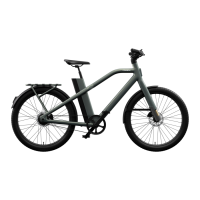
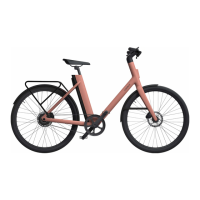
The Cowboy bike differs from pedal bikes
you may have had experience with as the
weight distribution is centered over the
rear wheel, where the motor sits. Bear in
mind the bike may feel rear-heavy when
loading, parking or lifting the bike.
Do not hang bags or heavy objects on
the handlebar as this may interfere
with your ability to steer accurately and
safely. Note that your bike has been
designed for a total maximum load
of 309 lbs (140kg), including the bike,
accessories, rider, and cargo.
Avoid wearing loose clothes such as
skirts and wide-legged pants. Make
sure you secure any loose straps that
can get caught in the wheels and cause
accidents. You may wish to use pant clips.


 To Next Page
 Loading...