Need help?
Do you have a question about the CR Remeha Avanta 12v and is the answer not in the manual?
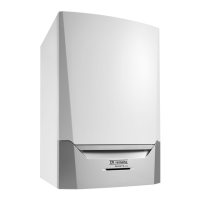
The Remeha Avanta is a series of wall-mounted, high-efficiency, fully condensing central heating boilers designed for open-vented systems. These boilers are available in several models: Avanta 12v, 15v, 18v, 24v, and 30v.
The Remeha Avanta operates as a room-sealed appliance, drawing air in through a fan. On the outlet side of the fan, a venturi injects a measured quantity of gas based on the available air volume. The fan speed is controlled by external controls, an advanced boiler controller (abc®), and prevailing temperatures measured by sensors. This gas/air ratio control ensures optimal combustion across the entire heat input range.
The gas and air mixture passes into a specially designed pre-mix burner. After combustion, hot flue gas is directed through a high-efficiency helicoil stainless steel heat exchanger with a large surface area, transferring heat to the circulating system water. In the condensing part of the exchanger, water vapor in the flue gas condenses, releasing latent heat that is also transferred to the system water. The resulting condensate is discharged via a siphon.
The boiler is equipped with an electronic regulation and control unit featuring an integrated ionization flame detector. A microprocessor, the abc® control, forms the core of the boiler's control system, managing and protecting the unit. This intelligent control continuously monitors boiler conditions, ensuring a reliable heat supply and adeptly handling negative influences such as flow reduction or airflow problems. Instead of locking out immediately, the boiler will first modulate back its output and, if necessary, temporarily switch off before attempting to restart. This prevents unnecessary service calls, provided the situation is not hazardous.
The Avanta can be regulated in several ways:
The boiler also features a low-water protection system based on temperature readings. It modulates down output if there's a risk of insufficient water flow, indicated by a flow/return ΔT > 22°C or a rate of rise in flow temperature > 1°C/sec. In such cases, the abc® control will shut down the boiler in a blocking mode (code [9]) for 10 minutes before restarting. If there is no water or the pump is not running, it will lock out (code [E][7]) requiring a manual reset. A high limit temperature protection device switches off the boiler if the flow temperature exceeds 98°C, entering a lock-out mode (code [E][1]) that also requires a manual reset.
General:
Gas and Flue Details:
CH Side:
Electrical:
Control Panel: The boiler features a control panel with four function keys (reset, -, +, enter) and an LED display. The display shows the current operating status and any error codes. In stand-by mode, one dot is lit; during operation, two dots are displayed. Error codes are shown as flashing red digits.
External Controls: The boiler supports various external controls, including on/off room thermostats (volt-free or 230V), modulating OpenTherm® controls (like Remeha qSense or iSense), and external time clocks. An outside temperature sensor can be connected for weather compensation. A DHW calorifier sensor or volt-free thermostat can also be connected for domestic hot water control.
Frost Protection: The boiler has an integrated frost protection device. If the CH water temperature drops below 7°C, the circulation pump switches on. If it drops below 3°C, the boiler switches on. This protection is active during longer periods of non-use if the room thermostat is set to a low temperature (e.g., 10°C) and Eco mode ([P][4] set to [1]) is enabled. For systems without frost protection, it's advisable to drain the boiler and central heating system if there's a risk of night frost during extended periods of non-use.
Error Code Memory: The control unit stores the last 16 errors, along with the number of times each error occurred, the operating status at the time, and the flow/return temperatures. This feature aids in quick fault diagnosis.
The Remeha Avanta is designed to be practically maintenance-free but requires an annual inspection.
Annual Inspection Checks:
General Maintenance Guidelines:
Water Treatment: Proper water treatment can improve boiler efficiency and extend its lifespan. It's recommended to use untreated tap water to fill the CH system, ensuring the pH value is between 6 and 9. If inhibitors are used, follow their instructions. New systems should be thoroughly flushed to BS 7593 (1992) to remove flux, debris, grease, and metal swarf. Old systems may require power flushing to remove sludge. The new boiler plant should not be in circuit during flushing with cleansing chemicals. Inhibitor concentration should be checked after installation, system modifications, filling, and every service.


 To Next Page
 General