Copyright © 2013 The Crosby Group LLC. All Rights Reserved.Copyright © 2013 The Crosby Group LLC. All Rights Reserved.
When the crane hook or attachment is too large and/or too heavy, use properly
sized CrosbyIP 5000 stinger assembly or a chain sling with D-shackle of 75 cm
(30 inch), with a strength that corresponds to the W.L.L. of the clamp. This will,
when setting the load down, prevent the hook from descending too far allowing
the clamp to open under the weight of the hook, or, in the case of an unprotected
crane hook, its descending from the lifting eye. When suspending the clamp
directly on the secured crane hook attention must be given to ensuring that the
crane hook can move freely in the lifting eye. Ensure that the crane hook and
other material is protected.
Remark: when handling the load, one should ensure that the load and or clamp
does not encounter obstacles which could release the load on the clamps
prematurely.
A clamp is a device that must be clean when used. Dirt has an adverse aect on
the operation and also on the reliability of the clamp. When the clamp is dirty and
greasy it can be cleaned with diesel oil or petroleum. Then blow dry with air or dry
with a cloth and apply a little lubricant. It is important to ensure that the gripping
surfaces are clean at all times. Regular cleaning will enhance the life and reliability
of the clamps.
1.2 Inspection protocols
Prior to every application of the clamp it is important the clamp operator inspects the
clamp for proper functioning.
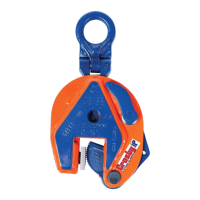
Attention must be paid to the following (see illustration(s) 3 for part reference):
Ensure that the plate surface with which the clamp is to come into contact is free
of scale, grease, oil, paint, water, ice, moisture, dirt and coatings that might
impede the contact of the gripping surface with the plate.
Inspect pivot(s) (C) and camsegment (B) for wear and defects. The pivot(s) and
teeth must be sharp and free of dirt.
Check the body (N) and the jaw for damage, cracks or deformation (this may
indicate overloading). The clamp must open and close properly (when the
operation of the clamp is sti or heavy, it should be removed from operation for
inspection).
Check the lifting eye (D) and camsegment shaft (G) for readily detectable wear
and/or damage.
Check the spring (M). Press when the latch lever (A) is closed on the lifting eye (D).
There should be clearly apparent spring tension. The clamp should, when the
lifting eye is released, return to the closed position without problems.
Check whether the W.L.L. and the jaw opening stamped on the body corresponds
with the load to be lifted.
Always apply the minimum load, otherwise the load risks slipping out
unintentionally.
1. General
You have chosen a CrosbyIP lifting clamp.
If CrosbyIP clamps are maintained as described in this manual, they will remain in
optimum condition. We believe that CrosbyIP clamps are the most reliable lifting
clamps available. But using reliable tools does not automatically mean that practices
are reliable. The people who work with clamps play an equally important role in reliable
lifting. Ensure that everyone who works with CrosbyIP lifting clamps has been
instructed in the proper application of the clamps.
Inter Product BV provides a 10 year warranty for its clamps. In order to benet from this
warranty programme and for more details on maintenance procedures, please consult
www.crosbyip.com/warranty for more information.
Please read and understand these instructions before using the lifting clamp.
1.1 Safety precautions
Proper instruction for the personnel is of vital importance. This will contribute to
maximum reliability in the working environment.
The IP10 – IPU10 clamps may be applied per piece, per set or several at the same
time for the lifting of steel plates. Because it is important that when more than 2
clamps are used each clamp receives an equal share of the load, it is recommended
that an equalizing beam is used.
Hardness: With the standard clamps it is possible to lift steel with a surface
hardness of 363 HV10. With the clamps IP..H and IPU..H steel up to a surface
hardness of 472 HV10. For harder steel types contact your CrosbyIP Customer
Service Centre.
Contact your CrosbyIP Customer Service Centre before using this clamp for
plates and constructions that have a radius.
Temperature: The standard lifting clamps may be used with temperatures that lie
between 100 ºC (212 ºF) and -40 ºC (-40 ºF). For other temperatures contact your
CrosbyIP Customer Service Centre.
There are restrictions for operation in special atmospheres (e.g. high humidity,
explosive, saline, acid, alkaline).
Loads: For proper application of the clamp consult the load diagrams 1-2.
Ensure that all attachments between lifting eye and crane are properly tted,
secured and coupled.
For each lift only one plate may be transported or lifted.
Pivot(s) and camsegment may not be placed on sloping or conical surfaces.
Contact your Customer Service Centre for assistance in selecting a clamp
suitable for bevelled plates.
It is not permitted
to stay in the
danger zone of
the load.
E
nsure that the
load remains on
the ground when
turning.
No changes may
be made to
CrosbyIP clamps.
Never straighten,
attempt to bend
or heat treat
parts.
Clamps suited for
stainless steel,
must be used
only for handling
stainless steel, to
avoid
contact
corrosion.
EN
07
EN
06


 To Next Page
 Loading...