BOX DESIGN NOTE S
Sealed Boxes VS Ported Boxes:
Sealed Boxes offer the most protection from mechanical damage, plus can offer the most accurate sound quality if not
undersized. Exact size is not too critical and can be adjusted by stuffi ng (see below). Response decreases gradually at low
frequencies giving a nearly fl at frequency response in many vehicles. But, there’s no path for heat to escape from the box (one
reason for mounting “inside out”)
do offer some heat ventilation. Sound quality is less accurate, but often more powerful. The trade-
off: more powerful sound is often boomier. At frequencies below the port tuning, the enclosure does not restrict cone motion.
Therefore, music with very low frequencies can bottom out the subwoofer, possibly causing damage. Also, the frequency
response rolls off quickly, because the port stops functioning like a port and becomes more like a huge leak-the front and back
waves from the subwoofer start to simply cancel each other. If possible, build the box so you can do test listening before fi nal
assembly. You can then adjust the port length to taste. If it sounds too boomy after fi nal assembly, you can experiment with
stuffi ng, but not near the port or cone or magnet vents.
Dense stuffi ng changes the thermal properties of the enclosure, and can make the enclosure act larger than the
measured dimensions. This means sealed boxes can be made somewhat smaller with the same sound. For example, stuffi ng
with 1 pound (1/2 kilo) of 100% polyester such as pillow stuffi ng could let you shrink the sealed box 15% but keep basically the
same sound. Ported boxes cannot take advantage of this effect very well, since stuffi ng the enclosure can negatively affect the
air fl ow in and out of the port. Coating the inside walls with anti-vibration compounds or sheeting can improve the sound as can
Air in the box resists compression, like a spring. The port basically makes a plug of air, with a certain mass. The system
resonates, kinda like how a car bounces up and down on its springs. A longer port has more mass, lowering the tuning. A
bigger port also has more mass, but the larger area changes how much box stiffness the port “sees” and tuning goes up. To
compensate, the port can be lengthened, but the port needs to be big enough to match the cone excursion. Unfortunately for
auto sound buffs, this all means that a round port big enough to fl ow all the air often can’t fi t in the box! And, ports should NOT
be built with elbows if at all possible, it kills the airfl ow.
Rounding the port ends reduces distortion at lower volumes. At high SPL, the air just “jets” in and out and the
radiusing has little effect. (For slot ports, the shape is different, so do radius the inside end if you can).
recommends the use of Precision Ports
for all round port applications. Precision
will increase SPL and reduce airfl ow turbulence at the entrance and exit of the port
with its unique fl are port design.
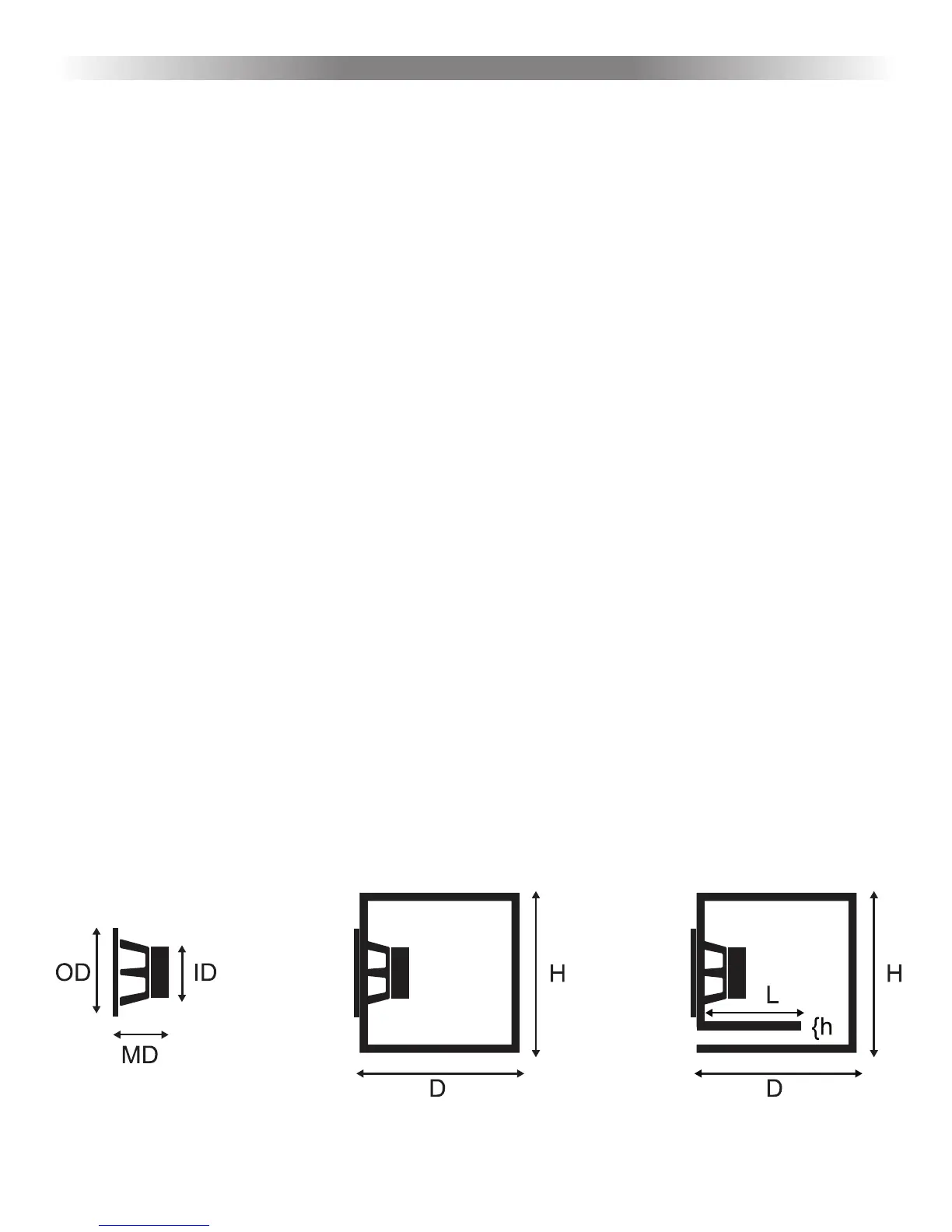
Sub Dimensions Sealed Box Ported Box


 To Next Page
 Loading...