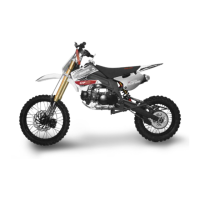
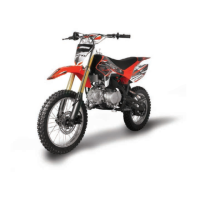
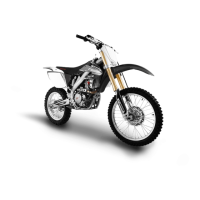
The provided document is an owner's manual for the Crossfire CF 125 Dirt Bike/Pit Bike, offering comprehensive information on its operation, maintenance, and safety.
Function Description:
The Crossfire CF 125 is a recreational off-road motorcycle designed for a single rider with basic experience. It is intended for off-road use only and is not equipped for public roads, lacking features like lights, turn signals, and a horn. The motorcycle is designed for durability and performance in off-road conditions, with a focus on ease of use for riders learning to build their skills.
Important Technical Specifications:
- Engine: The manual emphasizes proper engine break-in and maintenance. It recommends using unleaded gasoline with an octane rating of 90 or higher for optimal performance and reliability. The engine idle speed should be maintained at 1500 ± 100 RPM.
- Oil: SAE 10W-40 or 10W-30 engine oil is recommended, depending on air temperature. The manual explicitly states not to use oil with graphite or molybdenum additives, or oils labeled "energy conserving," as they may negatively affect clutch operation and lubrication performance.
- Tires: The recommended cold tire pressure for both front and rear tires is 15-18 Psi (104-124 kPa) for off-road use. The manual specifies tire sizes: Front Tire 70/100-14 and Rear Tire 80/100-12 (for one configuration), or Front Tire 70/100-17 and Rear Tire 90/110-14 (for another configuration). Both are Bias Ply, Tube Type.
- Brakes: The motorcycle is equipped with hydraulic disc brakes on both front and rear wheels. The brake fluid level should not be lower than half-way. The manual provides torque specifications for various brake components, including master cylinder bolts (10 N·m / 7.3 ft·lbs), brake pad bolts (18.9 N·m / 14 ft·lbs), and brake disc bolts (13.5 N·m / 10 ft·lbs).
- Drive Chain: The recommended slack for the lower drive chain, midway between the sprockets, is 8-10 mm. The rear axle nut should be tightened to 85 ft-lbs (115 N·m). High-quality chain lubricant is recommended.
- Suspension: The manual describes both adjustable and non-adjustable suspension systems. For adjustable rear suspension, turning the adjuster clockwise makes compression harder and rebound slower, while turning it counter-clockwise makes compression softer and rebound faster.
- Loading Capacity: The maximum vehicle capacity is 245 lbs (111 kg), which includes the weight of the operator and accessories.
- Serial Numbers: The Chassis (VIN) Number can be found on the right side of the frame, left side of the frame, or the steering head tube. The Engine Model & Serial Number is stamped on the left side of the engine under the countershaft sprocket.
Usage Features:
- Controls: The manual details the location and function of key controls:
- Clutch Lever: On the left handlebar.
- Hand Brake Lever & Throttle: On the right handlebar.
- Engine Stop Switch: On the left handlebar, used to turn off the engine.
- Fuel Fill Cap: Turn counter-clockwise to open, clockwise to close.
- Fuel Tap: "OFF" position closes fuel flow to the carburetor; "ON" position opens it.
- Choke Lever: Used for cold starts, pulling it up enriches the fuel-air mixture.
- Shift Lever: On the left side of the engine, for four (4) forward gears.
- Foot Brake Lever: On the right side of the engine, for the rear brake.
- Kick Start Lever: On the right side of the engine, for manual engine starting.
- Side Stand: Used to support the motorcycle when parked.
- Starting Procedures: Separate instructions are provided for electric start and kick start, both for cold and warm engines. These include turning the key to "ON," checking neutral gear, opening the fuel tap, using the choke (for cold starts), holding the brake lever, and opening the throttle slightly.
- Shifting Gears: The motorcycle has four forward gears. Shifting involves closing the throttle, squeezing the clutch lever, depressing the shift lever for first gear, and then gradually opening the throttle while releasing the clutch. Up-shifting and down-shifting techniques are explained, emphasizing smooth transitions to prevent damage.
- Braking Technique: Comprehensive instructions are given for effective braking, including using both front and rear brakes, understanding weight transfer, and adjusting pressure. It advises reducing speed before turns and exercising caution in wet or loose conditions. Engine compression braking is recommended for steep descents.
- Break-in Period: The first 80 km (50 miles) are crucial for the motorcycle's lifespan and performance. Riders are advised to vary engine speed and avoid excessive loading during this period. New tires also require a break-in period of 160 km (100 miles) with gradual increases in cornering lean angles.
Maintenance Features:
- Pre-Ride Inspection: A critical step before every ride, covering tires (pressure, damage), spokes & rims (tightness, bends), leaks (oil, gasoline), engine oil level, fuel level, drive chain (condition, slack, lubrication), brake hoses, nuts & bolts, and spark plug & cap. After mounting, throttle free-play and brake function should be checked.
- Scheduled Maintenance: A detailed periodic maintenance schedule (off-road) is provided, listing items to inspect, clean, adjust, lubricate, or replace at intervals of 1, 6, 12, 18, and 24 months. Key items include fuel filter, fuel line, throttle operation, air filter, spark plug, engine oil, engine idle speed, drive chain, brake pads, brake system, clutch system, side stand, suspension, nuts, bolts, fasteners, wheels & tires, and steering head bearings.
- Engine Oil Change: Detailed steps for draining old oil and filling with new, including running the engine, supporting the motorcycle, removing the oil filler cap and drain bolt, and applying fresh oil to threads. Oil replacement is recommended every 15 hours of riding.
- Air Filter Maintenance: Instructions for cleaning and oiling the air filter, emphasizing replacement if torn or broken. Proper installation is crucial to prevent dirt from entering the engine.
- Throttle Free-play Adjustment: Steps to adjust the throttle free-play (3-5 mm) using the upper adjuster, lock nut, and adjuster barrel.
- Spark Plug Inspection & Replacement: Guidance on cleaning, inspecting for wear, checking the gap (.02 - .03 in / 0.6 - 0.7mm), and proper installation. It warns against using improper heat range or non-resistor spark plugs.
- Brake Lever Adjustment: Procedure for adjusting the rear brake lever height by manipulating the cotter pin, pin, coupler, and lock nut.
- Brake Fluid Level Check: Instructions for checking front and rear brake fluid levels via sight glasses and adding fluid if necessary. It specifies using DOT 4 brake fluid.
- Brake Pad Wear Inspection: Regular inspection of brake pads at each maintenance interval, with replacement recommended if worn to 1 mm or less.
- Brake System Bleeding: Procedure for bleeding the brake system to remove air bubbles, involving cleaning, pumping the lever, and opening/closing the bleeder valve.
- Suspension Inspection: Checks for smooth suspension action, broken springs, damaged shock absorbers, and tightness of nuts and bolts. For the rear suspension, checking for loose swing-arm bearings is included.
- Drive Chain Maintenance: Includes checking slack, inspecting for damage (rollers, pins, links), lubricating, and replacing if excessively worn. It also covers inspection of sprockets.
- Drive Chain Removal, Cleaning & Replacement: Steps for removing the master link, cleaning the chain with non-flammable solvent, inspecting for wear, and re-installing with a new master link.
- Appearance Care: Recommendations for cleaning the motorcycle using water and mild detergents, advising against high-pressure washers on certain parts and emphasizing lubrication of the drive chain after washing.
- Troubleshooting: A comprehensive section addressing common issues like the engine not starting or being hard to start (carburetor, spark plug, compression), engine lacking power (drive-train, tire pressure, clutch, engine performance, ignition timing, lubrication), and poor handling (steering, wheel wobble, motorcycle pulling to one side). It also provides guidance on resolving unexpected issues like flat tires and crashes.
The manual strongly emphasizes safety, with numerous warnings and cautions throughout, covering topics like helmet use, riding off-road only, riding within limits, being alert for hazards, and avoiding riding under the influence. It also includes a section specifically for parents on ensuring child safety.

 Need help?
 General

 To Next Page