This document outlines the user manual for an Outdoor Gas-Wood Pizza Oven, Model #: TPO028LP / HPO03SH.
Function Description
This appliance is a versatile outdoor pizza oven designed for both gas and wood burning, allowing users to cook a variety of dishes, including pizzas, bread, roasted meats, vegetables, grilled fish, seafood, and desserts. It is intended for outdoor use only and should not be operated in enclosed areas like buildings, garages, porches, or verandas. The oven features a cooking stone and dome that provide radiant heat from all sides, creating natural convection for even cooking, while the option for wood burning imparts a unique crisp and smoky flavor.
Important Technical Specifications
- Dimensions: The oven has a height of 913.3 mm (36 inches), a width of 773 mm (30 inches), and a depth of 728 mm (29 inches). The overall height with the chimney is 2003 mm (79 inches). The cooking chamber height is 490 mm (19 inches) and the base height is 754 mm (30 inches). The base footprint is 780 mm (31 inches) wide and 980 mm (39 inches) deep.
- Fuel Type: The oven supports both Liquefied Petroleum Gas (LPG) and wood. It is not designed for natural gas.
- Gas Regulator and Hose: The gas regulator should comply with CAN/CSA-B339 and local codes. The flexible hose should also comply with relevant CAN/CSA-B339 standards and local codes, with a maximum length of 1.5 meters (59 inches), or 1.2 meters for Finland. A pressure control adapter with a flow rate of 10kg/h and G30/G31 operation at 28-30/37 mbar, utilizing a pipe ND 12mm CE En14800, is recommended.
- Minimum Clearances: A minimum clearance of 24 inches (61 cm) from the sides and back of the unit to combustible construction is required.
- Temperature Limits: The oven should not be overheated beyond 400°F (200°C) for oil/grease cooking, or 800°F (426°C) for general operation. The optimal temperature for cooking Neapolitan pizza is an air temperature of 400°C (752°F) and a refractory floor temperature of 350°C (662°F). For wood-fired pizza, the cooking stone should be at least 340°C (644°F).
- Cylinder Size: The recommended LPG cylinder size is 26 inches in height and 12.5 inches in width.
- Components: Key components include left and right legs, oven, ash pan, ash supports, chimney, chimney top, chimney handle, chimney decorative plates, strength bottom, door, door handle, insulation mats, side handle, thermometer support, thermometer, rigid casters, casters with brake, pizza shovel, pizza knife, pizza brush, split big shovel, "S" hooks, "L" hooks, ash cover, pizza stones, flat washers, spring washers, bolts, screws, movable nozzle connector, back burner bellows, ignition wire, main valve, igniter, gas hose, combination of regulator and gas hose, electrode, T-shape burner, knob base, knob, accessories gas system pre-assembly, bellows hook, fire exhaust dust cover welding, ignition pin fixing cover, and burner protection cover.
Usage Features
- Dual Fuel Capability: The oven can be operated with either gas or wood. When using gas, the burner protection cover (item 52) should be removed. When using wood, it should be in place to completely cover the burner.
- Temperature Control (Gas): The burner knob allows regulation of heat intensity. The oven door can also be used to adjust heat by opening or closing it.
- Ignition (Gas): Features a pulse ignitor module for easy lighting. If the igniter fails, a match can be used with the provided lighting rod.
- Preheating: Always preheat the oven for 5-10 minutes or until the thermometer reaches 300-330°C (572-626°F) for gas cooking. For wood-fired cooking, start the fire about an hour before cooking, slowly bringing the oven up to temperature.
- Wood Selection: Use only dry hardwood like oak, hickory, apple, cherry, mesquite, or pecan. Avoid resinous wood (pine, spruce) and treated lumber.
- Cooking Versatility: Supports high-temperature cooking (340-385°C / 644-725°F) for pizza, medium-temperature cooking (230-315°C / 446-599°F) for roasting and grilling, and low-temperature cooking (160-215°C / 320-419°F) for baking breads, pies, and desserts.
- Safety Features: Includes warnings for gas leaks, unattended operation, proximity to flammable materials, and proper handling of hot surfaces. The regulator is positioned to prevent water collection, and the vent hole should be kept clear.
- Portability: Equipped with casters (rigid and with brake) for easy movement.
Maintenance Features
- Leak Testing: Perform a complete gas tightness check at the installation site and periodically thereafter using a soap solution. Always check for leaks after every L.P. tank change.
- Gas Flow Check: Visually inspect burner flames for proper blue, stable appearance without yellow tips or excessive noise. Check for blockages in air shutters or burner ports.
- Hose Inspection: Inspect the hose assembly before each use for abrasion, wear, or cuts. Replace if damaged. The flexible hose should be substituted every 2-3 years.
- Cleaning (General): Clean the oven only when cool. Do not use traditional oven detergents, abrasive detergents, or those containing citrus extracts. A metal bristle brush or damp cloth can be used for the cooking stone.
- Cleaning (Burner): Clean the gas burner periodically to remove food residue. Do not damage valves or burners during cleaning.
- Cleaning (Thermometer): Clean with warm water, soap, and a soft cloth.
- Cleaning (Stainless Steel Surfaces): Wash with a soft cloth and soapy water, following the grain of the steel. Avoid detergents with acids, turpentine, or xylene. Rinse well and dry properly. A non-metal brush can be used for resistant residues.
- Burner/Venturi Tube Check: Regularly check and clean burner/venturi tubes for insects and nests to prevent fires.
- Storage: During cold seasons, store the oven in an enclosed dry area. Before storage, lightly lubricate metal parts with Vaseline oil to prevent corrosion. Check for malfunctions after storage.
- Igniter Maintenance: Check igniter battery installation and replace if needed. Inspect wire connections and electrodes for debris or damage.
- Regular Checks: Weekly checks are recommended for cracks in the air pipe, and damage to the ignition needle and thread.
- Replacement Parts: Information for obtaining replacement parts is available through customer service.

 Need help?
 General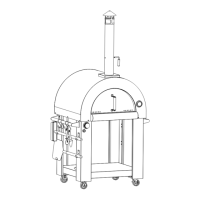

 To Next Page