EasyManua.ls Logo

Crumar Spirit - Control System; Modulation and Envelope Controls

Crumar Spirit
31 pages
Print Icon
To Next Page IconTo Next Page
To Previous Page IconTo Previous Page
Loading...
CONTROL
MASTER
OSCILLATOR
A
OSCILLATOR
B
TUNE
OCTAVE
WAVEFORM
SYNC.
WAVEFORM
OCTAVE
/
RANGE
TRIGGER
INTERVAL
SINGLE
GATE
SELECT
KBD
x
ON
v /
eXT
ON
MOO
:
?<
. · .
SHAPER
Y
.0.
·0·
A.
"-
. .
O
0
.
20
'"
. . . .
A
.........
-
'1
WIDE
_4 _4
. .
..
o
o
000
C:
0
••
_ 31
UNISON
BASS
20
1
~
rt..
MASTER
VOLUME
MASTER
KB
AMOUNT
0--; 0
oQ.
L _ _ , I L _ _ ,
-CUTOFF
-I-
RESONANCE
:-
SLOPE
--
TRACKING
I -
I I
I , _
__
.J
BRIGHTNESS
A B
RING
NO
I
SE
A
B
NOISE
"o
J
20B
.0.
OUT
~~~S
O V
ER
-
BANO
-
LO\NER
ONLY
DRI
V E
PASS.
SHAPER
V
PATH
-
FIL
TER/ADSR
PATH
-
LOWER
FILTER
L
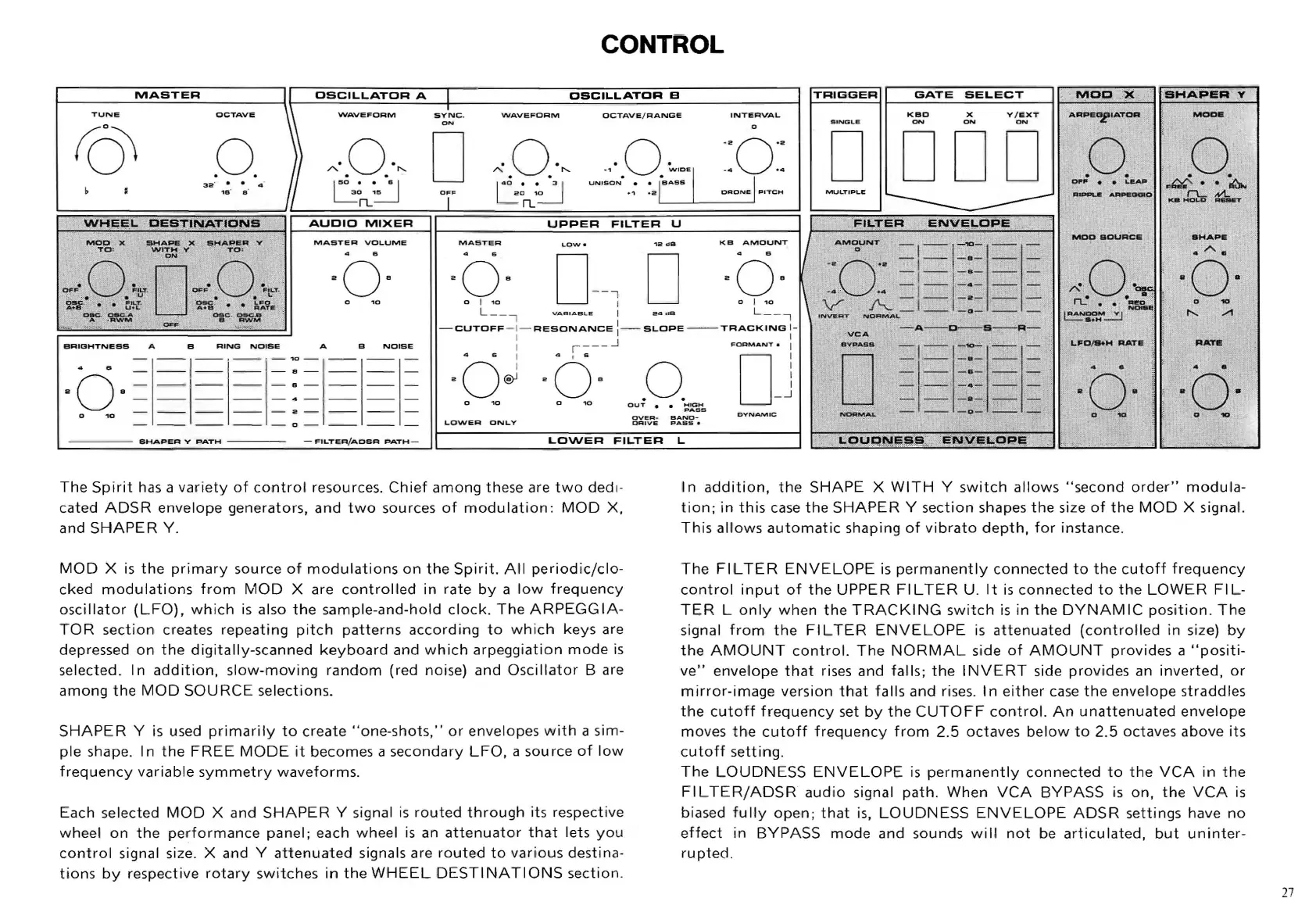
The
Spirit
has a
variety
of
control
resources.
Chief
among
these are
two
dedi·
cated
ADSR
envelope
generators,
and
two
sources
of
modulation:
MOD
X,
and
SHAPER
Y.
MOD
X
is
the
primary
source
of
modulations
on
the
Spirit.
All
periodic/clo-
cked
modulations
from
MOD
X are
controlled
in
rate
by
a
low
frequency
oscillator
(LFO),
which
is
also
the
sample-and-hold
clock.
The
ARPEGGIA-
TOR
section
creates
repeating
pitch
patterns
according
to
which
keys
are
depressed
on
the
digitally-scanned
keyboard
and
which
arpeggiation
mode
is
selected. I n
addition,
slow-moving
random
(red noise) and
Oscillator
Bare
among
the
MOD
SOURCE
selections.
SHAPER
Y
is
used
primarily
to
create
"one-shots
,"
or
envelopes
with
a sim-
ple
shape. I n
the
FREE
MODE
it
becomes a
secondary
LFO,
a
source
of
low
frequency
variable
symmetry
waveforms.
Each selected
MOD
X and
SHAPER
Y signal
is
routed
through
its respective
wheel
on
the
performance
panel;
each wheel
is
an
attenuator
that
lets
you
control
signal size. X and Y
attenuated
signals are
routed
to
various
destina-
tions
by
respective
rotary
switches
in
the
WHEEL
DESTINATIONS
section
.
I n
addition,
the
SHAPE
X
WITH
Y
switch
allows
"second
order"
modula-
tion;
in
this
case
the
SHAPER
Y
section
shapes
the
size
of
the
MOD
X signal.
This
allows
automatic
shaping
of
vibrato
depth,
for
instance.
The
FI
L
TER
ENVELOPE
is
permanently
connected
to
the
cutoff
frequency
control
input
of
the
UPPER
FI L
TER
U. I t
is
connected
to
the
LOWER
FI
L-
TER
L
only
when
the
TRACKI
NG
switch
is
in
the
DYNAM
IC
position
.
The
signal
from
the
FI
L
TER
ENVELOPE
is
attenuated
(controlled
in
size)
by
the
AMOUNT
control.
The
NORMAL
side
of
AMOUNT
provides
a
"positi-
ve"
envelope
that
rises and
falls;
the
INVERT
side
pro
vides an
inverted,
or
mirror-image
version
that
falls
and rises. I n
either
case
the
envelope
straddles
the
cutoff
frequency
set
by
the
CUTOFF
control.
An
unattenuated
envelope
moves
the
cutoff
frequency
from
2.5
octaves
below
to
2.5
octaves
above
its
cutoff
setting.
The
LOUDNESS
ENVELOPE
is
permanently
connected
to
the
VCA
in
the
FI L
TER/AOSR
audio
signal
path.
When
VCA
BYPASS
is
on,
the
VCA
is
biased
fully
open;
that
is,
LOUDNESS
ENVELOPE
ADSR
settings have
no
effect
in
BYPASS
mode
and sounds
will
not
be
articulated,
but
uninter-
rupted
.
27