EasyManua.ls Logo

Crumar Spirit - Filter Resonance and Tracking; Resonance, Slope, and KB Amount

Crumar Spirit
31 pages
Print Icon
To Next Page IconTo Next Page
To Previous Page IconTo Previous Page
Loading...
32
UPPER
FI
I
-
RESONANCE
:-
, _ _ _
-.J
4 , 6
eO
a
LOWER
FI
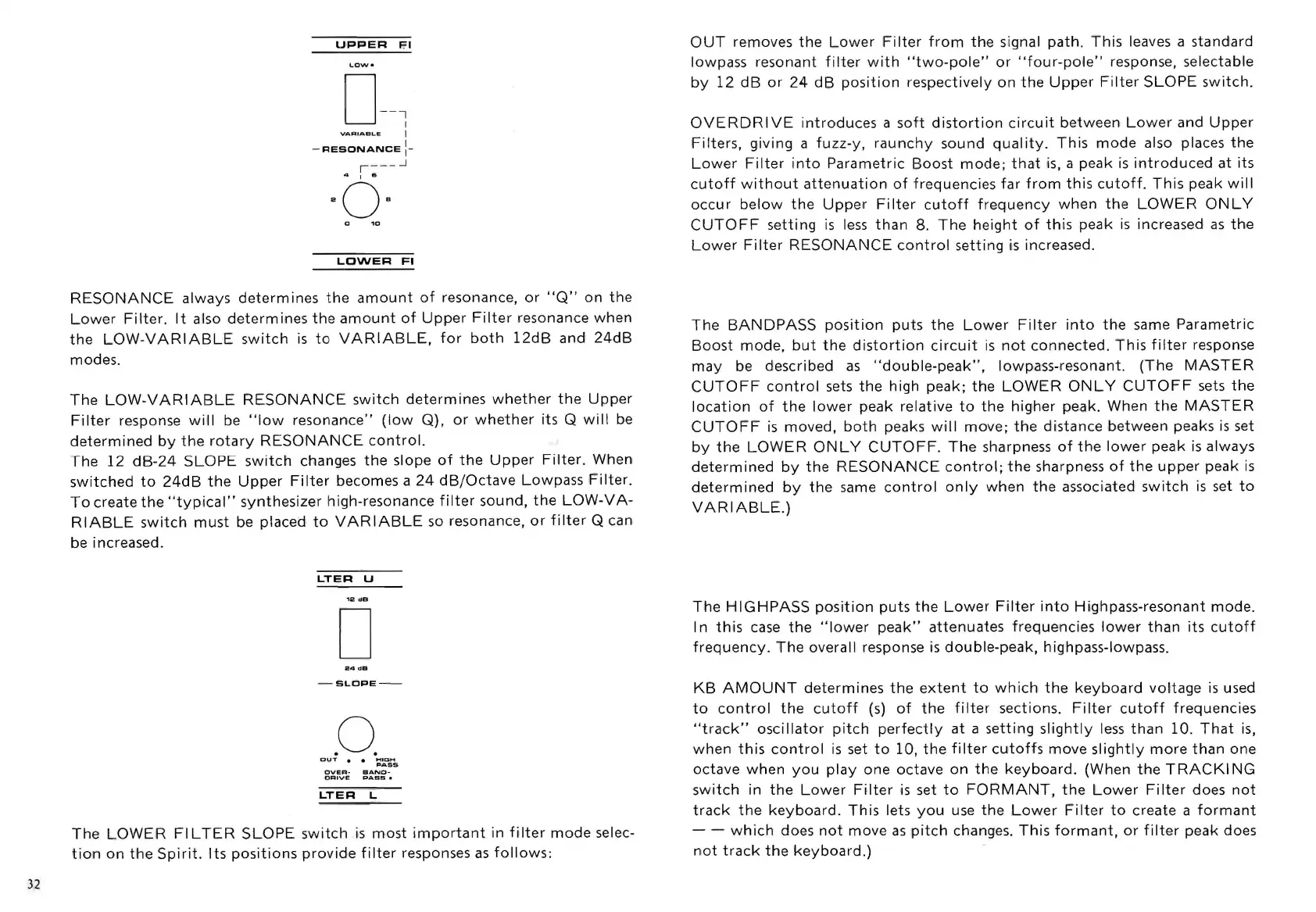
RESONANCE
always
determines
the
amount
of
resonance,
or
"Q"
on
the
Lower
Filter.
It
also
determines
the
amount
of
Upper
Filter
resonance
when
the
LOW-VARIABLE
switch
is
to
VARIABLE,
for
both
12dB
and
24dB
modes.
The
LOW-VARIABLE
RESONANCE
switch
determines
whether
the
Upper
Filter
response
will
be
"low
resonance"
(low
Q),
or
whether
its Q
will
be
determined
by
the
rotary
RESONANCE
control.
The
12
dB-24
SLOPE
switch
changes
the
slope
of
the
Upper
Filter.
When
switched
to
24dB
the
Upper
Filter
becomes a
24
dB/Octave
Lowpass
Filter.
To
create
the
"typical"
synthesizer
high-resonance
filter
sound,
the
LOW-V
A-
RIABLE
switch
must
be placed
to
VARIABLE
so
resonance,
or
filter
Q can
be increased.
LTER
U
D
-SLOPE-
.0.
OUT
HIGH
PASS
OVE~
w
IiIANO-
O~IVE
PASS.
LTER
L
The
LOWER
FI
L
TER
SLOPE
switch
is
most
important
in
filter
mode
selec-
tion
on
the
Spirit.
Its
positions
provide
filter
responses
as
follows:
OUT
removes
the
Lower
Filter
from
the
signal
path
.
This
leaves a
standard
lowpass
resonant
filter
with
"two-pole"
or
"four-pole"
response, selectable
by
12
dB
or
24
dB
position
respectively
on
the
Upper
Filter
SLOPE
switch.
OVERDRIVE
introduces
a
soft
distortion
circuit
between
Lower
and
Upper
Filters,
giving
a
fuzz-y,
raunchy
sound
quality.
This
mode
also places
the
Lower
Filter
into
Parametric
Boost
mode;
that
is,
a peak
is
introduced
at
its
cutoff
without
attenuation
of
frequencies
far
from
this
cutoff.
This
peak
will
occur
below
the
Upper
Filter
cutoff
frequency
when
the
LOWER
ONLY
CUTOFF
setting
is
less
than
8.
The
height
of
this
peak
is
increased
as
the
Lower
Filter
RESONANCE
control
setting
is
increased.
The
BANDPASS
position
puts
the
Lower
Filter
into
the
same
Parametric
Boost
mode,
but
the
distortion
circuit
is
not
connected.
This
filter
response
may
be described
as
"double-peak",
lowpass-resonant.
(The
MASTER
CUTOFF
control
sets
the
high
peak;
the
LOWER
ONLY
CUTOFF
sets
the
location
of
the
lower
peak
relative
to
the
higher
peak. When
the
MASTER
CUTOFF
is
moved,
both
peaks
will
move;
the
distance
between
peaks
is
set
by
the
LOWER
ONLY
CUTOFF.
The
sharpness
of
the
lower
peak
is
always
determined
by
the
RESONANCE
control;
the
sharpness
of
the
upper
peak
is
determined
by
the
same
control
only
when
the
associated
switch
is
set
to
VARIABLE.)
The
HIGHPASS
position
puts
the
Lower
Filter
into
Hi
.ghpass-resonant
mode.
I n
this
case
the
"lower
peak"
attenuates
frequencies
lower
than
its
cutoff
frequency.
The
overall response
is
double-peak,
highpass-Iowpass.
KB
AMOUNT
determines
the
extent
to
which
the
keyboard
voltage
is
used
to
control
the
cutoff
(s)
of
the
filter
sections.
Filter
cutoff
frequencies
"track"
oscillator
pitch
perfectly
at a
setting
sl
'
ightly
less
than
10.
That
is,
when
this
control
is
set
to
10,
the
filter
cutoffs
move
slightly
more
than
one
octave
when
you
play
one
octave
on
the
keyboard.
(When
the
TRACKI
NG
switch
in
the
Lower
Filter
is
set
to
FORMANT,
the
Lower
Filter
does
not
track
the
keyboard.
This
lets
you
use
the
Lower
Filter
to
create a
formant
- -
which
does
not
move
as
pitch
changes.
This
formant,
or
filter
peak does
not
track
the
keyboard.)