Need help?
Do you have a question about the CST Magna-Trak 100 and is the answer not in the manual?
Instructions on using the power switches to activate and deactivate the locator circuitry.
Guidance on adjusting audio volume and sensitivity/depth range using control knobs.
Description of the audio tone generated by the speaker during operation.
Explanation of the LCD display functions, including numeric and bar-graph indicators.
Procedure for using the locator in water, including submersion depth limits.
Technique for operating the locator accurately near a steel fence for object detection.
Examples of signal patterns from various buried ferrous objects like covers and pipes.
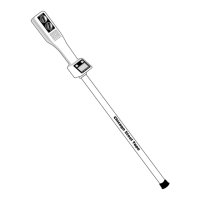
The Magna-Trak 100® Magnetic Locator is a sophisticated flux-gate type magnetometer designed to efficiently locate ferromagnetic objects by sensing their magnetic fields. This instrument employs a unique, patented technology that allows its magnetic sensing coils to be precisely balanced to a finite condition, representing an advanced state in magnetic balancing technology. The locator is engineered to provide a "peak response" over ferromagnetic objects, meaning it generates an increasing audio signal as the device approaches and passes directly over the target object. This design ensures accurate pinpointing of buried ferrous items.
At its core, the Magna-Trak 100 operates with two sensor coil assemblies that are meticulously spaced and electronically balanced. In a uniform magnetic field, such as the Earth's natural magnetic field, these coils maintain a balanced state, as both experience the same magnetic lines of force. However, when the locator encounters a ferromagnetic object, the magnetic field strength and angle upon each sensor differ, even if minutely. This difference is sufficient to disrupt the critical balance, thereby producing an audible indicating signal. When no ferromagnetic objects are present, the speaker emits a steady, low-frequency tone. As the locator approaches a target object, the audio frequency increases, peaking when the center of the object is directly beneath the locator's lower tip sensor. The frequency then decreases as the object is passed, with the peak indicating the exact location. It's important to note that nonferrous objects, such as those made of brass, aluminum, or copper, do not affect the locator's operation.
The Magna-Trak 100 is designed for user convenience and durability. It features a rugged, high-impact plastic enclosure with an aluminum sensor pole, ensuring resilience in various field conditions. The powerful magnetic speaker is equipped with a waterproof Mylar cone, enhancing its reliability in wet environments. The device is lightweight and comfortably balanced for easy handling during extended use.
For clear feedback, the locator incorporates an easy-to-view LCD display that provides visual signal strength and battery information. This display includes a two-digit numeric signal indicator, an expanding analog Bar-Graph signal indicator, and a flashing "Low Battery" indicator to keep the user informed about the device's status. The Magna-Trak 100 operates on six "AA" (1½ volt) batteries, offering approximately 100 hours of battery life under intermittent operation. Battery replacement is made convenient with a quick-access battery compartment.
User control is intuitive, with adjustable sensitivity and volume knobs. The volume knob allows the user to set the desired audio level, reaching full volume when turned fully clockwise. The sensitivity or depth range can be varied using the sensitivity knob, with maximum range achieved at full clockwise rotation. The optimal sensitivity setting depends on the specific application; areas with many undesired ferrous objects may require reduced sensitivity, while deeply buried objects will necessitate a higher sensitivity level. A decal with markings for both control knobs serves as a reference for future settings or comparisons. The device also features single-hand touch-switch operation for power ON/OFF, simplifying its use in the field. Under search conditions, it produces a deep tone audio, with signals "peaking" over magnetic objects, and boasts full depth capability. The locator comes with a padded carrying case, complete with a shoulder strap, or a hard case for protection and portability.
The LCD visual display offers several functions for ease of operation. The "Ferrous" indicator confirms the locator's basic function as a ferrous locator. The digital signal indicator, a two-digit numeric display, shows the signal level in relation to the audio response. At the lowest signal level (no ferrous metal), a small number (between "0" and "5") is displayed. As metal is approached, the numbers increase, reaching "99" at maximum peak. This feature helps pinpoint objects, with deeply buried objects or lower sensitivity levels yielding lower peak numbers. The analog bar-graph signal indicator expands outward from a central "diamond" in correlation with the audio signal response.
In terms of field operation, the recommended search position involves holding the locator at a 45° angle from the Earth's surface and scanning the pole side-to-side in a slow, sweeping motion while walking steadily. Maintaining a consistent height above the ground during this motion is crucial. Once an object is located, pinpointing its exact position is achieved by holding the locator vertically and sweeping it in an "X" pattern until the absolute signal peak is found. Both the audio sound and visual LCD display will aid in this pinpointing process. It's important for users to be aware that the magnetic locator is sensitive not only to buried ferrous objects but also to personal items containing ferrous material, such as steel-tipped shoes, pocket knives, wristwatches, or key chains, which can cause false signals. However, the locator is unaffected by nonferrous objects like copper, aluminum pull tabs, or foil, as well as environmental elements like snow, ice, water, wood, plastic, concrete, stones, and the ground itself.
For water locations, the pole section of the locator can be submerged into water up to just under the plastic case. When locating near a steel fence, the locator should be moved or slid across the ground, holding its body perpendicular to the fence. It's important not to roll the locator on the ground and to maintain a consistent distance between the tip of the locator and the fence. The object will be directly below the tip of the locator, approximately ¼" from it.
The Magna-Trak 100 provides typical signal responses for various scenarios. For instance, metal handles on a septic tank cover will generate a usable signal for determining the cover's location. Large metal objects may cause double signals, and the center of such an object can be found by sweeping the locator back and forth to create a ring pattern response, with the center null designating the object's center. Joints, elbows, and ends of iron pipes will produce the strongest signals; holding the locator in a vertical position while searching will yield the best results in these cases.
Maintenance features primarily revolve around battery replacement. The LCD will display a flashing "Low Battery" warning when the batteries fall below a predetermined voltage, indicating that replacement is needed soon. Several hours of battery life typically remain, though this time may be shorter in cold temperatures. To replace batteries, the user must first turn off the power. The thumb screw on the battery cover should be unscrewed (2-5 turns), and the cover lifted until its tab clears the slot. Batteries are removed by raising them at the contact point of each pair, and used batteries should be disposed of properly. New batteries must be inserted, observing the polarity labels inside the battery well. It is crucial not to mix old and new batteries, and all batteries should be replaced simultaneously. Additionally, batteries should not be replaced under wet or rainy conditions to prevent water from entering the compartment. After replacement, the cover is reinstalled in reverse, being careful not to overtighten the thumb screw. If the "Low Battery" indicator is not displayed, and no visual indications or sound are present after pressing the ON switch, the batteries may be dead. In such cases, the battery compartment should be checked immediately, and dead batteries removed promptly, as they are prone to leakage and can cause permanent damage. It is always recommended to remove batteries before storing the locator for extended periods.
 Power
Power| power source | Six AA batteries |
|---|---|
| battery life | ±100 hours |
| output | Powerful magnetic speaker |
 Operating Environment
| operating temperature | 0°F to 120°F (-18°C to 49°C) |
|---|---|
| construction material | High-impact water resistant plastic |
| sensor material | Aluminum |
 Weight and Dimensions
| weight | 3 lbs. (1.3kg) |
|---|---|
| length | 40 inches (101.6 cm) |
| nominal sensor length | 20 inches (50.8 cm) |

 To Next Page