3
Higher volumes of air exhausted by the vent
system result in better overall removal of smoke
and fumes from the kitchen. Longer duct runs
and greater numbers of duct transitions reduce
air volume, therefore it is extremely important
to keep duct runs as short and straight as
possible. When longer runs or multiple turns
are unavoidable, and inline blower may be used
to assist the remote blower.
To ensure that your installation meets this
requirement, add the actual straight length of
duct to the equivalent straight length of all duct
fittings to determine the total equivalent straight
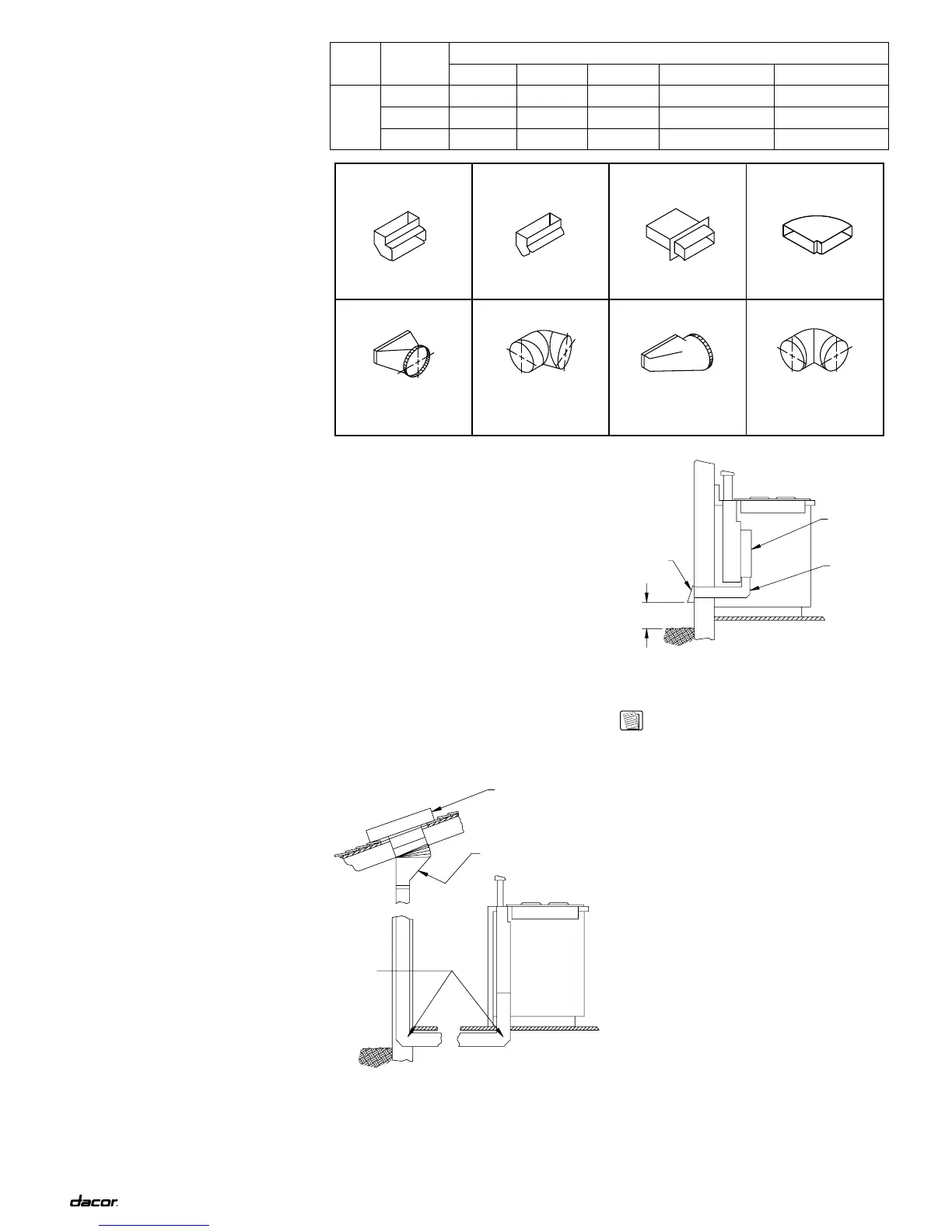
length of duct. (Refer to the table above, which
shows various common duct fittings with their
equivalent straight lengths for various common
duct sizes). If this total equivalent straight
length is less than or equal to the maximum
limits specified, then the installation is proper.
Consider the duct size that corresponds to the
majority of the duct used in the installation.
Sample problem:
Given a remote system installation having 25
feet of 31¼” x 10” rectangular duct, one (1) 90-
degree 3 1¼” x 10” elbow, and one (1) 31¼” x
10” to 8” round transition, would this installation
be proper?
Solution:
1. Add the total length of straight duct:
25’ (of 31¼” x 10”) = 25’.
3 1/4" x 10" 90° Elbow 3 1/4" x 10" 45° Elbow 3 1/4" x 10" Wall Cap 3 1/4" x 10"
90° Flat Elbow
Transistion
3 1/4" x 10" to Round
45° Elbow - Round Duct 90° Transistion
3 1/4" x 10" to 8" Round
90° Elbow - Round Duct
15 Feet 7 Feet 2 Feet 20 Feet
6" Diameter - 4 Feet
7" Diameter - 4 Feet
8" Diameter - 4 Feet
10" Diameter - 4 Feet
6" Diameter - 6 Feet
7" Diameter - 5 Feet
8" Diameter - 3 Feet
10" Diameter - 2 Feet
25 Feet 6" Diameter - 12 Feet
7" Diameter - 10 Feet
8" Diameter - 7 Feet
10" Diameter - 5 Feet
Model
#
Duct
Size
Maximum Equivalent Straight Lengths
CABP3 REMP3 REMP16 ILB10 & REMP16 ILB8 & REMP3
RV
8” 60’ 60’ - - 60’
10” 50’ 50’ - - 50’
3 1/4”x10” 50’ 50’ - - 50’
8. Do not rely on duct tape alone
to seal duct joints. Use sheet
metal screws as require to
support the duct weight.
9. The vent hood and cooking
appliance(s) must be
removable if service is
required.
10. Be certain that the ductwork
does not interfere with floor
joists or wall studs.
11. It is important to keep a
minimum number of turns in
the duct run, and to keep the
run as short as possible.
12. Do not restrict the air flow
by reducing the duct cross-
sectional areas when making
hard joints or squeezing
through a tight area.
13. With concrete slab
construction, "box-in" the
ductwork to prevent it from
collapsing when the wet
concrete is poured. Also allow
room for electrical conduit.
14. Cross-drafts or air currents
caused by adjacent open
windows or doors, HVAC
outlets, ceiling fans, and
recessed ceiling lights reduce
vent efficiency.
2. Using Table above, determine the
equivalent straight length of all duct
fittings: 90-degree 3 1¼” x 10” elbow
= 15’. 31¼” x 10” to 8” round transition
= 4’.
3. Add (1) and (2) to determine the
total equivalent straight length of the
complete duct system: 25’ + 15’ + 4’
= 44’ total equivalent straight duct
length.
4. For the remote system with 31¼” x
10” duct, the maximum allowable total
equivalent straight length of duct is 50
feet. Thus, this proposed installation is
proper.
After determining that your proposed ductwork
meets the maximum duct length requirement,
proceed with the location planning.
3 1/4” x 10” to 8” DIA.
ROUND TRANSITION
REMOTE BLOWER
90˚ ELBOW
3 1/4” x 10”
Run duct under floor (between joists) to nearest
wall and up to roof-mounted Remote Blower
.
RV30/RV36/RV46 with REMP3 Remote Blower,
Island Installation
WALL CAP
12” MIN.
CABINET
BLOWER
3 1/4” x 10”
90˚ ELBOW
Run duct directly through rear
wall to outside wall cap.
RV30/RV36/RV46 with CABP3 Cabinet Blower,
Direct Connection
NOTE:
The ILB8 & ILB10 Inline Blowers
are only approved as a boost
assist to the REMP3 and REMP16
Remote Blowers and the CABP3
Cabinet Blower.


 To Next Page
 Loading...