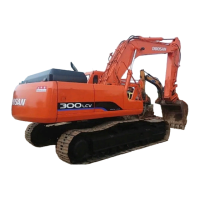
This document describes the hydraulic system, accumulator, center joint (swivel), cylinders, swing motor, and travel motor (with gearbox) for Daewoo Solar excavators.
Hydraulic System - General Notes
The hydraulic system incorporates several improvements over conventional systems, including cross-sensing total horsepower control to maximize output efficiency. It features an electronically controlled output optimization system, allowing the operator to choose between three distinct power modes: high-output/rapid cycling maximum-speed, low fuel consumption/low-noise light duty, and a standard power mode. Electronic management of hydraulic control valves optimizes application speed and operator control of hydraulic actuators.
Hydraulic Schematic - General Notes
The main pump assembly, driven by the engine, converts mechanical energy into hydraulic power. It consists of a right and a left main pump. The right pump supplies the right side of the control valve, operating valve spools for right travel, swing, boom2, and arm1 functions. The left pump supplies the left side of the control valve, operating control spools for left travel, bucket, boom1, and arm2 operations. A pilot pump controls the main pumps and operates pilot and solenoid valves.
Two-stage operation is a feature for boom and arm functions, allowing operation with either one or both halves of the hydraulic pump assembly for higher speeds. Boom up, arm crowd, and dumping functions can operate in standard or high-speed modes.
When travel control spools are shifted, main pump output passes through the center joint to the axial piston motors driving the crawler tracks. A pilot valve connected to the swash plate of each travel motor changes motor capacity proportionally to the travel switch position.
The hydraulic reservoir return line and pilot circuit have 10-micron full-flow filters. An 80-mesh, 177-micron reservoir intake strainer also helps maintain cleanliness. An oil cooler maintains operating temperature at approximately 50°C (122°F).
The arm cylinder operating circuit includes anti-vacuum valves. Boom, arm, and bucket cylinder circuits are protected by overload relief valves, which dump excess pressure to the reservoir return circuit during shocks or overloads. A selection valve in the travel circuit provides constant high torque/low speed or variable speed/variable torque output. For simultaneous travel and boom/arm/bucket operation, select the high torque/low speed travel position to prevent sliding.
Operation of Working Components
- Boom Operating Circuit: Includes right and left main hydraulic pumps, both sides of the control valve, and the boom cylinder. Overload relief valves are set at 360 kg/cm² (5,112 psi). A make-up valve and reservoir return circuit prevent cavitation.
- Boom Up Circuit: Pulling the boom control lever backward generates secondary boom up pilot pressure (7-10 kg/cm² or 100-142 psi) to BOOM1 and BOOM2 spools, opening them and directing oil from both pumps to the boom cylinder.
- Boom Down Circuit: Pushing the boom control lever forward generates secondary boom down pilot pressure (7-10 kg/cm² or 100-142 psi) to the BOOM1 spool, opening it and directing oil from only the left pump to the boom cylinder.
- Arm Operating Circuit: Includes both main hydraulic pumps, both sides of the control valve, arm regeneration valve, and arm cylinder. Operates in a two-stage speed control mode. Overload relief valves are set at 360 kg/cm² (5,112 psi) at crowd and dump cylinder ports. A make-up valve and reservoir return circuit prevent cavitation.
- Arm Crowd Circuit: Moving the arm control lever to crowd mode generates secondary pilot pressure (7-10 kg/cm² or 100-142 psi) to ARM1 and ARM2 spools, opening them and directing oil from both pumps to the arm cylinder. A regeneration valve prevents cavitation and irregular movement.
- Arm Dump Circuit: Moving the arm control lever to dump mode generates secondary pilot pressure (7-10 kg/cm² or 100-142 psi) to ARM1 and ARM2 spools, allowing oil from both pumps to flow to the arm cylinder.
- Bucket Operating Circuit: Includes right and left main pumps, both sides of the control valve, and the bucket cylinder. Overload relief valves are set at 360 kg/cm² (5,112 psi) at crowd and dump cylinder ports.
- Bucket Crowd Circuit: Moving the bucket control lever to crowd mode generates secondary pilot pressure (7-10 kg/cm² or 100-142 psi) to BUCKET and BC spools, opening them and directing oil from both pumps to the bucket cylinder.
- Bucket Dump Circuit: Moving the bucket control lever to dump mode generates secondary pilot pressure (7-10 kg/cm² or 100-142 psi) to the BUCKET spool, opening it and directing oil from the left pump to the bucket cylinder.
- Swing Operating Circuit: Consists of the right main pump, right half of the control valve, and the swing motor. An electrical sensor activates a mechanical brake to prevent coasting when the swing control is in neutral.
- Right Swing Operating Circuit: Pushing the swing control lever to the right directs pilot pressure from the left side pilot valve to the SWING spool, and output flow from the right pump goes to the swing motor.
- Left Swing Operating Circuit: Pushing the swing control lever to the left directs pilot pressure from the left side pilot valve to the SWING spool in the opposite direction, and output flow from the right pump goes to the swing motor.
- Swing Relief Valve and Make-up Valve: A relief valve and large-capacity make-up valve are installed in the swing motor to prevent surge pressure and cavitation when the spool shifts to neutral.
- Relief Valve Setting Pressure: S420LC-V: 270.0 kg/cm² (3,840 psi); S470LC-V: 280.0 kg/cm² (3,980 psi).
- Travel Operating Circuit: Output flow from both halves of the pump assembly is directed to the right and left travel motors through the right and left sides of the control valve and the upper works center joint.
- Forward Travel Circuit: Pushing right and left travel control levers forward directs output from both main pumps through TRAVEL (R) and TRAVEL (L) spools to the travel motors.
- Reverse Travel Circuit: Pushing right and left travel control levers backward directs output from both main pumps through TRAVEL (R) and TRAVEL (L) spools to the travel motors.
Procedural Troubleshooting Baseline Recommendations
Initial checks include hydraulic flow and pressure. Engine operation should be checked at 2,150 RPM (no load) and 2,000 RPM (stall load). If engine RPM drops excessively or fails to reach rated speed (1,900 RPM), performance issues may be due to inadequate hydraulic flow. Verify actual flow with a flow meter. If engine tests meet specifications and the EPOS trouble code display is clear, check pilot pressure, Negacon pressure, main relief pressure, swing pressure, port relief pressure, power boost circuit, and perform standard performance tests (cylinder speed, hydraulic motor speed, cylinder oil-tightness).
Pilot Pressure - Adjustment and Testing
Vent hydraulic pressure from the reservoir. Install "t-style" adapters and test gauges (60 bar/1,000 psi) at the gear pump outlet port and joystick control valve pilot line. Start the engine, warm it to normal operating temperature, then set engine speed to minimum rated RPM. Check pressure at both points. If outside tolerance, adjust gear pump relief pressure by loosening the lock nut and turning the set screw (clockwise to increase, counterclockwise to decrease).
- Specifications: Minimum Speed Setting (full left) on Speed Control Dial: Pilot Pressure @ Pump 40 ±5 bar (580 ±73 psi); Pilot Pressure - Joystick 40 ±5 bar (580 ±73 psi).
Power Mode Valve - Current Signal and Hydraulic Pressure Adjustments
The electromagnetic pressure proportioning control (EPPR) "power mode" valve is located on the underside of the pumps. To test and adjust power shift current and pressure, a multi-lead jumper harness and VOM meter are required. Turn off the engine, disconnect the electrical lead from the valve, connect the jumper harness, and reconnect the valve electrical lead. Vent the hydraulic tank, connect a 60 bar/870 psi (1,000 psi) test gauge to the valve pressure port. Restart the engine, warm the hydraulic system to at least 45°C (113°F). Select Power Mode on the Instrument Panel and check current and pressure readings. Adjust if necessary by turning the adjusting screw.
- Specifications:
- Power Mode: High Idle: 2,150 RPM, Current 600 ±20 mA, Pressure 1.5 bar (22 psi).
- Standard Mode: High Idle 2,150 RPM, Current 0 mA, Pressure 18 bar (261 psi).
Boom/Front Priority Valve - Control Valve Pressure and Current Adjustments
The front priority control valves are located behind the cabin. Use the same jumper harness as for the power mode valve. Turn off the engine, disconnect an electrical lead, and connect test equipment. Connect a 60 bar/870 psi (1,000 psi) test gauge to the outlet side. Set engine speed to maximum, warm the engine to at least 45°C (113°F). Operate swing and boom simultaneously, measure signal current and hydraulic pressure. Reset work mode to "digging," then "trenching" and repeat tests.
- Specifications:
- Digging Mode: Front Priority Voltage 0 V, Pressure 40 bar (580 psi).
- Trenching Mode: Front Priority Voltage 20 - 30 V, Pressure 0 bar (0 psi).
Pressure Up Valve - Checks and Adjustments
Vent hydraulic pressure from the reservoir. Install a "t-style" adapter and test gauge (60 bar/1,000 psi) at the pilot pump signal port relief valve outlet. Start the engine, turn speed dial to maximum, and warm to normal operating temperature. Check and readjust pilot pressure. Select "pressure display" for the rear pump on the Instrument Panel. Select Power Mode. Stall the boom cylinder (extend side). Read rear pump pressure. Repeat with and without "pressure up" selected. If the 2-stage main relief valve is outside tolerance, adjust by loosening the outer lock nut and turning the adjusting screw (clockwise to increase, counterclockwise to decrease). Pressure must be 350 bars (5075 psi) or up to 10 bars (145 psi) higher. Check low-stage main relief pressure without "pressure up." It should be at least 320 bars (4,641 psi), but less than 325 bars (4,714 psi).
- Specifications:
- Mode Neutral, No Operation: Main Pressure 20 - 40 bar (290 - 580 psi), Pilot Pressure 30 bar + 10 bar (435 psi + 145 psi).
- Mode Cylinder Stall: Main Pressure 320 bar + 5 bar (4,641 psi + 75 psi), Pilot Pressure 30 bar + 10 bar (435 psi + 145 psi).
- Mode W/ pressure Up Cylinder Stall: Main Pressure 350 bar + 10 bar (5,075 psi + 145 psi), Pilot Pressure 30 bar + 10 bar (435 psi + 145 psi).
The electrical pressure up (power boost) solenoid valve must be operating correctly for pressure tests and adjustments.
A flow meter is strongly recommended for accurate adjustments. Vent hydraulic pressure from the reservoir before installing the flow meter kit. Mark setscrew positions at the current regulator control setting. Adjustments are performed if the engine is consistently overloaded, cylinder speed is reduced, or pump output is unbalanced.
- Adjustment Screws:
- Screw 2 (Pi-Q control valve curve): Clockwise to shift the curve decrease compensating control pressure. 1/2 turn = -0.7 kgf/cm² of Pi.
- Screw 3 (Pd-Q curves): Clockwise to shift curves right and increase input horsepower. 1/2 turn = +33 kgf/cm² of Pd.
- Screw 1 (Delivery rate Q): Affects maximum cut flow.
Balance both pumps for equal output.
Flow Meter and Flow Meter Kit Installation and Testing
To check regulator and pump output balance and verify adjustments, install a flow meter. Turn off the engine, release hydraulic pressure from the accumulator and reservoir. Remove guard panels. Disconnect the main pump discharge output line, install the flow meter input flange, and cap the unused pump discharge line. Bolt a pre-measured hydraulic hose between the flow meter output and the reservoir top. Maintain even tightening torque on all flange fittings and use Loctite. Restart the engine (minimum RPM) to de-aerate and warm the system. Record pump pressure, measured flow, and engine RPM for unloaded, "travel right," and "travel left" tests at specified pressures.
- Maximum Flow Tests: When testing bucket and swing functions, read maximum flow tests at 320 kg/cm² (4,550 psi), not 350.0 kg/cm² (4,978 psi).
Swing System Troubleshooting
- Precautions/Initial Checks: Stop work, release load, turn off engine, disengage controls. Check oil level, for overheating, leaks, clogged cooler, broken fan belt. Drain tank oil to check for metal shavings, grit, cloudiness, water, or foam. Check engine/pump flex coupling for wobble. Investigate unusual noises/vibration.
- Swing Relief Valve Checking and Adjustment: Check operating pressures if the swing motor fails to turn, swings in one direction, continues to coast, or drifts on a slope.
- Connect two 600 bar (8,700 psi) pressure gauges to the inlet and outlet measuring ports on top of the swing motor. Pressure should be 270-280 bar (3,916-4,061 psi) with swing locks engaged. With locks released, pressure should approach 250 bar (3,625 psi) during acceleration/deceleration.
- Connect a 60 bar (870 psi) pressure gauge at the "SH" port of the hydraulic brake. Pressure should be ≥ 4 bar (58 psi) when operating swing, boom, or arm.
- Connect a 10 bar (145 psi) gauge at the motor makeup valve. Pressure should be ≥ 2.5 bar (36 psi).
- If main inlet/outlet pressures are off, adjust swing relief valve pressure. If adjustment fails, troubleshoot the swing table.
- If "SH" port pressure is below 4 bar (58 psi), check the shuttle valve. If pressure is restored but the brake fails to release, the brake piston or friction plate may be frozen.
- If motor makeup valve pressure is below minimum, check the restriction valve. If problems persist, disassemble the upper swing motor housing.
- If all pressures are at recommended levels and no mechanical problems exist, further hydraulic troubleshooting or e-EPOS self-diagnosis (code "0.2" indicates swing priority proportional valve malfunction) may be needed.
Troubleshooting - Swing Gearbox
- Swing motor fails to operate:
- Low pressure at motor, brake, or makeup valve: Defective swing relief valve, brake release valve, or motor makeup valve. Remedy: Adjust pressure or disassemble/clean/replace valve components.
- All three pressure checks OK, but left travel also fails: Exchange front and rear pump inlet/outlet hoses. Remedy: If swing/left travel restored, repair P1 pump.
- All three pressure checks OK, but machine fails to swing: Brake assembly or motor friction plate failing to release, pilot pressure low, or swing control valve stuck. Remedy: Check binding, disassemble/repair, or repair pilot pressure swing spool/control valve.
- Swing motor defective: Test motor drain rate. Replace/repair motor.
- Gear train defective: Refer to "Swing Gear Troubleshooting."
- Swing functions but only at reduced RPM: Causes listed above, dragging swing, hot/wrong oil, worn parts. Remedy: Check list, replace oil, test motor drain rate, check "02" reading.
- Left travel speed reduced: Low output at P1 pump or external pilot piping leaks/clogged. Remedy: Clean/repair piping or replace P1 pump.
- Swing control movement reversed: Inlet/outlet piping reversed. Remedy: Reset controls or reverse piping.
- Machine swings but continues coasting past stopping point: Swing control valve spool not centered, pilot pressure outside range, or faulty swing relief valve. Remedy: Replace return spring, clean/repair valve piston/spool, disassemble/clean/replace pilot relief valve/pilot valve, or repair/replace swing relief valve.
- Swing movement in one direction only: Unequal pilot pressure (right/left), stuck swing control valve spool, or faulty swing relief valve. Remedy: Clean/repair piping/valve, repair/replace swing control valve, or repair/replace swing relief valve.
- No rotation:
- Pressure at swing motor inlet increases: Swing brake not releasing, internal gearbox drive train damage, or overload. Remedy: Check brake engagement/disengagement, replace gears/drive train, or reduce load.
- Pressure at swing motor inlet shows no increase, motor making irregular noises: Swing motor drive shaft damage or internal gearbox drive train damage. Remedy: Replace swing motor or repair assemblies.
- Pressure at swing motor inlet shows no increase, no irregular noises: Hydraulic pump or valve problem. Remedy: Troubleshoot hydraulic system.
- Oil Leakage:
- From drive shaft, bolted connections, or assembled surfaces: Damaged oil seal, old/non-sealing assembly compound, loose bolt, or warped flange. Remedy: Replace oil seal, disassemble/check mating surfaces, reapply Loctite, torque bolts.
- Excess heat:
- Gearbox casing excessively hot, with/without irregular noises: Low oil level or worn bearings/gears. Remedy: Replace oil or repair/replace gearbox.
Troubleshooting - Hydraulic Problems
- Attachment cylinders, swing, and travel motors all inoperable, loud noises from main pump: Main pump(s) malfunction, low oil level, or damaged main pump inlet piping/hose. Remedy: Repair/replace pump(s), refill, or repair piping/hose.
- Attachment cylinders, swing, and travel motors all inoperable, no unusual/loud noises: Pilot pump malfunction, pilot cutoff solenoid stuck, or pilot cutoff switch faulty. Remedy: Repair/replace.
- Engine/pump flex coupling damaged: Replace flex coupling.
- Sluggish performance of all hydraulic functions: Main pump(s) damaged/worn, main relief valve pressure off, low oil level, or clogged hydraulic reservoir intake strainer. Remedy: Repair/replace pump(s), readjust pressure, refill, or clean strainer.
- Pump inlet piping/hose allowing air into hydraulic system: Tighten connection.
- Oil temperature abnormally high: Oil cooler clogged/air circulation blocked, cooling fan belt tension too loose, relief valve set too low, or relief valve in constant use. Remedy: Clean cooler, readjust belt tension, readjust valve, or reduce workload/cycling rate.
- Hydraulic oil severely neglected or incorrect for application: Replace oil.
- One circuit in hydraulic system inoperable: Overload relief valve malfunction, oil leak at make-up valve, control valve spool damaged/dirty, actuator damaged/worn, internal seal leak in cylinder, cylinder rod damaged, pilot valve/piping malfunction, or mechanical linkage frozen/loose/damaged. Remedy: Readjust/replace/repair/clean.
- Travel motors inoperable: Center joint damaged, parking brake not releasing, travel motor worn/damaged, or travel motor pilot piping damaged. Remedy: Repair/replace.
- Travel motors operate very slowly: Track tension poorly adjusted, low oil in idlers/rollers, travel brake dragging, or track frame out of alignment/deformed/twisted. Remedy: Readjust tension, refill, repair.
- Swing motor inoperable: Swing brake not releasing, relief valve malfunction, or pilot piping damaged. Remedy: Repair/replace.
Troubleshooting - Control Valve
Check control valve problems only after other hydraulic circuit operational tests (pump flow, pilot pressure, Negacon pressure, main relief pressure, port relief pressure) have been made. Ensure the hydraulic system is topped up and free of oil leaks or air.
- Swing motor operates unevenly: Swing gear/bearing/mounting loose/worn, inadequate lubricant, or faulty swing relief valve. Remedy: Repair/replace, grease, or repair/replace swing relief valve.
- Main Relief Valve:
- Particulate contamination: Disassemble/clean main poppet.
- Broken/damaged spring: Replace.
- Adjusting screw loose: Readjust.
- Main poppet sticking: Repair/replace.
- Clogged orifice in pilot passage to control valve: Clean/replace.
- Cylinder goes down in spool neutral: Excessive clearance between casing/spool, spool not returning to neutral/sticking, spool not returning due to dirt/contaminants, broken/damaged spring, or main/port relief not operating properly. Remedy: Replace spool/casing, check secondary pilot pressure, clean, replace, or see above.
- Cylinder drops before start at boom up operation: Impurities in pilot circuit, rod check valve damaged/clogged, poppet sticking, or broken/damaged spring. Remedy: Clean, clean/replace, clean/replace, or replace.
- Slow operation or response: Excessive clearance between spool/casing, sticking spool, broken/damaged spring, or main/port relief valve damaged. Remedy: Check pilot pressure/replace spool/casing, clean/replace, replace, or check pressure/replace.
- Swing priority not operating correctly: Sticking spool or faulty solenoid valve. Remedy: Clean/replace or replace.
- Boom and arm cylinders do not perform normally in combined operation: Priority valve faulty/spool sticking, broken/deformed spring, excessive clearance between right/left casing and valve spool, or clogged spool passage. Remedy: Check pilot pressure, replace, clean/replace, or clean/replace/replace filter.
- Relief valve malfunctions:
- Pressure does not increase at all: Main poppet/pilot poppet stuck open. Remedy: Clean/replace.
- Irregular/uneven pressure: Poppet seat damaged/pilot piston sticking to main poppet, loose lock nut/adjusting screw, or worn components. Remedy: Clean/replace, readjust, or replace.
Troubleshooting - Travel Control Valve
- Secondary pressure does not increase: Low primary pressure, broken spring, spool sticking, excessive spool to casing clearance, or worn/loose universal joint. Remedy: Check primary pressure, replace spring, clean/repair/replace spool/casing, or repair/replace U-joint.
- Secondary pressure too high: Dirt/other interference between valve parts or return line pressure too high. Remedy: Clean/repair/replace or redirect return line.
- Secondary pressure does not hold steady: Dirt/other interference between valve parts, worn spool sticking intermittently, interference/binding on spool return spring, unsteady pressure in tank return line, or air bubbles/leak in piping. Remedy: Clean/repair/replace, repair/re-route tank return line, or vent air/repair leak.
Troubleshooting - Joystick Control Valve
- Secondary pressure does not increase: Low primary pressure, broken spring, spool sticking, excessive spool to casing clearance, or worn/loose handle subassembly. Remedy: Check primary pressure, replace spring, clean/repair/replace spool/casing, or repair/replace handle subassembly.
- Secondary pressure too high: Dirt/other interference between valve parts or return line pressure too high. Remedy: Clean/repair/replace or redirect return line.
- Secondary pressure does not hold steady: Dirt/other interference between valve parts, worn spool sticking intermittently, interference/binding on spool return spring, unsteady pressure in tank return line, or air bubbles/leak in piping. Remedy: Clean/repair/replace, repair/re-route tank return line, or vent air/repair leak.
Accumulator
- Function Description: A gas-charged storage device that holds a reserve of hydraulic fluid under pressure. It compensates for minor variations or lags in pump output, preventing unsteady or irregular operation.
- Usage Features: Accumulators are solidly constructed to resist high operating pressures. They have three main moving parts: a plug for pre-charging/expelling gas, a valve assembly for passing hydraulic fluid, and an elastic diaphragm separating the two chambers. The diaphragm changes shape to conform to changing pressures and volumes.
- Diaphragm Positions:
- No gas charge, no oil: Diaphragm hangs loosely.
- Gas pre-charge (usually nitrogen) introduced: Diaphragm expands to maximum size, valve button seals off lower valve. If gas pressure exceeds system oil pressure, no fluid enters.
- Hydraulic system pressure overcomes pre-charge pressure: Diaphragm retracts upward.
- System oil at highest working pressure, accumulator full: Diaphragm pushed into top chamber.
- System oil pressure falls/checked: Compressed gas pushes oil out, maintaining pressure.
- Minimal system pressure: Equilibrium reached, minimal oil stored.
- Maintenance Features: Annual checks of actual pre-charge pressure ("P1" pressure) should be made by tapping a hydraulic pressure gauge into the valve at the bottom. The gauge reading should be compared to the manufacturer's "P1" rated pressure. The highest working pressure is referred to as "P3" pressure.
- Important Technical Specifications:
- Models: Solar 300LC-V, 300LL, 340LC-V, 420LC-V, 470LC-V.
- Nitrogen Charge: 10 kg/cm² (142 psi).
- Volume: 320 cc (19.5 in³).
Center Joint (Swivel)
- Function Description: Designed to allow continuous 360° rotation of the upper structure relative to the lower structure by enabling hydraulic oil flow from the upper to lower components.
- Maintenance Features:
- Inspection: Check for external oil leakage every 2,000 hours. Leaking O-rings indicate contamination and wear. If internal seals or sliding surfaces are worn, complete overhaul/repair/replacement may be required.
- Testing: To check pressure, use a test kit including a 700 bar (10,000 psi) pressure gauge, adapters, connectors, piping, flange block-off plates, a high-pressure relief valve (1.5 times max system pressure), a stop valve, and a manually operated in-line change-over valve. Install the change-over valve upstream from a stem high-pressure port, the gauge downstream from a body port, and the stop valve between the change-over valve and the stem. This setup pressurizes the swivel above normal working pressure for a leak-down test. A similar kit can be made for the drain port.
- Disassembly:
- Clean the exterior.
- Mark the cover and body for reassembly alignment.
- Unbolt the three 8 mm fasteners holding the cover.
- Remove the cover and withdraw the spindle. If stuck, use a wooden block and hammer.
- Replace O-rings and seals. Use a smooth-edge scraper to avoid damage. The O-ring (10E) is tucked behind the top slip ring.
- Visually inspect ball bearing surfaces for wear/damage. Replace if more than 0.5 mm (0.020") visible wear.
- Check clearance between spindle and body. Replace/repair if more than 0.1 mm (0.0039") measurable wear.
- Reassembly:
- Pre-lubricate O-rings with hydraulic oil, white grease, or petroleum jelly.
- Clean all component surfaces.
- Reverse disassembly steps. Apply a light film of white grease/petroleum jelly to the lower rim of the spindle and inner surface of the body. Slowly push the spindle into the body to avoid seal damage.
- Clean fastener threads, apply Loctite #243, and torque cover bolts.
- Pre-fill the center swivel with clean hydraulic fluid before reassembly of piping. Bleed air from the hydraulic system and verify tank fluid level.
Cylinders
- Function Description: Two types of hydraulic cylinders are used: one with a rod stopper for boom/bucket (fully retracted), and arm cylinders with a cushion/stopper for both directions.
- Theory of Operation: Piston rods extend/retract by oil flow to the back side (oil path A) or front side (oil path B) of the cylinder.
- Extension Force (F1): F1 = P x πB²/4 (P = circuit oil pressure, B = cylinder inside diameter).
- Retraction Force (F2): F2 = P x π(B²-R²)/4 (R = piston rod diameter).
- The volume of oil for extension (Q1) is greater than for retraction (Q2), so extension takes longer.
- Parts List: Includes bushing, dust wiper, retaining ring, U-packing, buffer seal, rod bushing, bolt, rod cover, O-rings, backup ring, piston rod, cylinder tube, cushion ring, piston, slide ring, wear ring, slipper seal, piston nut, set screw, cushion plunger, check valve, spring support, spring, plug, and stop ring.
- Special Tools and Materials: Piston nut wrench (Material SM45C (AISI 1045), Rockwell Hardness 22-27, Oil Quench) and piston jig (Material SM45C (AISI 1045), Rockwell Hardness 22-27, Oil Quench).
- Important Technical Specifications: Dimensions for various cylinder models (S55-V, S130-V, S220LC-V, S200W-V, S290LC-V, S330LC-V, S400LC-V, S170W-V) are provided for ARM, BOOM, BUCKET, DOZER, and OUTRIGGER cylinders, including measurements A, B, C, D, E, F, G, H, I.
- Disassembly:
- Vent air from the hydraulic system, discharge accumulator, and vent residual tank pressure.
- Remove cylinder from attachment, support, and drain oil. Rotate to vent trapped air.
- Extend piston rod approximately 0.5 m (20").
- Loosen bolts (7) on the end of the cylinder. Wrap a cloth around the piston rod to prevent scratching.
- Tap two bolts into the cylinder head cover (180° apart) to back off the cover.
- Withdraw the piston rod assembly. Attach lifting support when 1/3 of the rod is still inside.
- Lower the piston rod to support blocks and detach the wear ring (18).
- Immobilize the piston rod.
- Loosen the set screw with a socket wrench.
- Fabricate or purchase a piston nut removal wrench and remove the nut.
- Use a second piston tool to separate the piston. Detach the cushion ring (15) carefully.
- Use a plastic hammer to pull off the rod cover (9). Be careful not to damage the rod bushing (6), dust wiper, U-packing, and other seals.
- Use a dull, rounded-tip tool to pry off the O-ring (11) and backup ring (12).
- Use a screwdriver to remove the slipper seal (19), wear ring (18), and slide ring (17) from the piston (16).
- Pull off the O-ring (20) and backup ring (21) from the cylinder head.
- During cylinder head disassembly, be careful not to damage the buffer seal (5) and U-packing (4).
- Disassemble the retaining ring (3) and dust wiper (2). Separate the retaining ring (8) and rod bushing (6).
- Force out the pin bushing (1) from the cylinder body.
- Reassembly:
- Replace any damaged/worn parts. Replace all O-rings and flexible seals. Clean and dry all parts, pre-lubricate with clean hydraulic fluid.
- Reassemble pin bushing (1) to the piston rod (13) and cylinder body (14).
- Install dust wiper (2) and rod bushing (6) to the rod cover (9). Insert retaining rings (3 and 8).
- Pre-lubricate O-rings and seals.
- Before rebuilding the piston assembly, heat the slipper seal for 5 minutes in an oil bath (150°-180°C / 302°-356°F). Use a special slipper seal jig to attach the seal. Cool the seal by pushing a retracting jig against it. Apply sealing tape around the slipper seal.
- Immobilize the piston rod. Assemble the O-ring (20) and backup ring (21). Attach the rod cover assembly to the piston rod. Push the rod cover by tightening the piston nut (22).
- Assemble the cushion ring (15) and attach the piston assembly to the piston rod.
- Use a specially fabricated or factory-sourced tool to tighten the piston nut (22).
- Assemble the wear ring (18), slide ring (17), and set screw (23) to the piston assembly.
- Immobilize the cylinder body.
- Pre-apply fastener locking compound (Loctite #242 or #243) to all end cover retaining bolts. Wrap a protective cushion around the end of the rod while tightening.
Swing Motor
- Function Description: An axial-piston type hydraulic motor. High-pressure oil enters the cylinder block through the valve plate, driving pistons that generate force against the swash plate. This force is divided into two resultant forces: F1 (direct output force) and F2 (lateral force), providing rotational energy to turn the cylinder block around the drive shaft. All nine pistons transmit drive torque to the swash plate and cylinder block.
- Swing Motor Anti-cavitation Make-up Valve: Incorporated into each relief valve to prevent oil starvation by allowing greater oil flow through one side of the motor circuit when case drain pressure increases past the set value.
- Relief Valve: One of two valves (Item "51" in assembly). Return line pressure pushes the valve piston to open ports "R" and "P" when the hydraulic system operates. It momentarily opens upon hydraulic function engagement, then closes as pressure at the spring chamber ("g") reduces. Pressure increases until the piston reaches the end of travel at "h," then to maximum relief pressure ("Ps").
- Swing Brake Operation: Normally applied, preventing upper deck rotation when the hydraulic system is not operated. Automatically released when swing controls are engaged. The brake spring (712) locks the friction plate (742), split plate (743), and swing motor casing (301). Hydraulic pressure to the back side of the brake piston separates these components, releasing the brake. A 2-position positive swing lock is also provided and should be secured during maintenance/transport.
- Parts List: Includes brake valve, O-rings, relief valve, backup ring, reactionless swing valve, drive shaft, spacer, cylinder block, spherical bushing, cylinder spring, push rod, front spacer, rear spacer, piston assembly, piston, shoe, retainer, shoe plate, valve plate, casing, valve casing, front cover, plunger, spring, socket bolt, snap ring, roller bearing, spring pin, VP plug, RO plug, oil seal, brake piston, brake spring, friction plate, separation plate, PT plug.
- Important Technical Specifications:
- Models: Solar 170W-V, 220LC-V, 220LL, 170LC-V.
- Type: Axial Piston.
- Displacement: 121.6 cc/rev (18.85 in³/rev) for 170W-V/220LC-V/220LL; 128.0 cc/rev (7.81 in³/rev) for 170LC-V.
- Crossover Relief Valve Setting: 280 kg/cm² (3,980 psi) for all models.
- Maximum Supply Flow Rate @ 2000 rpm: 227 lpm (60 gpm) for 170W-V/220LC-V/220LL; 210 lpm (55 gpm) for 170LC-V.
- Max. Motor Shaft Speed: 1,867 rpm for 170W-V/220LC-V/220LL; 1,640 rpm for 170LC-V.
- Rated Motor Shaft Torque: 54.2 kg•m (392 ft lb) for 170W-V/220LC-V/220LL; 57 kg•m (412 ft lb) for 170LC-V.
- Weight: 56.5 kg (125 lb) for 170W-V/220LC-V/220LL; 62 kg (137 lb) for 170LC-V.
- Special Tools: A special tool for disassembling the brake piston assembly is required.
- Disassembly:
- Work in a clean, well-lit area.
- Open the drain plug and drain all oil. Position the motor with the drive shaft facing downwards.
- Make two permanent marks on the motor exterior to indicate the assembly position of the motor casing (301) and upper valve casing (303).
- Disassemble the brake valve (31).
- Loosen and remove the relief valve assemblies (51).
- Remove the RO plug (469) to allow separation of the spring (355) and plunger (351).
- Loosen and remove all four socket head bolts (401) and separate the upper valve casing (303) from the lower casing (301). Take care not to scratch the valve plate (131).
- Remove all twenty brake springs. Check and record free height if reusing.
- Disassemble the brake piston assembly using the special tool.
- Reposition the motor so the drive shaft faces out. Pull out the cylinder block (111) and disassemble pistons (121), retainer plate (123), spherical bushing (113), front spacer (117), and shoe plate (124). Record piston positions.
- Pull out friction plates (742) and separator plates (743).
- Remove the lock ring (437) from around the drive shaft. Use snap-ring pliers. Use caution when pulling off the front cover (304); the drive shaft oil seal (491) must be replaced if damaged.
- Separate the casing and drive shaft (101) by tapping the upper end of the drive shaft with a soft-faced hammer.
- Tap the bearing race out of the casing.
- If necessary, replace the drive shaft bearing by pulling away the stop ring (432) and spacer (106). Use a press to separate the bearing cage from the drive shaft.
- Disassemble the oil seal from the front cover if not already separated.
- If replacing the upper bearing, separate it from the cover.
- Relief valves can be replaced in sets. To disassemble, pull out the plug (201), disassemble the bushing (343), spring (322), and spring seat (331) from the rod (303). Position the valve housing facing down and separate the piston (302), rod (303), spring (321), spring seat (331), and plunger (301). Do not touch the adjusting screw and lock nut; replace the valve as a complete unit if damaged.
- Cleaning and Inspection (Wear Limits and Tolerances):
- Inspect all components and precision surfaces for wear. Clean, air-dry, and re-lubricate all parts with clean hydraulic fluid.
- Replace all O-rings and oil seals unless minimally used and in perfect condition.
- Spherical bushing and push plate must be replaced as a set.
- Service Standards for Replacing Worn Parts:
- Clearance between cylinder bore and piston (D-d): Standard 0.028 mm (0.0011 in), Limit 0.058 mm (0.0023 in). Remedy: Replace piston or cylinder.
- Clearance between piston and shoe socket: Standard 0 mm (0 in), Limit 0.30 mm (0.0118 in). Remedy: Replace piston, shoe assembly parts.
- Thickness of shoe (t): Standard 5.5 mm (0.2166 in), Limit 5.30 mm (0.2087 in). Remedy: Replace piston, shoe assembly parts.
- Height of push plate, round bushing assembly (H-h): Standard 6.5 mm (0.256 in), Limit 6.0 mm (0.236 in). Remedy: Replace set; spherical bushing and retainer.
- Thickness of friction plate: Standard 4.0 mm (0.157 in), Limit 3.6 mm (0.142 in). Remedy: Replace.
- Reassembly:
- Reverse disassembly steps. Use a torque wrench for fasteners.
- Position the motor casing face down.
- If drive shaft roller bearings were not disassembled, proceed. If disassembled, replace the stop ring (432) and spacer (106) on the drive shaft (101). Ensure bearing raceways face the correct direction. Heat bearing cages in oil to expand inner diameters for reassembly.
- Reassemble the drive shaft (101), roller bearing (443), and lower casing (301). Pay attention to bearing alignment.
- Install the oil seal inside the cover with the correct side facing in.
- Lightly grease the O-ring (471) in the lower casing (301) before replacing.
- Apply grease to the lip of the front cover oil seal before tapping the front cover into place.
- Use snap-ring pliers to replace the lock ring (437) into the lower casing (301).
- Turn the motor sideways and assemble the shoe plate (124). Use grease to hold components in place.
- Examine the cylinder block for damage. Put push rods (116) and front spacer (117) back into the cylinder block and replace the spherical bushing (113).
- Using reference notes, replace all pistons and shoes (121, 122) in their original cylinder bores.
- Put the cylinder block (111) and retainer plate (123) back into the motor. Ensure spherical bushing and grooves of cylinder block splines fit without force.
- Turn the motor so the front cover side (304) is down. Put separator plates (743) and friction plates (742) back in the correct order and position.
- Lightly grease larger O-rings (706 and 707) before replacing them in the casing (301).
- Position the brake piston (1) in the casing. Ensure piston grooves align with the valve-connected side. Tighten two 8 mm bolts progressively.
- Reinstall brake springs, ensuring they are fully seated.
- Tap the roller bearing (444) race back into the upper valve casing (303) using a hammer and copper rod.
- Assemble the valve plate (131), O-ring, and upper valve casing (303). Ensure the "R" part (2, Figure 43) of the valve plate is turned away from the mounting flanges (1). Lightly grease the O-ring.
- Bolt up the two halves of the motor casing (301 and 303). Tighten four 20 mm socket head bolts progressively. Ensure brake springs are seated and inlet/output ports match.
- Put plungers (351), springs (355), O-rings (488), and RO plugs (469) back in the casing. Ensure plungers move freely.
- Reassemble relief valves (51) by putting rod, spring, stop, and piston back together. Turn plunger side up to reassemble valve body components.
- Before replacing relief valves (51), install backup rings and O-rings.
- Replace VP plugs (464, 468) and O-rings (485, 487). Reinstall the brake cutoff valve (31).
Travel Motor (With Gearbox) (A6V160HD)
- Function Description: Consists of a hydraulic motor and a reduction gearbox. The hydraulic motor includes a rotary part, cross relief valve, negative brake, counter balance valve, and tilting parts. The reduction gearbox is a 3-speed planetary gearbox.
- Theory of Operation:
- Hydraulic Motor Operation: High-pressure oil from the pump flows to the cylinder block through the rear flange and timing plate. This oil acts on pistons, generating force F on the swash plate. Force F is divided into F2 and F3. F3 develops torque, rotating the cylinder block and driving shaft.
- Brake Valve - During Travel: Pressure oil from port A opens valve (130), flows to motor inlet port C, turning the motor. Oil flows from spool (126) to chamber b, moving the spool left. Port D (motor return) and port B (tank) connect, and return oil flows to the tank. Pressure oil also goes to ports P and S. In port P, it releases the parking brake. In port S, it presses the stopper (157), preventing spool (137) movement and closing port C. If oil is supplied from port B, the spool (120) and valve (130) operate in reverse.
- Brake Valve - When Stopping by Deceleration: If pressure oil from port A is cut off, the spool (126) returns to neutral. Back pressure from chamber b controls spool return speed. The motor rotates by inertia. Return oil from port D flows to port B through a gap. When the spool returns to neutral, the motor stops. The spool's return speed controls motor stopping. Pressure at port D rises, connecting ports D and C, preventing cavitation and pressure rise. Valve (127) opens oil passage between port A and motor suction, preventing cavitation.
- Parking Brake - During Travel: If pressure oil is supplied by the brake valve, the brake valve spool operates, opening the passage to the parking brake. Pressure oil flows into cylinder a. If pressure rises above 11 kg/cm², it overcomes spring force, and piston (112) moves. Piston movement releases the separator plate (116) and friction plate (115), allowing them to move freely, releasing the brake. If pressure rises above 45 kg/cm², it is reduced and fixed at 45 kg/cm². A safety valve set at 100 kg/cm² is installed.
- Parking Brake - During Braking: If cylinder pressure drops below 11 kg/cm² (brake valve oil blocked), piston (112) returns by spring (113) force. Piston (112) pushes separator plate (116) and friction plate (115) to the reduction device spindle. This generates braking torque (49.3 kg•m) on the hydraulic motor shaft.
- High and Low Speed Switching Device:
- Low Speed (Pilot pressure < 10 kg/cm²): If pilot pressure is not applied from port A, valve (163) is pushed left by spring (166). Supply port B oil is blocked. Chamber C oil flows through valve (163) into motor case. Swash plate (103) tilts to maximum angle, maximizing piston stroke volume, resulting in low speed.
- High Speed (Pilot pressure > 20 kg/cm²): If pilot pressure is supplied from port A, valve (163) is pushed right by spring (166). Supply port B oil flows through valve (163) into chamber C. Piston (161) is fixed. Swash plate (103) is pushed to plate b of the spindle. Swash plate slope becomes minimum, minimizing piston displacement volume, resulting in high speed.
- Reduction Gearbox Operation: A combined planetary and differential gear system. Reduces rotational speed and increases output torque.
- Planetary Gear: Sun gear (S) rotates, planetary gear (P) turns around ring gear (R) and rotates. Torque transmitted to carrier (K).
- Differential Gear: Carrier combined to input shaft rotates, planetary gears (P1, P2) turn. If gear ratios between (R) and (P1), (P1) and (P2) differ, co-axial gears (P1, P2) transmit torque by generating different rotation with gear (D).
- Combined Device: Sun gear (S and R), (P1), and carrier rotate by planetary motion of gear (P1). Carrier rotation causes differential motion between gears (R) and (P1), and between (P2) and (D), causing ring gear rotation and torque transmission.
- Parts List: Includes travel motor, rotary group, control, housing, retaining ring, shaft seal ring, back up plate, O-ring, rocking screw, threaded pin, seal lock nut, cylinder, control lens, center pin, piston, steel sealing ring, adjustment shim, pressure spring, retaining plate, screw, drive shaft, shim, back up plate, rocking screw, throttle pin, valve, pressure control valve, pressure relief valve, positioning piston, positioning trunnion, control bush, control piston, pressure spring, throttle screw, valve screw, bush, socket-head screw, cylinder pin, double break-off pin, ball, circlip.
- Important Technical Specifications:
- Name Plate Identification: A6VE 160 HZ3 / 63W - V Z L - 220B - S.
- 1: Unit with CBV, Brake Release Valve & Relief Valves Incorporated.
- 2: Beginning of Regulation At Max Displacement.
- 3: 2 hole Flange.
- 4: Drive Shaft 45 mm Diameter.
- 5: Viton Seals.
- 6: Alternating Direction of Rotation.
- 7: Series.
- 8: Two-point Control.
- 9: Max Displacement 160 cc/rev.
- 10: Beat Axis Plug-in Type Motor.
- Component Specifications:
- Rated Torque: 81.5 kg•m.
- Max Rotation Rate: 3680@99 cc/rev.
- Max Output/rev: 160 cc/rev.
- Operating Rotation: 2900 rpm.
- Max Output Pressure: 320 kg/cm².
- 2 Speed Switching Pressure: Auto. Switching.
- Parking Brake Torque: 11.140 kg•m.
- Parking Brake Releasing Pressure: 12.5 kg/cm².
- Tightening Torques: Tables provided for shaft bolts (Metric ISO Standard Thread) for strength classes 8.8, 10.9, 12.9 (lb.ft and Nm), locking screws Vsti (Metric ISO Fine Thread) (lb.ft and Nm), seal-lock nuts (Metric ISO Standard Thread) (lb.ft and Nm), and cross-slotted lens head screws Din 7985 (Metric ISO Standard Thread) (lb.ft and Nm).
- Travel Motor Disassembly:
- Seal Kits and Component Groups: Observe notices for repair work. Close all hydraulic aggregate points. Replace all seals with original Hydromatik spare parts. Check all seal and sliding surfaces for wear. Reworking sealing areas with crocus cloth can damage the surface. Fill hydraulic aggregates with oil before start-up. Seal kit for drive shaft, external seal kit, housing.
- Disassembly Port Plate:
- Note dimension X.
- Remove Qmin-screw.
- For disassembly, swivel the rotary group to zero position.
- Hang out piston rings from cylinder boring. Swivel rotary group to zero position with screw Qmax.
- Mark port plate position. Loosen screws. Remove.
- Check O-ring. Coat new O-ring with grease. Do not swivel rotary group.
- Remove braking valve.
- Remove throttle pin.
- Remove valve.
- Remove pressure control valve.
- Remove pressure relief valve.
- Remove positioning piston.
- Remove H-Z- control.
- Remove check valve.
- Screw in threaded pin into center pin.
- Fix cylinder with disc and locknut.
- Press out rotary group. Do not hit drive shaft if bearings are reused.
- Exchanging Rotary Group:
- Complete rotary group. Setting of hydraulic part necessary.
- Rotary group. Mechanical part: Adjust drive shaft with bearing. Hydraulic part: Adjustment necessary.
- Remove fixing screw (cylinder).
- Remove cylinder.
- Disassemble retaining plate. Screws are glued, use Torx-tools.
- Check for corrosion, erosion, fretting, or damage to splines/keyways.
- Check pistons for scoring/pittings.
- Check center pin for scoring/pittings.
- Check retaining plate for scoring/wear.
- Check cylinder block/control lens for scoring/wear, cracks.
- Check control housing for scoring/wear on sliding surface/side guides.
- Visual check: Bearing areas free of scoring/wear.
- Travel Motor Speed Reduction Gearbox Disassembly:
- Drain gear oil. Remove travel motor and O-ring.
- Remove motor flange (8 socket bolts, M16 x 35).
- Remove O-ring from motor flange.
- Remove O-ring from hub groove.
- Attach disc (B) to spring retainer; fasten pusher (A) to hub and install screw rod (C).
- Remove circlip from hub groove using pliers.
- Remove jig and circlip.
- Remove spring retainer.
- Pull spring from groove.
- Blow air into brake port hole and remove brake piston using pliers.
- Remove brake shaft.
- Remove disc.
- Remove O-ring and backup ring.
- Turn reduction gear assembly over and remove 2 plugs (M22 x 1.5).
- Remove 16 socket bolts (M14 x 40).
- Remove end cover using a puller.
- Remove O-ring from end cover groove.
- Remove first sun gear.
- Remove first planetary gear assembly.
- Remove second sun gear.
- Remove second planetary gear assembly.
- Remove third sun gear.
- Loosen bolts (4, M 30 x 150) from third planetary gear assembly.
- Remove bolts.
- Separate hub from reduction gear housing using a press and stopper. Do not remove main ball bearing.
- Remove third shift assembly from hub.
- Remove bushing from hub using a jig.
- Remove bearing inner race and spacer from hub using a puller.
- Remove gasket.
- Cleaning and Inspection (Wear Limits and Tolerances):
- Gearbox Inspection: If a gear is damaged, replace it and the interlocking gear. If one planetary gear is damaged, replace the entire assembly. Replace O-rings. Apply grease to O-ring assembly side.
- Travel Motor Speed Reduction Gearbox Reassembly:
- Install seal to jig.
- Install jig to housing.
- Clean seal surface.
- Install seal to hub using jig.
- Apply lubricant to seal surface.
- Support ball bearing housing with spacers. Install bearing into housing. Install spacer between balls, noting diameter.
- Install upper balls and upper housing.
- Install hub to housing.
- Press hub into housing using a press and stopper.
- Install four bushings using a press.
- Assemble planetary gear assembly.
- Install four planetary gear assemblies using a press.
- Tighten gearbox of planetary gear assembly to 150 Nm (110.7 ft lb).
- Assemble third shift sun gear.
- Assemble the second shift reduction assembly.
- Place planetary gear carrier on hub.
- Press planetary gear carrier into hub.
- Apply Loctite to planetary gear carrier fastening bolts.
- Install and tighten bolts. O-ring and backup rings are different, be careful not to switch them.
- Install O-ring to end cover.
- Install end cover to housing. Apply Loctite 243 to bolts and torque to 10 Nm (7.38 ft lb).
- Tighten plugs to 6 - 8 Nm (4.42 - 5.90 ft lb).
- Turn housing over and install second shift sun gear.
- Install first shift planetary gear assembly.
- Install first shift sun gear.
- Install O-ring and backup ring into hub groove. Be careful not to switch them.
- Install brake shaft while turning the reduction gear assembly.
- Install brake disc assembly, starting with a copper disc (seven pieces) and alternating with steel discs (six pieces).
- Install jig to hub and insert spring retainer disc under the left side of the circlip.
- Install circlip using circlip pliers.
- Install O-ring to hub groove.
- Place brake piston inside hub, being careful not to damage the seal.
- Insert springs into brake piston holes.
- Install retainer disc.
- Install O-ring to motor flange groove.
- Tighten motor flange to hub.
- Travel Motor Reassembly:
- Rotary Group Assembly:
- Rotary group completely assembled.
- Place assembly sleeve.
- Warm up housing to 80°C (176°F).
- Insert rotary group into housing to seat position.
- Fix zero position of cylinder with Qmax-screw.
- Disassemble cylinder fixing screw.
- Insert O-ring.
- Rotary Group Adjustment:
- Determine cylinder swivel range to max. angle with screw.
- Disc.
- Place centering disc.
- Mount measuring device.
- Check dimension X.
- Assembly of Port Plate:
- Stick control lens in sliding surface with grease.
- Assemble in reversal order.
- Mount port plate.
- Assemble port plate. Take care of assembly design. Tighten fixing screws with torque.
- Set Qmin-screw to dimension (*).
- Assemble plug.
- Remove assembly sleeve.
- Assemble shaft seal, disc, and safety ring. Press-in with assembly sleeve. Take care of press-in depth.

 Need help?
 General

 To Next Page