Need help?
Do you have a question about the Dahua VTO6531H and is the answer not in the manual?
Introduces basic operations of the digital door station (VTO).
Lists the supported door station models.
Explains signal words used in the manual for safety.
Details the version and release date of the manual.
Provides general information and disclaimers about the manual.
Lists precautions for device installation and operation.
Details requirements for power supply and connection.
Step-by-step guide for physically mounting and securing the door station.
Outlines the overall steps for configuring the door station.
Guides on how to log in and perform the initial setup of the web interface.
Explains how to change the door station's IP address through the web interface.
Details how to configure SIP server settings for network communication.
Configures the door station to function as the primary SIP server.
Assigns a unique identification number to the door station.
Instructions for registering indoor monitors (VTH) to the system.
Configures the system when the management platform acts as the SIP server.
Sets the door station number when the platform is the SIP server.
Details how to access the advanced engineering settings menu.
Guides on configuring the network IP address for the door station.
Details capturing facial images and issuing access cards for users.
Guidance on optimal face positioning for recognition accuracy.
Criteria for acceptable facial images for recording.
Important notes before recording fingerprints.
Suggests which fingers are best suited for fingerprint recording.
Demonstrates the correct technique for pressing a finger onto the sensor.
Illustrates common mistakes to avoid during finger pressing.
Essential steps for basic equipment network security.
Guidelines for creating secure and robust passwords.
Recommends keeping software and firmware up-to-date for security patches.
Optional but beneficial security enhancements for the system.
Covers physical protection, regular password changes, and reset information.
Recommends enabling account lock and changing default service ports.
Focuses on HTTPS, whitelisting, and MAC binding for secure access.
Recommends disabling unnecessary services and encrypting sensitive data.
Emphasizes auditing, network logging, and safe network construction.
This document serves as a Quick Start Guide for the Digital Door Station (VTO65 Series), providing essential information for its basic operations, including installation, configuration, and user registration. For more in-depth details, users are directed to consult the comprehensive user manual. The VTO65 Series encompasses several models, specifically VTO6521H, VTO6521H-D, VTO6531H, VTO6541H, VTO6521F, and VTO6531F. While these models feature distinct front panels, they share a common rear panel design.
The Digital Door Station (VTO) is designed to facilitate various functions within a building's access control and communication system. Its primary role involves device management, enabling administrators to oversee and control the door station's operations. A key function is calling, allowing users to initiate voice and video calls, typically to indoor monitors (VTHs) or other designated recipients. Monitoring capabilities are also integrated, providing visual surveillance through the device's camera.
The VTO can operate in different configurations depending on the SIP (Session Initiation Protocol) server type. When the door station itself acts as the SIP server, it is suitable for single-building scenarios. In this setup, the VTO manages the communication sessions for connected indoor monitors. Alternatively, when a management platform, such as DSS Express or DSS Pro, functions as the SIP server, the VTO integrates into a larger system supporting multiple buildings or units. This flexibility allows the VTO to adapt to various architectural and operational requirements.
User registration is a fundamental aspect of the VTO's functionality, enabling the system to recognize and authenticate individuals for access. This includes registering usernames, personnel numbers, room numbers, fingerprints, and card numbers. Once registered, users can unlock doors using various methods, including face recognition, fingerprint scanning (for VTO 6541H models), and card swiping. The device supports the issuance of multiple cards per user, and card numbers are automatically recognized upon swiping. For enhanced security, the system allows for the use of authorized cards or password-based card issuance.
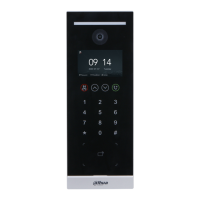
The VTO also incorporates a group call function, which, once enabled, allows for simultaneous calls to a main indoor monitor (VTH) and its extensions. This feature is particularly useful in residential or office environments where multiple indoor units need to be alerted. The device's internal components include a white illuminator for visibility, a microphone (MIC) for audio input, a camera for video capture, a display for visual feedback, a card swiping area for access control, a keyboard for input, a loudspeaker for audio output, and a fingerprint sensor for biometric authentication. A tamper button is also included, likely for security alerts if the device is interfered with. Function ports are available for connecting to external devices such as locks, access controllers, and alarm in/out devices, further expanding its integration capabilities.
The VTO65 Series is designed for straightforward configuration and operation, with both web-based and on-device settings. Initial setup involves planning IP addresses for each door station and indoor monitor, ensuring proper network connectivity. The web interface provides a graphical user interface for initializing the device, setting up an administrator password, and configuring network parameters like IP address, subnet mask, and gateway. The default IP address of the door station is 192.168.1.108, and it's crucial for the PC used for configuration to be within the same network segment.
When configuring the SIP server, users can select between the VTO itself or a management platform (Express/DSS). If the VTO acts as the SIP server, specific parameters such as IP address, port, username, and password need to be configured. The VTO number, which is unique to each door station, can also be modified, especially when the VTO is not functioning as a SIP server. For systems with indoor monitors (VTHs), these must be added to the door station's web interface to enable communication. This can be done individually or in batch, with specific guidelines for room numbers and extension numbering to support group call functions.
The engineering setting, accessible via a project password on the door station, offers advanced configuration options. This interface allows for detailed IP settings, general settings, user registration, device information, and image mode adjustments. The IP settings on the device itself allow for direct modification of IP address, subnet mask, and gateway.
User registration is a key usage feature, supporting multiple authentication methods. For face entry, users need to position their face correctly within the camera frame, ensuring clear visibility and adherence to specific guidelines regarding head position, distance, and facial expressions. The system automatically captures face images, with options to retake if necessary. Fingerprint registration, available on VTO 6541H models, requires users to press their finger onto the sensor multiple times, following voice prompts. Up to three fingerprints can be recorded per user. Card issuance allows for up to five cards per user, with automatic recognition of card numbers. The system supports both authorized cards and password-based card issuance, providing flexibility in access management.
The manual emphasizes several important safeguards and warnings to ensure the correct application and longevity of the device. Proper installation is critical, advising against placement in environments with condensation, high temperatures, direct sunlight, or dusty/corrosive conditions. Horizontal installation on stable surfaces is recommended to prevent falling. Users are cautioned against dripping or splashing liquids onto the device and should avoid placing liquid-filled objects on it. Adequate ventilation is necessary, and ventilation openings should not be blocked. The device should only be used within its rated input and output range, and arbitrary dismantling is strictly prohibited. The use of screened network cables is also specified.
Power requirements are clearly outlined, recommending the use of electric wires that comply with local specifications and meet SELV (safety extra low voltage) requirements. The power supply should conform to Limited Power Source in IEC60950-1, with specific details available on device labels. It is crucial not to cut off the power supply during device upgrades, as power can only be disconnected after the upgrade is complete and the device has rebooted.
Cybersecurity recommendations are provided to enhance the security of the VTO and the overall network. These include mandatory actions such as using strong passwords (at least 8 characters, including a mix of upper/lower case letters, numbers, and symbols, avoiding common patterns or personal information) and regularly updating firmware and client software. Users are encouraged to enable "auto-check for updates" and download the latest software versions from the manufacturer.
"Nice to have" recommendations for improved security include physical protection of the equipment, especially storage devices, by placing them in secure locations with access control. Regular password changes are advised to mitigate the risk of guessing or cracking. Setting up and timely updating password reset information, such as email addresses and security questions, is also recommended. Enabling the account lock feature, which is typically enabled by default, helps prevent unauthorized access by locking accounts after multiple failed login attempts.
Further security enhancements involve changing default HTTP and other service ports to non-standard numbers (between 1024~65535) to reduce the risk of external attacks. Enabling HTTPS is suggested for secure web service communication. Implementing a whitelist function to restrict access to specified IP addresses is also recommended, requiring users to add their computer's IP address and the equipment's IP address to the whitelist. MAC address binding is another feature to consider, linking the IP and MAC address of the gateway to the equipment to prevent ARP spoofing.
Assigning accounts and privileges reasonably, based on business and management requirements, helps limit access to only necessary functions. Disabling unnecessary services like SNMP, SMTP, or UPnP can reduce potential risks. If these services are required, using secure modes such as SNMP v3 with strong encryption, TLS for SMTP, SFTP for FTP, and WPA2-PSK for AP hotspots is advised. For sensitive audio and video data, enabling encrypted transmission is recommended, though it may slightly impact transmission efficiency.
Secure auditing practices include regularly checking online users for unauthorized logins and reviewing equipment logs to track IP addresses and key operations. For long-term log storage, enabling the network log function to synchronize critical logs to a network log server is suggested. Finally, constructing a safe network environment involves disabling router port mapping, partitioning and isolating networks using VLANs or network GAP technologies, and establishing an 802.1x access authentication system to prevent unauthorized access to private networks. These measures collectively contribute to a robust and secure operation of the Digital Door Station.
 General
| Model | VTO6531H |
|---|---|
| Video Compression | H.264 |
| Ingress Protection | IP65 |
| Display Screen | Yes |
| Screen Size | 4.3" |
| Camera | Yes |
| Night Vision | Yes |
| Audio Input | 1 |
| Audio Output | Yes |
| Audio | Two-way audio |
| Ethernet | Yes |
| Network Protocol | TCP/IP |
| Alarm Input | Yes |
| Alarm Output | 1 |
| RS485 | 1 |
| Door Control | 1 |
| Tamper Switch | 1 |
| Power Supply | DC 12V |
| Working Temperature | -30°C to 60°C |
| Working Humidity | 10% to 90% (non-condensing) |


 To Next Page