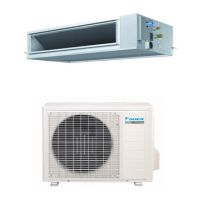
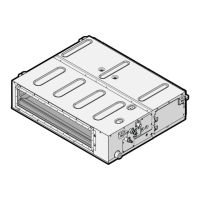
This document is an operation manual for Daikin Split System Air Conditioners, specifically for ceiling-mounted duct type models. It covers various aspects of the device, including safety precautions, operation procedures, characteristics, and maintenance.
Function Description
The Daikin Split System Air Conditioner (ceiling-mounted duct type) is designed for air conditioning in various settings such as shops, light industry, farms, and commercial use. It provides cooling, heating (for heat pump types), automatic operation, program dry, and fan operation modes. The system consists of an indoor unit and an outdoor unit, controlled by a remote controller, which can be wired or wireless. It supports individual control, group control (up to 16 indoor units with one remote controller), and two remote controllers control system (two remote controllers for one indoor unit or one group of indoor units).
Important Technical Specifications
The manual provides operation ranges for cooling and heating modes, specifying temperature and humidity conditions for both indoor and outdoor units.
Cooling Operation Range:
- Outdoor Unit Temperature: -5 to 50°C (Dry bulb temperature) for RZAS-B, RZA-B, RZAV-C, and RZF models. -5 to 46°C (Dry bulb temperature) for RZAC-C models.
- Indoor Unit Temperature: 21 to 32°C (Dry bulb temperature) and 14 to 25°C (Wet bulb temperature).
- Indoor Unit Humidity: 80% or below.
Heating Operation Range:
- Outdoor Unit Temperature: -15 to 21°C (Dry bulb temperature) for RZAS-B, RZA-B, RZAV-C, and RZAC-C models. -15 to 16°C (Wet bulb temperature) for RZAS-B, RZA-B, RZAV-C, and RZAC-C models.
- Indoor Unit Temperature: 15 to 27°C (Dry bulb temperature).
The appliance is filled with R32 refrigerant. The manual emphasizes the importance of using fuses with the correct ampere reading and advises against using improper substitutes. It also notes that the floor area required for installation refers to the installation manual of the outdoor unit.
Usage Features
The air conditioner offers several operational modes and features:
- Cooling Operation: Reduces indoor temperature. During low indoor temperatures, it may automatically switch to DEFROST OPERATION to prevent frost formation on the heat exchanger.
- Heating Operation: Increases indoor temperature. It generally takes longer to reach the set temperature compared to cooling. The system employs a warm air circulating system. The indoor fan may run at a gentle wind speed until the internal temperature reaches a certain level, indicated by " / " on the remote controller. Heating capacity decreases as outside air temperature falls, suggesting the use of supplementary heating systems if needed.
- Automatic Cooling/Heating Operation: Automatically adjusts operation based on temperature.
- Program Dry Operation: Lowers humidity without significantly reducing indoor temperature. Fan speed and temperature are set automatically in this mode. If the indoor temperature is low, it may switch to DEFROST OPERATION.
- Fan Operation: Circulates air without cooling or heating.
- TIMER OPERATION: Allows users to schedule operation, which is advisable for heating due to longer warm-up times.
- Automatic Restart: If the main power supply is turned off during operation, the unit will automatically restart when power is restored.
- Centralized Control: The unit can be part of a centralized control system, where operation may be managed externally.
Safety Precautions for Usage:
- Children aged 8 and above, and persons with reduced physical, sensory, or mental capabilities, or lack of experience, can use the appliance under supervision and instruction. Children should not play with the appliance.
- Cleaning and user maintenance should only be performed by persons described in the manual.
- The appliance is not intended for use by unattended young children or incompetent persons.
- Do not use means to accelerate defrosting or clean other than recommended.
- Store the appliance in a room without continuous ignition sources.
- Do not pierce or burn the unit.
- Be aware that refrigerants may not have an odor.
- Do not place burners or heaters in the airflow path.
- If malfunctioning (e.g., burning odor), turn off power and contact a dealer.
- Consult a dealer for modifications, repairs, and maintenance.
- Do not use improper fuses or wiring.
- If submerged due to natural disaster, do not operate.
- Start/stop with the remote controller, not the power circuit breaker.
- Avoid using in atmospheres contaminated with oil vapor, flammable sprays, organic solvents, excessive oily smoke, flammable/corrosive gas, or metal dust.
- Beware of refrigerant leakage; if suspected, turn off the unit and contact a dealer.
- Do not insert objects into air inlets or outlets.
- Consult a dealer for internal cleaning.
- Avoid prolonged, direct exposure to cool or warm air.
- Consult a dealer for installation work and accessory attachment.
- Do not remove the outdoor unit's outlet side grille.
- Do not touch air inlets or aluminum fins.
- Do not place moisture-susceptible objects directly beneath units.
- Do not place heaters directly below the indoor unit.
- Do not place appliances with naked flames in the airflow path.
- Do not block air inlets or outlets.
- Do not use for purposes other than air conditioning (e.g., cooling precision instruments, food, plants).
- Do not install where flammable gas leakage is possible.
- Ensure proper drain piping.
- Check unit stand and mounts after prolonged use.
- Do not sit or place objects on the outdoor unit.
- Ensure the remote controller is not exposed to direct sunlight.
- Do not wipe the controller panel with benzene or organic solvents.
- Do not operate remote controller buttons with hard, pointed objects.
- Do not pull or twist the remote controller cord.
- Do not operate when using room fumigation type insecticide.
- Exercise caution when working high above ground level.
- Do not operate with the control panel lid open.
Maintenance Features
The manual outlines maintenance procedures for both users and service personnel.
User Maintenance:
- Air Filter Cleaning: The remote controller will indicate " " or "Time to clean filter" after a certain running time (200 hours for normal contamination, 100 hours for more contaminated environments). Users should clean the air filter when prompted. If contamination is difficult to remove, the air filter should be replaced (optional accessory).
- Cleaning Air Outlet, Outside Panels, and Remote Controller: Clean with a soft cloth. For difficult stains, use water or neutral detergent.
- Long Stop Preparation: Turn on FAN OPERATION for half a day on a fine day to dry the indoor unit, then turn off the power circuit breaker. Clean the air filter and outside panel.
- Start-up After Long Stop: Check for blocked air inlets/outlets. Clean the air filter. Turn on the power circuit breaker at least 6 hours before operation to activate the air conditioner smoothly and protect it.
Service Personnel Maintenance (Qualified Service Person Only):
- Internal Cleaning: The inside of the air conditioner may become contaminated after several seasons, leading to performance degradation and water leakage. This requires a qualified service person.
- Air Filter Installation/Removal/Cleaning (Optional): If an optional air filter is used, a special contractor should be requested for cleaning. The long-life filter chamber (optional parts) should always be used.
- Troubleshooting: If issues arise that cannot be resolved by basic checks (e.g., fuse blown, circuit breaker tripped, water leakage, abnormal noises, error codes on remote controller), contact the local dealer.
General Maintenance Advice:
- Prevent direct sunlight during cooling.
- Keep doors and windows closed during operation.
- Do not place objects near air inlets/outlets.
- Set the airflow flap horizontally.
- Adjust room temperature appropriately to avoid excessive heating/cooling.
- Install TVs, radios, and stereos at least 1m away from the indoor unit and remote controller to prevent interference.
- Turn off the power circuit breaker when not in use for a long period to save energy.
- Use TIMER OPERATION effectively.


 To Next Page
 General