EasyManua.ls Logo

Daitsu MONOBLOC LOGIK I Series - User Manual

Daitsu MONOBLOC LOGIK I Series
30 pages
Print Icon
To Next Page IconTo Next Page
Loading...
MODBUS PROTOCOL
(V2.2)
MONOBLOC LOGIK
SERVICE MANUAL
USER MANUAL
Serie
UE MONOBLOC
LOGIK I - LOGIK II
Edition
03/24
Models
AOWD-MB LOGIK-14K- AOWD-MB LOGIK-14K2
AOWD-MB LOGIK-18K- AOWD-MB LOGIK-18K2
AOWD-MB LOGIK-28K- AOWD-MB LOGIK-28K2
AOWD-MB LOGIK-36K- AOWD-MB LOGIK-36K2
AOWD-MB LOGIK-40K- AOWD-MB LOGIK-40K2
AOWD-MB LOGIK-45K- AOWD-MB LOGIK-45K2
AOWD-MB LOGIK-54K- AOWD-MB LOGIK-54K2
AOWD-MB LOGIK-28TK- AOWD-MB LOGIK-28TK2
AOWD-MB LOGIK-36TK- AOWD-MB LOGIK-36TK2
AOWD-MB LOGIK-40TK- AOWD-MB LOGIK-40TK2
AOWD-MB LOGIK-45TK- AOWD-MB LOGIK-45TK2
AOWD-MB LOGIK-54TK- AOWD-MB LOGIK-54TK2
Question and Answer IconNeed help?

Do you have a question about the Daitsu MONOBLOC LOGIK I Series and is the answer not in the manual?

Overview

This document describes the Modbus Protocol (V2.2) for the AOWD-MB LOGIK Heat Pump Water Heater, providing a comprehensive guide for its integration into Building Management Systems (BMS). It covers communication formats, data structures, and operational guidelines for both monitoring and control.

Function Description:

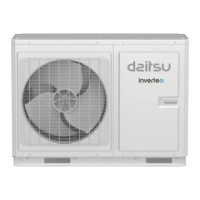
The Daitsu AOWD-MB LOGIK Heat Pump Water Heater is designed for efficient water heating and can be integrated into a BMS or Daitsu long-distance monitoring system via an RS485 Modbus communication interface. This integration allows for remote monitoring and control of up to 255 units simultaneously. The BMS system's control functions are equivalent to those of the long-distance monitoring system, with the most recently sent command taking priority. The protocol facilitates monitoring of various operational parameters such as running temperature, compressor status, and failure status. It also enables remote setting of operational modes, temperature, and on/off status.
Important Technical Specifications:

  • Communication Protocol: Modbus RTU (V2.2)
  • Communication Interface: RS485
  • Baud Rate: 9600 bit/s (other baud rates may be selected if compatible with the protocol)
  • Data Format:
    • Start Bit: 1
    • Data Bit: 8
    • Check Bit: None
    • Stop Bit: 1
  • Network Topology: Master-slave network, supporting up to 255 slave units per network. Multiple networks can be established for larger installations.
  • Function Codes Supported:
    • Read Multiple Coils (0x01)
    • Read Multiple Registers (0x03)
    • Write Multiple Coils (0x0F)
    • Write Multiple Registers (0x10)
  • Data Types: Coils (1-bit Boolean values for switches, failure bits, etc.) and Registers (2-byte, 16-bit words for temperature, mode, analog values).
  • Device Address Range: 1-255 (0 is reserved for broadcast).
  • CRC (Cyclic Redundancy Code): 2-byte code for error detection, calculated using a specific method involving preloading a 16-bit register with FFFF hex, exclusive ORing with message bytes, and shifting operations with a polynomial value of A001.

Usage Features:

  • Remote Monitoring: Users can monitor the running temperature, compressor status, and failure status of the heat pump water heater from a remote location.
  • Remote Control: The system allows for remote adjustment of temperature settings, running modes (Heat, Hot water, Cool+Heat water, Heat+Hot water, Cool), and on/off status.
  • Optional E-Heater Control: The protocol supports controlling optional electric heaters with settings for 1 set, 2 sets, or off.
  • Disinfection Function: Users can set a disinfection temperature (40-70°C) and monitor its status (Running, Done, Failed, Off).
  • Floor Debug Segments: Configuration of floor debug segments (1-10 sections) and their associated temperatures (25-35°C) and segment times (12-72 hours).
  • Quiet Mode: Activation of quiet mode with options for Off, One time, Timer, or Always ON.
  • 3-Way Valve Control: Control of a 3-way valve for directing flow to DHW or AIR.
  • Running Frequency Setting: Adjustment of running frequency for DHW, cool, and heat modes (65-85 Hz).
  • Hot Water Control Mode: On/Off control for hot water.
  • WiFi Control: On/Off control for WiFi functionality.
  • Start/Stop Delay: Configurable start and stop delays for room and water temperature control.
  • Power Limit: Setting a power limit for the compressor (0.1 kW resolution).
  • Error Reset: Functionality to clear faults.
  • Antistall Protection: WP antistall interval (1-12 hours) and duration (10-100 seconds) settings.
  • EH Power Settings: Configuration of EH Power 1 and EH Power 2 (0-3KW).
  • Tank Heater Power: Setting for tank heater power (0-3KW).
  • C/P Limit Value: Minimum C/P limit value (1-15%).
  • Unit Status Monitoring: Real-time monitoring of unit status (Cool, Heat, Hot water, Off).
  • Temperature Readings: Access to various temperature readings including T-outdoor, T-discharge, T-defrost, T-suction, T-economizer in/out, T-water out PE, T-optional water sensor, T-water in PE, T-tank ctrl., T-remote room, T-gas pipe, T-liquid pipe, T-floor debug, and T-weather depend.
  • Frequency and Water Flow: Monitoring of fan frequency and water flow.
  • Energy Consumption Monitoring: Detailed monthly energy consumption data (Jar, Feb, Mar, Apr, May, Jun, Jul, Aug, Sep, Oct, Nov, Dec) for both high and low readings, with a resolution of 0.01 kWh.
  • EXV Steps: Monitoring of EXV1 and EXV2 steps.
  • State Variables: Monitoring of various state variables such as Weekly Timer, Clock Timer, Temp Timer, Gate-Ctrl, Solar heater, Ctrl.state, Fast Hot Water, Cool+Hot Water Priority, Heat+Hot Water Priority, Weather depend, Disinfection, Floor Debug, Emergen. mode, Other thermal, Water Tank, Solar setting, Remote sensor, Holiday Mode, Refri. recovery, Manual defrost, Cool 2-Way valve, Heat 2-Way valve, Cool control mode, Heat control mode, HWPS Limit Function, LSWP enabled, Water pump antistall, Other Heat Source State, Flow Switch State, IDU E-heater 1/2 State, Water Tank Heater/Pump State, IDU Water Pump State, Circulating 2-way Valve State, Plate Heater State, 3-way Valve State, Compressor State, ODU Fan State, HP-Antifree, 4-way Valve State, Compressor Crankcase Heater State, Underpan Heater State, Defrosting State, Oil Return State.
  • Error Monitoring: Detection and reporting of various errors including Ambient Temp Sensor Error, Defrost Temp Sensor Error, Discharge Temp Sensor Error, Suction Temp Sensor Error, ODU Fan Error, High-Pressure Sensor Error, High/Low Pressure Protection, High Discharge Protection, Capacity DIP Setting Error, Communication Error between IDU and ODU, Economizer In/Out Sensor Error, System Recoverable/Irrecoverable Protection, Flow Switch Protection, Charging Circuit Error, AC Input Voltage Error, Drive Board Temp Sensor Error, AC Contactor Protection or Input Cross-zero Error, Temp Drift Protection, Sensor Connection Protection, Condenser Leaving/Entering Water Temp Sensor Error, E-heater Leaving Water Temp Sensor Error, Refrigerant Liquid/Vapor Line Temp Sensor Error, Water Tank Temp Sensor Error, Remote Room Temp Sensor Error, Jumper cap Error, E-heater Welding Protection, Water Heater Welding Protection, Water Flow Protection, IDU Recoverable/Irrecoverable Protection.

Maintenance Features:

  • CRC Calculation Method: The document provides a detailed, normative description of the CRC calculation method, including a C-language example, which is crucial for ensuring data integrity during communication. This allows for robust error detection in transmitted and received data.
  • Precautions for Use: Emphasizes the importance of using the proper adapter, reinforcing communication cord stability through soldering and insulation, and understanding that parameter modifications with memory function activate immediately but are memorized after 30 minutes.
  • BMS Address Setting: Clear instructions are provided for setting the BMS address of the controller via the device's interface, ensuring proper identification within the network.
  • Error Codes: A comprehensive list of alarm codes (e.g., Illegal data, Illegal address) and their descriptions is provided to aid in troubleshooting communication faults.
  • Conditional Settings: Specific guidelines are given regarding when certain settings (e.g., Mode, Cool, Hot water, Disinfection, Floor Debug) are effective, helping to prevent invalid operations and ensuring correct system behavior. For instance, mode changes are only effective when the unit is off, and certain hot water settings are ineffective if the water tank is unavailable.
  • Data Validation: The protocol defines valid data ranges and transmission values for various parameters, which helps in validating data sent to and received from the heat pump.

Daitsu MONOBLOC LOGIK I Series Specifications

General IconGeneral
BrandDaitsu
ModelMONOBLOC LOGIK I Series
CategoryHeat Pump
LanguageEnglish

Related product manuals