The Dataradio Viper Narrowband IP Modem/Router is a DSP-based radio designed for SCADA, telemetry, and industrial applications. It provides connectivity for any IP-enabled device to transmit narrowband data and supports serial and Ethernet/IP Remote Terminal Units (RTU) and programmable logic controllers (PLC). The Viper is standard IEEE 802.3 compliant and supports any protocol running over IPv4, including ICMP, IPinIP, IPSec, RSVP, TCP, and UDP protocols. It also provides MAC layer bridging, HTTP, ARP, and static routing packet forwarding.
Technical Specifications:
- Frequency Range: 136-174 MHz (VHF), 406.1-512 MHz (UHF), or 928-960 MHz (900 MHz).
- Frequency Stability: 1.0 ppm (VHF/UHF), 1.5 ppm (900 MHz).
- Channel Bandwidth: 6.25 kHz, 12.5 kHz, 25 kHz.
- Modes of Operation: Simplex, Half-Duplex.
- Frequency Increment: 1.25 kHz.
- Power Source: 10-30 VDC, Negative GND.
- RF Impedance: 50 Ω.
- Operating Temperature: -30°C to +60°C.
- Storage Temperature: -40°C to +85°C, 95% non-condensing RH.
- Operating Humidity: 5% to 95% non-condensing RH.
- Rx Current Drain at 25°C:
- DC Input 10V: 520 mA (max), 450 mA (typ)
- DC Input 20V: 270 mA (max), 240 mA (typ)
- DC Input 30V: 190 mA (max), 170 mA (typ)
- Tx Current Drain at 25°C (Max Pwr):
- DC Input 10V: 5.8 A (max), 3.6 A (typ)
- DC Input 20V: 2.5 A (max), 1.8 A (typ)
- DC Input 30V: 1.6 A (max), 1.2 A (typ)
- Tx Current Drain at 25°C (30 dBm/1W):
- DC Input 10V: 1.6 A (max), 1.2 A (typ)
- DC Input 20V: 0.8 A (max), 0.6 A (typ)
- DC Input 30V: 0.6 A (max), 0.4 A (typ)
- Cold Start: 20 seconds.
- Nominal Dimensions: 5.50" W x 2.125” H x 4.25" D (13.97 x 5.40 x 10.8 cm).
- Shipping Weight: 2.4 lbs. (1.1 Kg).
- Mounting Options: Mounting plate/pattern & DIN Rail.
- Fan Output: 5VDC, 400mA max.
- Carrier Output Power: 1-10 Watts Adjustable (VHF/UHF), 1-8 Watts Adjustable (900 MHz).
- Duty Cycle: 100% (Power Foldback Allowed for High Temperatures).
- Radiated Spurious Emissions: Per FCC/Regulatory.
- Conducted Spurious Emissions: <-65 dBc.
- Transmitter Stability into VSWR: > 10:1 (Power Foldback Allowed).
- RX to TX Time: < 2ms.
- Channel Switching Time: < 15 ms (Band-End to Band-End).
- Data Sensitivity @ 10⁻⁶ Bit Error Rate (BER) (Maximum):
- 25 kHz Channel (VHF/UHF): -111 dBm @ 16kb/s, -103 dBm @ 32kb/s
- 25 kHz Channel (900 MHz): -108 dBm @ 16kb/s, -101 dBm @ 32kb/s
- 12.5 KHz Channel (VHF/UHF): -114 dBm @ 8kb/s, -106 dBm @ 16kb/s
- 12.5 KHz Channel (900 MHz): -109 dBm @ 8kb/s, -103 dBm @ 16kb/s
- 6.25 kHz Channel (VHF/UHF): -112 dBm @ 4kb/s, -103 dBm @ 8kb/s
- Data Sensitivity @ 10⁻⁶ Bit Error Rate (BER) (Typical):
- 25 kHz Channel (VHF/UHF): -114 dBm @ 16kb/s, -106 dBm @ 32kb/s
- 25 kHz Channel (900 MHz): -111 dBm @ 16kb/s, -104 dBm @ 32kb/s
- 12.5 KHz Channel (VHF/UHF): -116 dBm @ 8kb/s, -109 dBm @ 16kb/s
- 12.5 KHz Channel (900 MHz): -112 dBm @ 8kb/s, -106 dBm @ 16kb/s
- 6.25 kHz Channel (VHF/UHF): -115 dBm @ 4kb/s, -106 dBm @ 8kb/s
- Adjacent Channel Rejection: > 75 dB (VHF/UHF 25 kHz), > 70 dB (900 MHz 25 kHz), > 60 dB (VHF/UHF 12.5 kHz), > 60 dB (900 MHz 12.5 kHz), > 45 dB (VHF/UHF 6.25 kHz).
- Spurious Response Rejection: > 75 dB.
- Intermodulation Rejection: > 75 dB.
- Receive Input Power: 17 dBm (50mW) max.
- Data Rate (Selectable): 16 kbps, 32 kbps (25 kHz), 8 kbps, 16 kbps (12.5 kHz), 4 kbps, 8 kbps (6.25 kHz).
- Modulation Type: 2FSK, 4FSK.
- Addressing: IP.
- Serial Setup Port Interface: EIA-232F DCE.
- Serial Setup Port Data Rate: 300 – 19,200 bps (Default: 19.2 Kbps).
- Com Port Data Rate: 300 – 115,200 bps (Default: 9.6 Kbps).
- Display: 5 Tri-color status LEDs (Power, Status, Activity, Link, Rx/Tx).
- Connectors: TNC female (Tx/Rx) Antenna Connector, DE-9F Serial Setup Port, DE-9F Serial Terminal Server, 10 BaseT auto-MDIX Ethernet RJ-45.
- Power I/O: DRL p/n 415-7108-113 (Weidmüller p/n 1615550000) 4 Pin, 3.5mm, Power Header; DRL p/n 897-5008-010 (Weidmüller p/n 1639260000) 4 Pin, 3.5mm, Power Plug. Cable: 60 inches. Connections: Fan Output, Ground, Power, Enable.
- Diagnostics Message Elements: Temperature, Voltage, Local RSSI, Remote RSSI, Forward Power, Reverse Power, Packet Error Rate.
- Encryption: AES 128-bit data encryption (Applies to Serial and IP connections).
- Data Compression: Superior data compression (zlib compression algorithm applies to Serial and IP connections).
Usage Features:
- Rugged Packaging: Housed in a compact and rugged cast aluminum case, suitable for industrial applications and extended temperature ranges.
- Simple Installation: Typically uses an omni-directional antenna at the master station or Relay Point and a directional antenna at each remote site. Basic setup involves connecting an antenna, Ethernet LAN to the Viper’s LAN port, applying primary power, and configuring operating parameters via a web browser.
- Flexible Management: Configuration, commissioning, maintenance, and troubleshooting can be done locally or remotely via a web browser. No physical switches or adjustments are required.
- Long Range: Narrowband configurations provide better coverage over harsh terrain.
- Access Point/End Point: Configurable in Bridge mode for quick setup on the same network or Router mode for advanced networks.
- Embedded Web Server: Provides access to status and setup information.
- Remote Firmware Upgrades: System firmware can be upgraded over-the-air.
- Online and Offline Diagnostics: Offers comprehensive diagnostic capabilities.
- Multiple Channels: Supports up to 32 different frequency channel pairs.
- IP Forwarding Modes:
- Bridge Mode: Simpler setup, all devices on the same IP subnet, transparent to the network. Ethernet messages are sent as broadcast messages over the air.
- Router Mode: Provides network configuration flexibility and RF diagnostics. Allows greater flexibility with different protocols and enables advanced IP configuration settings like Network Address Translation (NAT). Each Viper has unique Ethernet and RF IP addresses.
- Relay Point Feature: Allows a unit to relay data between RF coverage areas, extending system coverage over multiple hops.
- Collision Avoidance: Features RF collision avoidance technology (checks airwave for carrier before transmitting) and Ethernet CSMA.
- Listen Before Transmit: Allows the radio to monitor the RF channel for activity before transmitting, ensuring data has the best chance of reaching its destination.
- IP Services: Supports RIPv2 (dynamic IP routing), IPSD (I/P Services Delivery for online diagnostics), and NAT (Network Address Translation).
- IP Addressing Schemes: Provides guidance on choosing appropriate IP addresses and subnet masks for Bridge and Router modes, including examples.
- Serial Port Configuration: Two serial ports (SETUP and COM) can be configured for various services, including CLI, Serial/RF Bridge (DOX or RTS/CTS mode), Online Diagnostics, or Custom. Supports TCP and UDP transport protocols.
- Security: Password control, access control tables, and AES 128-bit encryption for data passing through Ethernet and serial ports.
- Neighbor Management: A powerful module to detect units in the RF network and add necessary IP routes. Operates in Router mode with Manual-Scan, Auto-Scan, or Disabled modes.
Maintenance Features:
- Unit Status: Displays general and diagnostic information, including software revision, station name, local time, IP forwarding mode, relay point status, and unit status (errors).
- Local Diagnostics: Provides detailed information such as date and time, time since reset, modem and radio firmware versions, RSSI from RF-MAC, DC input voltage, TX/RX frequency, transmit power level, transceiver temperature, PA forward/reverse power, and power state.
- Online Diagnostics: Can be enabled to transmit diagnostic data from the Viper, including MAC addresses, IP addresses, temperature, supply voltage, forward/reverse power, and packet error rate.
- Ping Test: A network tool to test host reachability on the IP network, measuring round trip time and packet loss.
- Unit Configuration Control: Allows users to create checkpoints of configurable settings, export configurations to a PC, and restore user configurations.
- Package Control: Verifies successful firmware upgrades and reports any missing or corrupt files.
- Net Tests: Allows users to test the reliability of the RF link by transmitting test packets and viewing statistics on the receiving Viper, including RSSI.
- RF Tests: Provides options to transmit unmodulated, random data, or 1 KHz sine wave test tones for 20 seconds.
- Firmware Upgrade: Field-upgradeable via the Ethernet port using FTP for modem firmware and CLI for radio firmware.
- Alarm Reporting: Can be enabled to send SNMP traps for forward power, reverse power, and PA power alarms.

 Need help?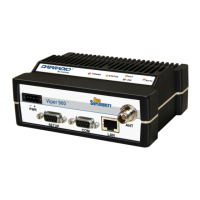

 To Next Page
 General