EasyManua.ls Logo

Datron 1062 - Page 25

Default Icon
202 pages
Print Icon
To Next Page IconTo Next Page
To Previous Page IconTo Previous Page
Loading...
17
Secondly, the latches of the
D
-
A converter
(M13, M14)
are
set up with the input
bias current (lb)
compensation
data. The
ID lines
are set to the appropriate
pattern
and the
information
is clocked
on to M13
and M14 by a delayed
low
to high edge from
Ml
7-4, originating from
I
A0
going
low. The
delay makes sure
that the signal from
Ml
7-10
has
disabled
the
"F.E.T."
latch
M21.
Once again,
the
IA0
line
returns
to the resting state of
logic
'1'.
Thirdly,
the DC
analog circuits
are enabled
by setting all the
ID lines
high
except for
IDO, then
clocking
M20 by a low
to high
edge
from
Ml
6-6
caused
by both I
A lines
going low.
Once
DC has been
selected, the F.E.T.
pattern
latch is
enabled
from
M12-1,
and the penultimate
step
is to load
this
latch
with
1000V range
data
from
the
ID lines (ID4
low,
the rest
high). This is
executed
by clocking
the
'F.E.T.'
latch
from Ml
7-4
once again,
but this time
being
due
to
IA1
going low.
The final
step is
to reselect
DC as described
above.
3. 2.1. 3 General
Interface
Update Sequence
Before
the start of
each reading, the
analog interface
undergoes
a complete
update. The series of
events is
the
same
as
the
power-up
sequence for selection
of function
and
range, as can
be seen by comparing
the two flowcharts
(Figs.
3.3 and
3.5). When
Ohms or Current is
selected,
the
DC Isolator
or AC assembly
is also used
in the
measure-
ment procedure
as seen in the following
table.
^
Type of
Measurement
Circuits Selected
Use of D
-
A
DC Volts Analog
Assembly Input
Bias Current
Compensation
AC Volts
AC
Assembly
Frequency
Compensation
AC
-H
DC Volts
AC Assembly Frequency
Compensation
Resistance
Ohms Assembly
and
Analog
Assembly
Input Bias
Current
Compensation
DC Current
Current
Assembly
and
Analog
Assembly
Input
Bias Current
Compensation
AC Current
Current
Assembly
and AC
Assembly
Frequency
Compensation
AC
-1-
DC Current
Current
Assembly
and
AC
Assembly
Frequency
Compensation
The update
sequence
order
is (i)
Deselect
all
assemblies,
(ii)
Load D
-
A latches,
(iii)
Select
AC
assembly
or DC
Isolator,
(iv)
Load range
pattern
into
DC
or
AC range
latches,
(v)
Deselect
DC
or
AC
and
select
either
the
Ohms
or
Current
assembly,
(vi)
Load range
pattern
into
f2's
or
I
range
latches,
(vii)
Reselect
circuits
selected
in
(iii)
and
(iv).
Note:
Steps
(v)
and
(vi)
are
used only
when
I
or 12 is
selected.
/
\
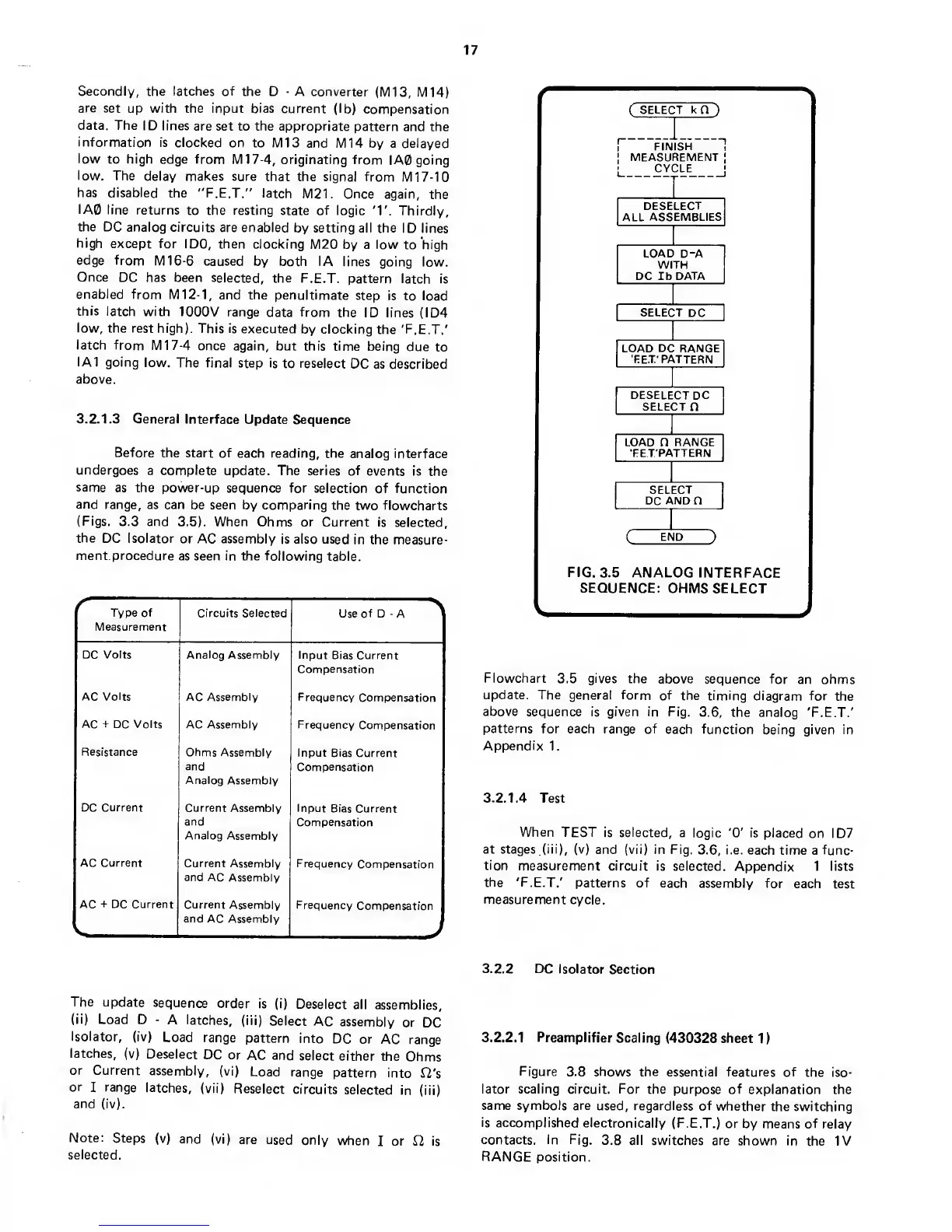
FIG.
3.5 ANALOG
INTERFACE
SEQUENCE:
OHMS SELECT
Flowchart
3.5
gives
the
above sequence for
an ohms
update. The general form
of
the
timing
diagram
for
the
above
sequence is given in Fig.
3.6,
the analog 'F.E.T.'
patterns for each range
of
each function
being given in
Appendix
1.
3.2.
1.4 Test
When
TEST is selected,
a logic
'0'
is placed
on
ID7
at stages (iii), (v)
and (vii) in Fig.
3.6,
i.e. each
time a func-
tion
measurement circuit
is
selected.
Appendix
1 lists
the 'F.E.T.'
patterns of each
assembly for
each test
measurement cycle.
3.2.2 DC
Isolator
Section
3.2.2.1 Preamplifier
Scaling
(430328
sheet
1
)
Figure
3.8 shows the
essential features of
the iso-
lator scaling circuit. For
the purpose of
explanation the
same symbols are
used, regardless of
whether
the switching
is accomplished
electronically
(F.E.T.)
or by means of
relay
contacts.
In
Fig.
3.8 all
switches are
shown in
the IV
RANGE
position.