EasyManua.ls Logo

Datron 1062 - Page 40

Default Icon
202 pages
Print Icon
To Next Page IconTo Next Page
To Previous Page IconTo Previous Page
Loading...
A29
The
buffer output
voltage
(3.12V
full range)
is
developed across
R52-R56
and R70,
referred to
Output
Common at M4
input.
Log-feedback
stage
M4/IV13
closes
the 'Square-Root'
loop,
providing
feedback
current
for the
RMS computation
in Ml
1
.
When
the AC,
or
DC-coupled
AC
option
is selected,
Q3
connects
the
buffer
output
to
the
Analog-to-Digital
converter.
Test
links
TLC, D,
E and
F are
selectively
removed at
manufacture
to set
the
correct
output
level.
A3.3.4
High Frequency
Compensation
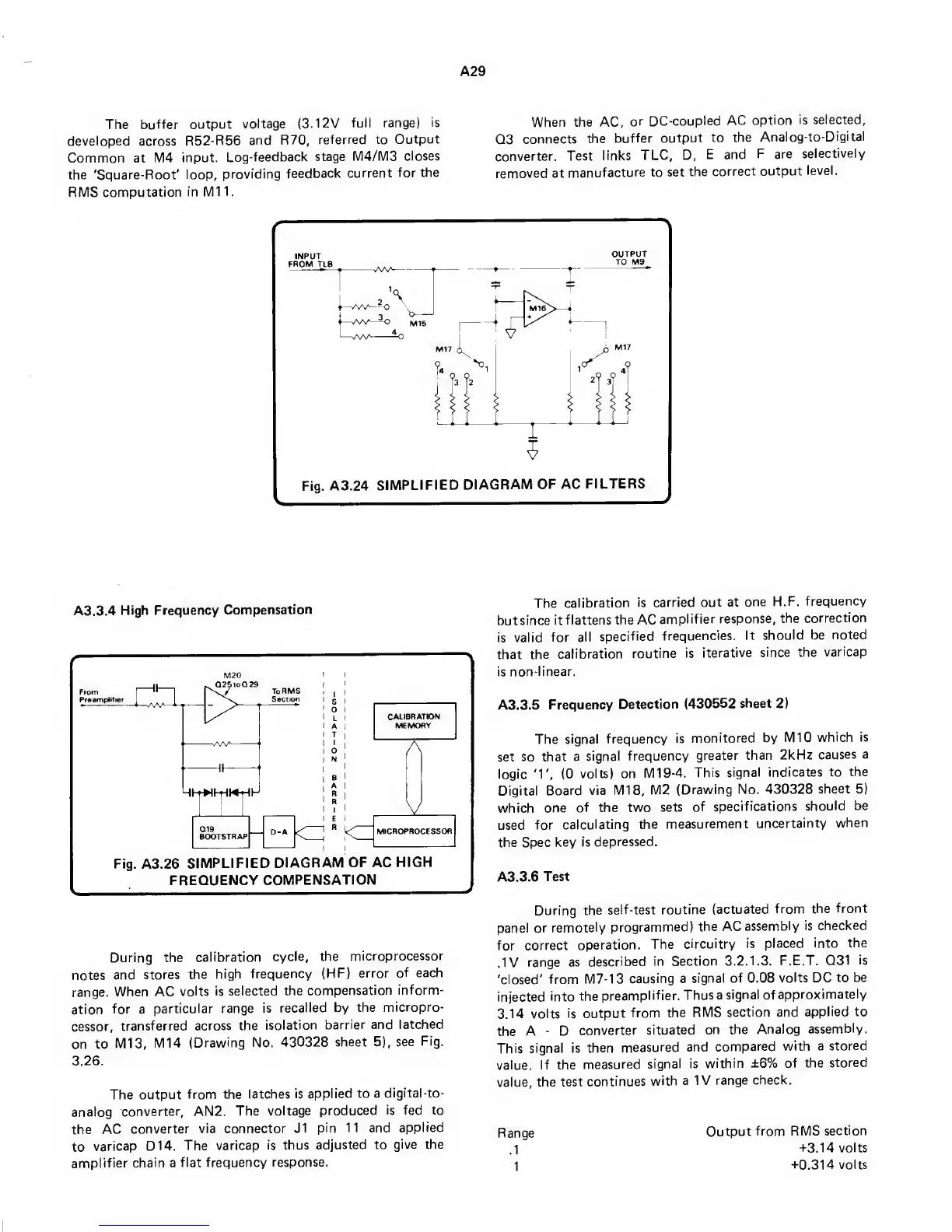
During the
calibration
cycle, the
microprocessor
notes
and
stores
the
high
frequency
(HF) error
of each
range.
When AC
volts
is selected
the
compensation
inform-
ation
for a
particular
range
is
recalled by
the
micropro-
cessor,
transferred
across the
isolation
barrier and
latched
on to
Ml
3,
M14
(Drawing No.
430328
sheet
5),
see
Fig.
3.26.
The output
from the
latches
is applied to a
digital-to-
analog
converter,
AN2.
The
voltage
produced
is fed to
the
AC
converter
via connector
J1
pin 11 and
applied
to
varicap D14.
The varicap
is thus
adjusted to
give the
amplifier
chain a flat
frequency
response.
The
calibration
is carried
out at
one
H.F.
frequency
but
since
it flattens
the AC
amplifier
response,
the
correction
is
valid
for all
specified
frequencies.
It
should be
noted
that
the
calibration
routine
is
iterative
since the
varicap
is non-linear.
A3.3. 5
Frequency
Detection
(430552
sheet
2)
The
signal
frequency
is
monitored
by M10
which is
set so
that a
signal
frequency
greater
than 2kHz
causes a
logic
'1',
(0
volts)
on M19-4.
This signal
indicates to
the
Digital
Board via Ml
8,
M2
(Drawing
No. 430328
sheet
5)
which one
of the
two
sets
of
specifications
should
be
used
for
calculating
the
measurement
uncertainty
when
the Spec
key is
depressed.
A3.3.6
Test
During
the
self-test
routine
(actuated
from
the
front
panel or
remotely
programmed)
the AC
assembly
is
checked
for
correct
operation.
The
circuitry
is placed
into the
.IV
range
as
described
in
Section 3. 2. 1.3.
F.E.T.
Q31
is
'closed'
from M7-13
causing a
signal
of
0.08
volts DC
to be
injected
into the
preamplifier.
Thus a
signal
of
approximately
3.14
volts is
output
from
the RMS
section and
applied to
the
A
-
D
converter
situated
on the
Analog
assembly.
This
signal
is then
measured
and
compared
with a
stored
value. If the
measured
signal
is within
±6% of the
stored
value, the
test
continues
with a IV
range check.
Range
Output
from RMS
section
.1
+3.14
volts
1
+0.314 volts