EasyManua.ls Logo

Datron 1062 - Page 41

Default Icon
202 pages
Print Icon
To Next Page IconTo Next Page
To Previous Page IconTo Previous Page
Loading...
30
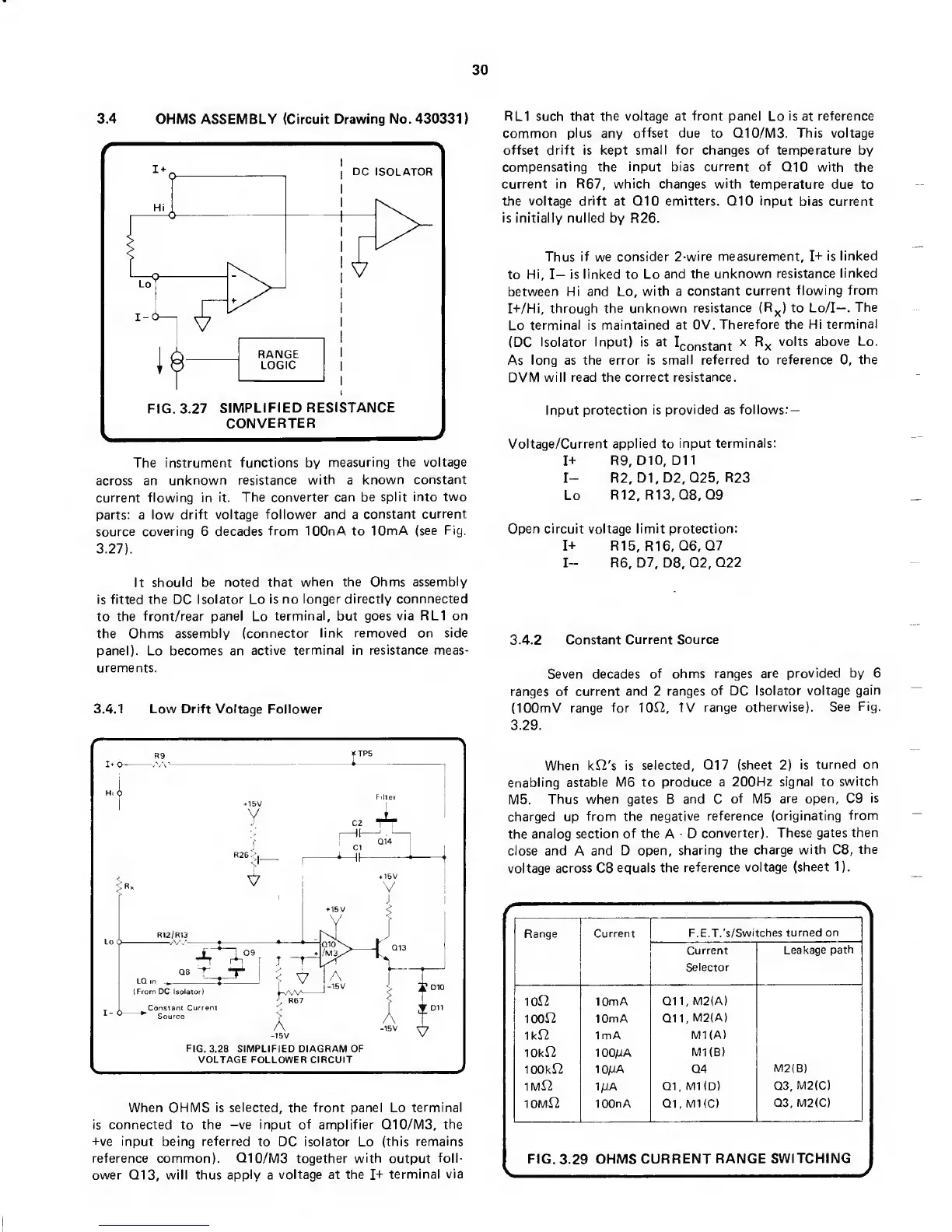
The instrument functions by
measuring the voltage
across an
unknown resistance
with
a
known
constant
current flowing in
it. The converter
can be split into
two
parts: a low
drift voltage follower
and
a
constant
current
source
covering 6 decades
from lOOnA to
10mA (see
Fig.
3.27).
It
should be noted that
when the Ohms
assembly
is fitted the DC
Isolator
Lo
is
no
longer directly connnected
to the
front/rear panel
Lo
terminal,
but
goes via RL1 on
the Ohms
assembly (connector
link removed on side
panel). Lo
becomes
an
active
terminal in resistance meas-
urements.
3.4.1 Low Drift Voltage
Follower
When OHMS
is selected,
the
front panel
Lo
terminal
is connected to the -ve
input
of amplifier Q10/M3,
the
-tve
input
being
referred
to DC isolator
Lo
(this remains
reference common).
Q10/M3
together with output
foll-
ower
013,
will thus
apply
a
voltage at the
I-i- terminal
via
RL1 such that
the voltage at
front
panel
Lo
is
at
reference
common plus any offset due to Q10/M3. This voltage
offset drift is kept
small for
changes
of
temperature by
compensating the
input bias current of
Q10 with
the
current in R67,
which
changes
with
temperature
due to
the voltage drift at 01 0
emitters.
Q10 input bias
current
is
initially nulled by
R26.
Thus if we consider
2-wire measurement,
I-i- is linked
to
Hi,
I-
is linked to Lo
and the
unknown
resistance linked
between Hi and
Lo, with a
constant current
flowing from
I-t/Hi, through
the unknown
resistance (R^) to Lo/I—.
The
Lo
terminal is
maintained at OV,
Therefore the Hi
terminal
(DC
Isolator Input) is at
Iconstant
^
above Lo.
As
long as the error
is small referred
to
reference
0,
the
DVM
will read the correct
resistance.
Input
protection is
provided as follows:-
Voltage/Current
applied
to
input terminals:
1+
R9,
DIO, Dll
I- R2,
D1,D2,Q25, R23
Lo R12,
R13,
Q8,
Q9
Open
circuit
voltage
limit protection;
I-t
R15, R16,
Q6,
07
I- R6, D7, D8,
02,
022
3.4.2 Constant
Current Source
Seven decades
of ohms ranges
are
provided by 6
ranges
of current and 2 ranges
of DC
Isolator voltage
gain
(lOOmV
range for
10J7, IV
range otherwise).
See
Fig.
3.29.
When kf2's
is selected, 017
(sheet
2)
is
turned on
enabling
astable M6 to
produce a
200Hz signal to
switch
M5.
Thus when gates B
and
C
of
M5
are open, C9
is
charged up
from the
negative reference
(originating
from
the
analog
section of the A
-
D converter).
These
gates
then
close and A
and D open,
sharing the
charge
with
C8,
the
voltage
across
C8
equals the
reference voltage
(sheet
1
).
^
1
Range
Current
F.E.T.'s/Switches
turned
on
Current
Selector
Leakage
path
i
10^2
lOOfi
1kf2
10kf2
lOOkTi
liviiT
lOMiT
10mA
10mA
1 mA
100/HA
10A1A
lOOnA
Q11,
M2(A)
Q11,
M2(A)
MKA)
MKB)
Q4
Q1,
Ml
(D)
Q1,
MKC)
M2(B)
Q3,
M2(C)
Q3,
M2(C)
^
FIG.
3.29
OHMS
CURRENT
RANGE SWITCHING
j