EasyManua.ls Logo

Datron 1062 - Page 44

Default Icon
202 pages
Print Icon
To Next Page IconTo Next Page
To Previous Page IconTo Previous Page
Loading...
33
3.6.4
Test
3.8.1
Processor
and Memory (430329
sheet
1
)
When
TEST is selected,
the ratio option is
checked to
see if it
is
fitted,
by interrogating
the
AD4
line
to see if
it is
held
high.
3.7
ANALOG OUTPUT
(Circuit Drawing
No.
430308)
3.7.1
General
The
Analog
Output Board accepts
the DC Isolator or
AC
Converter
Output and converts it
to
a
±1
volt
DC full
range
output. This signal
can then be
used, for
example,
to
drive X-Y
plotters or
strip chart recorders.
A 6800 microprocessor (MPU) together with 16k
bytes
of memory controls
the
communication
between the
front panel, digital interface,
display
drivers. Digital
and
analog assemblies. The
memory can be split into five
main areas:
(1)
Program Memory
-
needed to operate
the
whole
instrument
system.
(2)
Constant
Data
e.g. Self Test limits.
Memory
Error read-out
specific-
ations
and
other
fixed
factors.
3.7.2
Description
The
3.16V
full
range signal from
the DC Isolator
or
AC
Converter is buffered
by
unity gain
amplifier
M2. The
output
is
potentially
divided
by R7 and R8
so that 1 volt
full
range is
presented
to Ml, another unity
gain amplifier.
Potentiometer
R5
is
adjusted
to remove any offset
caused
by
Ml and M2. Positive
temperature coefficient
thermis-
tors
R3,
R4
and diodes
D1, D2,
protect the Analog
Output
circuitry from
accidental input applied
to
the Analog
Output external
connector.
3.8
DIGITAL
ASSEMBLY
(Circuit Drawing
No. 430329)
(3)
Non-volatile
Calibration
Memory
(4)
Operating Memory
(5)
Volatile Display
Memory
used to
store all the
calibration
errors used
for each reading
and
determined during
the
'Auto-cal' cycle.
used for scratch pad
operations and
storing.
volatile data such as
Max-Min stores. Limit
stores and computation
stores.
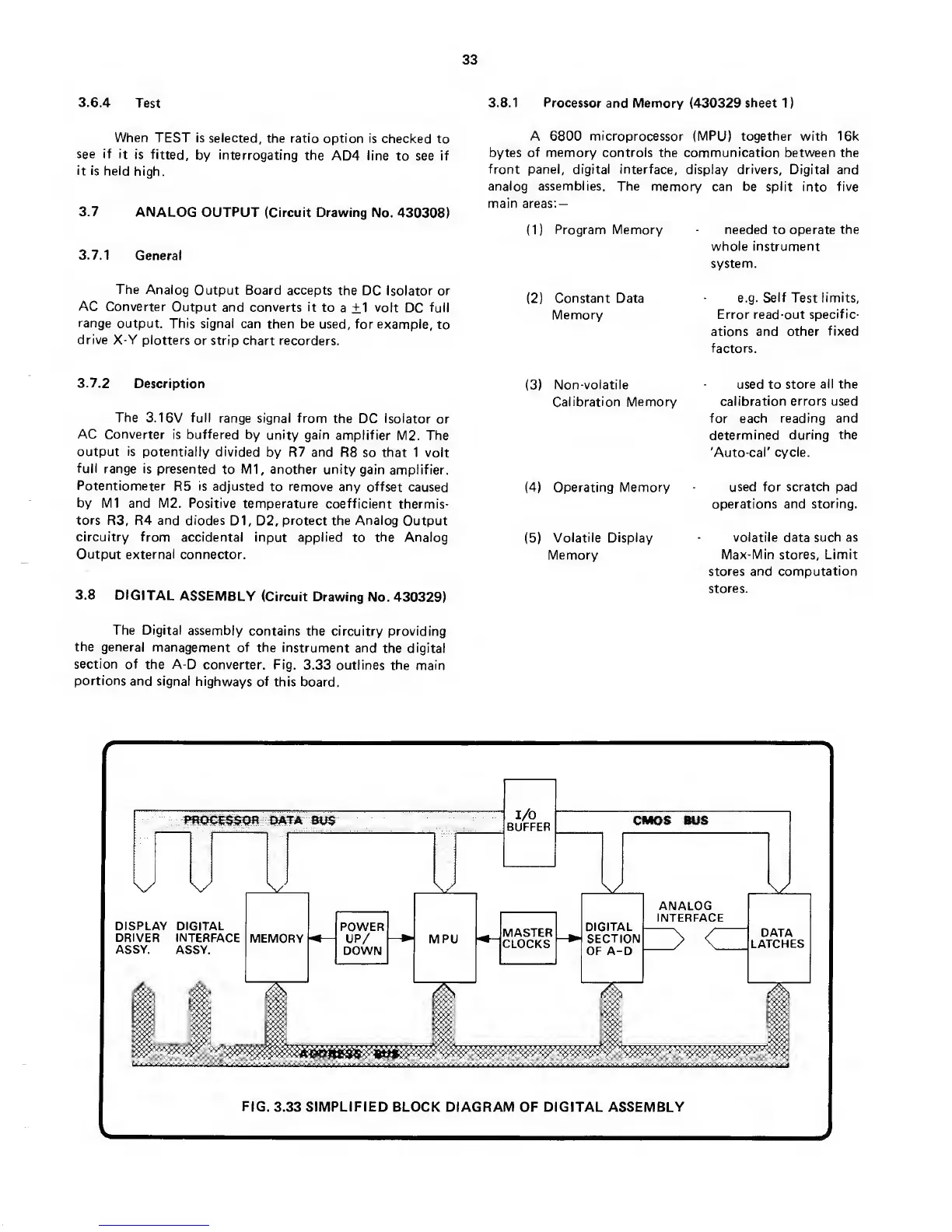
The Digital
assembly
contains the circuitry
providing
the general
management
of the instrument
and
the
digital
section
of
the A-D converter.
Fig.
3.33 outlines the main
portions
and signal
highways
of this board.
FIG.
3.33
SIMPLIFIED
BLOCK DIAGRAM OF DIGITAL ASSEMBLY