EasyManua.ls Logo

DayTronic 5M78 - User Manual

DayTronic 5M78
16 pages
Print Icon
To Next Page IconTo Next Page
Loading...
The Model 5M78 is a single-channel conditioner of phase-sensitive carrier-amplifier
design. Intended for applications involving transformer-coupling to the transducer
bridge (as with rotary-transformer torque sensors), this conditioner can also be used in
conventional installations when high sensitivity is required or where the electrical
environment is especially noisy. Responding only to the modulated carrier frequency,
the 5M78 rejects extraneous voltages that can cause errors in DC systems,
particularly when there is a need to “blow up” a portion of the transducer range.
User-adjustable phase and symmetry controls are provided.
calibration resistor is 59 kilohms, 1% which is located internally to the 5M78 case.
1 GENERAL DESCRIPTION AND SPECIFICATIONS
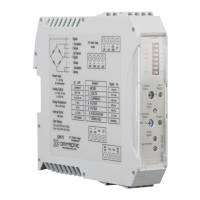
Model 5M78 AC Strain Gage Module
Access switch settings via the front
panel of the 5M78 by gently pulling the
clear plastic cover (from the bottom
side) so the cover rotates open from
DIN AC Strain Gage Conditioner
MODEL 5M78
AC Strain Gage
C
ONDITIONER Module
5M78
1.A.1.5M78
GENERAL DESCRIPTION AND SPECIFICATIONS 5M78.1
or without power to the unit. Once
completed, return the cover to the
View of Side Label of the Model 5M78 AC Strain Gage Module
the top. Use a small tool or finger to
place the switches to the left or right
position as you face the front of the
module. This process can be done with
original position.
AC Strain Gage Phase Operation
to the conditioner's demodulator. When
the demodulator is aligned properly through
calibration, maximum amplitude and
accuracy are achieved.
The Model 5M78's is calibrated by means of a “two-point (dead-weight)” or
shunt-calibration technique, which are outlined in section three. The supplied shunt
92342.00
Question and Answer IconNeed help?

Do you have a question about the DayTronic 5M78 and is the answer not in the manual?

Overview

The Daytronic Model 5M78 is a single-channel AC Strain Gage Conditioner Module designed for precise measurement in demanding environments. Its core function is to condition signals from phase-sensitive carrier-amplifier designs, making it particularly suitable for applications involving transformer-coupling to transducer bridges, such as rotary-transformer torque sensors. Beyond these specialized uses, it excels in conventional installations where high sensitivity is paramount or where the electrical environment is prone to noise.

Function Description:

The 5M78 operates by responding exclusively to the modulated carrier frequency, effectively rejecting extraneous voltages that can introduce errors in DC systems. This capability is crucial when there's a need to "blow up" a specific portion of the transducer's range, allowing for enhanced resolution and accuracy. The module features user-adjustable phase and symmetry controls, enabling fine-tuning for optimal performance with various transducers and setups. Calibration of the 5M78 can be performed using either a "two-point (dead-weight)" method or a shunt-calibration technique. An internal 59 kilohm, 1% shunt calibration resistor is provided for convenience.

Important Technical Specifications:

  • Measurement Range: Adjustable from 0.5 mV/V to 5.0 mV/V, nominal full-scale.
  • Transducer Types: Compatible with conventional 4-arm strain gage bridges, typically transformer-coupled, with resistances ranging from 120 to 10 k ohms.
  • Excitation: Nominal 2.77 Vac rms at 3.28 kHz, sensed.
  • Power Supply: 11-28 Vdc, regulated; 100 mA maximum.
  • Analog Output: Selectable options include ±0 to 5 Vdc, ±0 to 10 Vdc, 4-12-20 mA, or 4-20 mA (with 20% over-range for voltage outputs only).
  • Operating Temperature: -10 to +70 degrees C, with 5 to 95% relative humidity (non-condensing).
  • Amplifier Normal-Mode Range: ±1.5 V rms operating; ±8 V without instrument damage.
  • Input Impedance: Differential > 10 MΩ.
  • Offset:
    • Vs. Temperature: ±30 ppm/°C.
    • Vs. Time: ±10 ppm/month.
  • Gain Accuracy: Limited only by calibration accuracy.
  • Gain Stability:
    • Vs. Temperature: ±30 ppm/°C.
    • Vs. Time: ±10 ppm/month.
  • Linearity: Better than ±0.03% of full scale.
  • Filter: 3-pole modified Butterworth; 3 dB down at selectable frequencies of 10 Hz, 100 Hz, or 650 Hz.
  • Step-Response Settling Time (Full-Scale Output @ 10 Hz):
    • To 1% of final value: 0.08 sec (0.008 sec @ 100 Hz) (0.0011 sec @ 650 Hz).
    • To 0.1% of final value: 0.095 sec (0.0095 sec @ 100 Hz) (0.0016 sec @ 650 Hz).
    • To 0.02% of final value: 0.10 sec (0.01 sec @ 100 Hz) (0.0014 sec @ 650 Hz).
  • Dimensions: Housing height [A]: 114.5 mm, Housing depth [B]: 99 mm, Housing width [C]: 22.5 mm.

Usage Features:

  • Front Panel Access: Switch settings are accessible via the front panel by gently pulling open the clear plastic cover. Switches can be adjusted with a small tool or finger, even with power applied.
  • Calibration Procedures: The manual outlines detailed steps for calibration, including initial power-up, warm-up, setting zero and span controls, and adjusting the PHASE control for maximum output.
  • Shunt Calibration: The 5M78 supports shunt calibration, either using its internal 59 kΩ resistor or an external one. The manual provides guidance on calculating equivalent input values for shunt calibration, especially when dead-weight calibration is impractical.
  • Symmetry Adjustment: A symmetry control is provided to compensate for transducers with asymmetrical sensitivity characteristics, allowing for precise adjustment of negative output span to match positive output span.
  • Master/Slave Connections: In setups involving multiple 5M78 units, one unit can be designated as a "master" to drive the excitation clock, preventing beat frequencies that might arise from independent oscillators. Other units are configured as "slaves" and wired accordingly.
  • Remote Calibration Check: The instrument can be placed in calibration mode (positive or negative) by shorting specific terminals on the lower I/O connector, offering a convenient method for periodic calibration monitoring.
  • I/O Connections: Connections are made via non-removable screw terminals that accept wire sizes from AWG 12 to 26. Recommended cabling is eight-wire, individually shielded, twisted pair.
  • Zero Adjustment: Switch 7 ("Zero Adj") allows selection between normal (approximately 25% zero authority) and extended (100% zero offset control) ranges, providing flexibility for different preloading conditions.
  • Phase Adjustment: The PHASE control aligns the transducer's return output signal to the conditioner's demodulator, crucial for achieving maximum amplitude and accuracy with AC modulated signals.

Maintenance Features:

  • Troubleshooting Guide: The manual includes a section for verifying normal operation and troubleshooting common issues, such as power-up failures or inability to balance correctly.
  • Shunt Resistor Replacement: Instructions are provided for replacing the internal 59 kΩ shunt resistor, which involves removing the housing and unsoldering/resoldering the resistor.
  • Shunt Reference Adjustment: The internal shunt resistor can be referenced from +Signal to either +Sense (SHP) or -Sense (SHN). Provisions are made to reference Common instead of +Signal for specific sensor types, requiring a solder bridge modification.
  • Cable Inspection: Users are advised to inspect all cables for breaks or cracks in the insulation before each use and replace defective cables immediately to ensure safety and proper operation.
  • Factory Service: In case of malfunction requiring repair, users are directed to contact the factory Service Department or a local Daytronic Representative.
  • Warranty: Daytronic Corporation warrants its products to be free from defects in material and workmanship under normal use, with repair or replacement as the primary remedy. Damage due to customer negligence or misuse is excluded from warranty.

DayTronic 5M78 Specifications

General IconGeneral
BrandDayTronic
Model5M78
CategoryControl Unit
LanguageEnglish