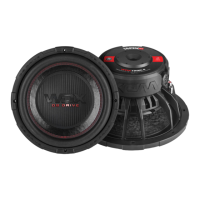
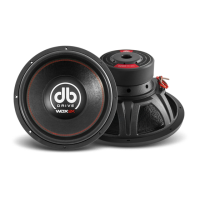
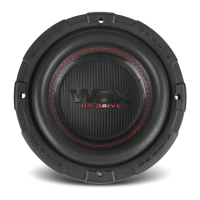
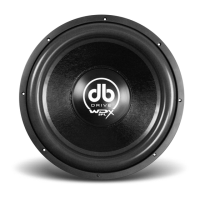
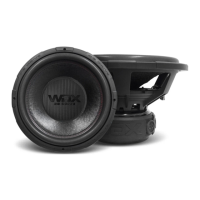
This document provides installation instructions and an owner's manual for DB Drive WDX series subwoofers, specifically models WDX12G3.4 and WDX15G3.4.
Function Description
The DB Drive WDX series subwoofers are state-of-the-art car audio products designed to deliver high-quality musical reproduction and enhanced bass performance. They are intended for integration into existing car audio systems or as part of a new system. The subwoofers are engineered to provide optimal product and performance for musical enjoyment, with a focus on delivering immediate performance benefits upon installation. Proper installation is crucial to maximize the system's overall performance, and it is recommended to have the product installed by an authorized DB Drive retailer. For those who choose to install it themselves, the manual emphasizes careful reading and a quality installation process. To achieve maximum performance from a stereo system, the use of 100% authentic DB Drive electronics and DB LINK wiring and accessories is recommended. Matching DB Drive amplifiers and speakers with the electronics is critical for optimizing system performance, as adequate current and signal transfer are vital for audio systems. DB LINK offers a comprehensive range of wiring and accessories, including wiring rolls, speaker, power, ground, and remote cables, amplifier kits, RCAs, fuse holders, distribution blocks, and battery connectors.
Important Technical Specifications
The WDX series subwoofers feature a robust construction designed for durability and high performance. Key product features include:
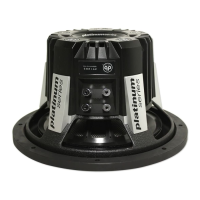
- Protective magnet cover: Shields the magnet assembly from damage.
- Large gauge compression terminals: Ensure secure and efficient electrical connections.
- Rubber gasket trim ring: Provides a seal and a clean aesthetic finish.
- Die-cast aluminum vented basket: Offers structural rigidity and aids in heat dissipation.
- Dual poly-cotton dampeners: Contribute to controlled cone movement and durability.
- Double stitched foam surround: Enhances cone excursion and longevity.
- Non-Pressed paper cone: A lightweight and rigid material for accurate sound reproduction.
- High temperature voice coil: Designed to withstand high power levels without overheating.
Model-Specific Specifications:
| Feature |
WDX12G3.4 |
WDX15G3.4 |
| Structure |
12" (30.48cm) |
15" (38.1cm) |
| Max Power |
4000 Watts |
4000 Watts |
| Nominal Power |
2000 Watts |
2000 Watts |
| Impedance |
3" (76.2mm) 4Ω Dual Voice Coil |
3" (76.2mm) 4Ω Dual Voice Coil |
Product Dimensions:
| Feature |
WDX12G3.4 |
WDX15G3.4 |
| Frame Diameter |
12.95 in. (329 mm) |
15.71 in. (399 mm) |
| Mounting Depth |
7.46 in. (189.5 mm) |
8.56 in. (217.5 mm) |
| Cutout Diameter |
11.18 in. (284 mm) |
13.74 in. (349 mm) |
Thiele/Small Parameters:
| Model |
Fs |
Re |
Qms |
Qes |
Qts |
Vas |
Cms |
BL |
Mms |
SPL |
X-Max |
| WDX12G3.4 |
35.54Hz |
3.20 x 2 |
4.88 |
0.98 |
0.82 |
25L |
63.4 mm/N |
21.4 N/A |
316.0 gr |
82.5dB |
23mm |
| WDX15G3.4 |
34.76Hz |
3.20 x 2 |
4.74 |
1.00 |
0.83 |
56.7L |
58.0 mm/N |
22.5 N/A |
361.0 gr |
85.6dB |
23mm |
Recommended Enclosure Specifications:
| Enclosure Type |
Feature |
WDX12G3.4 |
WDX15G3.4 |
|
Woofer Cutout |
11.18 in. (284 mm) |
13.74 in. (349 mm) |
|
Mounting Depth |
7.46 in. (189.5 mm) |
8.56 in. (217.5 mm) |
| Sealed Box |
Volume |
1.9 cuft. (53.80 L) |
3.1 cuft (61.73 L) |
| Vented Box |
Volume |
3.27 cuft. (92.59 L) |
4.08 cuft. (115.53 L) |
|
Vent Area |
38 sq in. (245.16 cm2) |
48 sq in. (309.67 cm2) |
|
Vent Length |
24 in. (60.96 cm) |
24 in. (60.96 cm) |
|
Tuning |
35Hz |
35Hz |
|
Dynamic Power |
4000 Watts |
4000 Watts |
|
Nominal Power |
2000 Watts |
2000 Watts |
Usage Features
The manual details two primary enclosure types:
- Sealed Enclosure (Air-Suspension design): These are simpler to construct and generally offer better control over the woofer's excursion, leading to improved performance at lower frequencies. This control allows for higher power handling or the use of a larger amplifier. A perfect seal is crucial for optimal performance, with glues and sealants recommended for all seams. The enclosure's size directly impacts performance: smaller enclosures tend to boost the frequency response and increase SPL, while larger enclosures provide a lower but flatter response for deeper bass. Benefits include a smaller footprint, simpler build, higher power handling, a more linear flat response, superior sound quality, and extended low-frequency output.
- Ported Enclosure (Bass-Reflex or Vented): This is a sealed enclosure with an added port or vent, tuned to achieve higher output at a specific frequency (typically 3dB or more). Another advantage is reduced cone motion, which lowers distortion at higher power levels within the port's tuned frequency response. However, ported enclosures are more complex to build than sealed ones. Incorrect port design can lead to poor sound quality and potential woofer damage if played too loud or outside the tuning frequency. The manual advises against guessing and recommends following the provided guidelines or seeking professional help. Benefits include higher volume output at the tuned frequency, stronger bass output, and lower power input.
Enclosure Construction:
For enclosure construction, 3/4" MDF (Medium Density Fiberboard) is recommended. It is critical to prevent the side walls from flexing due to woofer-generated pressure, which may require bracing. Enclosure sides should be secured with nails/screws, and glues and sealants should be used to maintain integrity and eliminate leaks.
Calculating Enclosure Volume:
- External Volume: Measure Width x Height x Depth. Convert cubic inches to cubic feet by dividing by 1728.
- Internal Volume: Multiply the wood thickness by two (e.g., 3/4" x 2 = 1.5"). Subtract this value from each of the outside measurements (Width, Height, Depth). Multiply the new totals (H x W x D) to get the internal cubic inches, then divide by 1728 to convert to cubic feet.
Wiring Configurations (4Ω DVC):
The manual provides diagrams for various wiring configurations (Series, Parallel, and Series/Parallel) to match the impedance loads that maximize amplifier power output. Different configurations result in different impedance loads.
- Series: Alternating positive with negative terminals (string method).
- Parallel: Matching positive to positive and negative to negative terminals.
- Series/Parallel: A combination of both, recommended with series for the terminal and parallel for the leads to the amplifier.
Maintenance Features
- Sales Receipt: Keep the sales receipt attached to the manual in a safe place. It is necessary to establish the purchase date for warranty service.
- Warranty: DB Drive™ offers a limited warranty for products purchased in the U.S.A. from an authorized DB Drive™ dealer. All products are warranted against defects in material and workmanship under normal use and service for one (1) year. This warranty applies only to the original purchase. DB Drive™ will either repair or replace (at its option) any unit found to be defective within the one (1) year warranty period. The warranty does not cover units subjected to misuse, abuse, neglect, or accident. Products showing evidence of alteration, modification, or service without DB Drive™'s authorization will be ineligible for warranty. To obtain warranty service, contact your retailer or visit www.dbdrive.net for more details.
Safety Warnings:
- Before making any connections, disconnect the car's battery until the installation is completed to avoid possible damage to the electrical system.
- Exposure to high power sound systems can cause hearing loss or damage. Listening to the system at loud levels while driving will impair the ability to hear traffic sounds and emergency vehicles. Use common sense when listening to the system.

 Need help?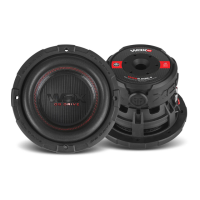




 To Next Page
 General