EasyManua.ls Logo

dbx 122 - Page 27

dbx 122
45 pages
Print Icon
To Next Page IconTo Next Page
To Previous Page IconTo Previous Page
Loading...
26
never
have
been
audible
in
conventional
recordings
can
become
an
annoyance
when
captured
on
a
quiet
dbx
recording.
For
this
reason,
the
ambient
room
noise
should
be
heid
to
an
absolute
minimum.
Subsonics
and
Interference
The
dbx
122
and
124
incorporate
very
effective
band-
pass
filters
that
maintain
full
frequency
response
through-
out
the
audible
spectrum
(—3dB
at
27Hz
and
at
27kHz).
Their
purpose
is
to
reduce
subsonic
and
supersonic
(bias)
frequencies
which
might
otherwise
introduce
errors
in
the
encode
or
decode
process.
Howaver,
in
some
extreme
cases,
rumbles
from
passing
trains,
trucks,
aircraft,
or
even
air
conditioning
may
be
picked
up
by
your
microphones
and
fed
to
the
dbx's
encoding
circuitry.
These
subsonics
can
cause
the
rms
level
detector
to
modulate
the
program,
even
though
the
low
frequencies
themselves
are
not
audible
and
are
not
recorded
on
the
_
tape
(a
tape
machine
usually
cannot
record
accurately
fre-
quencies
below
30Hz).
As
a
result,
the
low
frequency
information
that
created
encoding
changes
is
missing
upon
playback
so
the
decoder
is
‘‘fooled.’”
The
result
may
be
a
mysterious
and
unwanted
deviation
in
program
level.
Should
you
encounter
this
rare
problem,
it
can
be
eliminated
by
using
a
high
pass
filter
between
the
micro-
phone
preamplifier
and
the
dbx
RECORD
INPUT;
the
LOW
CUT,
SUBSONIC
or
RUMBLE
filter
on
your
pre-
amplifier
may
be
suitable,
although
on
some
preamplifiers
the
cut-off
frequency
may
be
higher
than
necessary.
If
unexplained
playback
level
deviations
occur
after
copying
a
conventional
phonograph
disc
onto
a
tape
(using
dbx
II
tape
noise
reduction
encoding),
use
of
the
RUMBLE
filter
during
recording
will
solve
the
problem
by
cutting
sub-
sonic
frequencies.
When
to
Use
dbx
I
Tape
Noise
Reduction
Plus
Expansion
By
recording
and
playing
back
a
program
with
dbx
II
tape
noise
reduction,
then
expanding
it
with
a
dbx
dynamic
range
expander
such
as
our
Model
3BX
or
118,
you
can
reduce
the
noise
and
increase
the
dynamic
range
of
the
original
program
source.
This
process
is
especially
effective
on
FM
broadcasts
or
noisy
phonograph
discs.
By
itself,
the
dynamic
range
enhancer
can
lower
the
noise
and
increase
the
dynamic
range
of
conventional
(non-dbx-encoded}
phono-
graph
discs,
FM
programs,
pre-recorded
tapes
or
other
sources.
Together,
the
dbx
II
tape
noise
reduction
system
and
the
dbx
dynamic
range
enhancer
can
significantly
increase
your
listening
pleasure.
The
dbx
Model
128
is
a
combination
unit
containing
basically
the
same
circuitry
as
the
Model
122
(dbx
II
tape
noise
reduction
unit)
and
the
Model
118
(dbx
dynamic
range
enhancer).
How
to
Playback
with
Expansion
1.
Connect
your
system
as
shown
in
Figure
18.
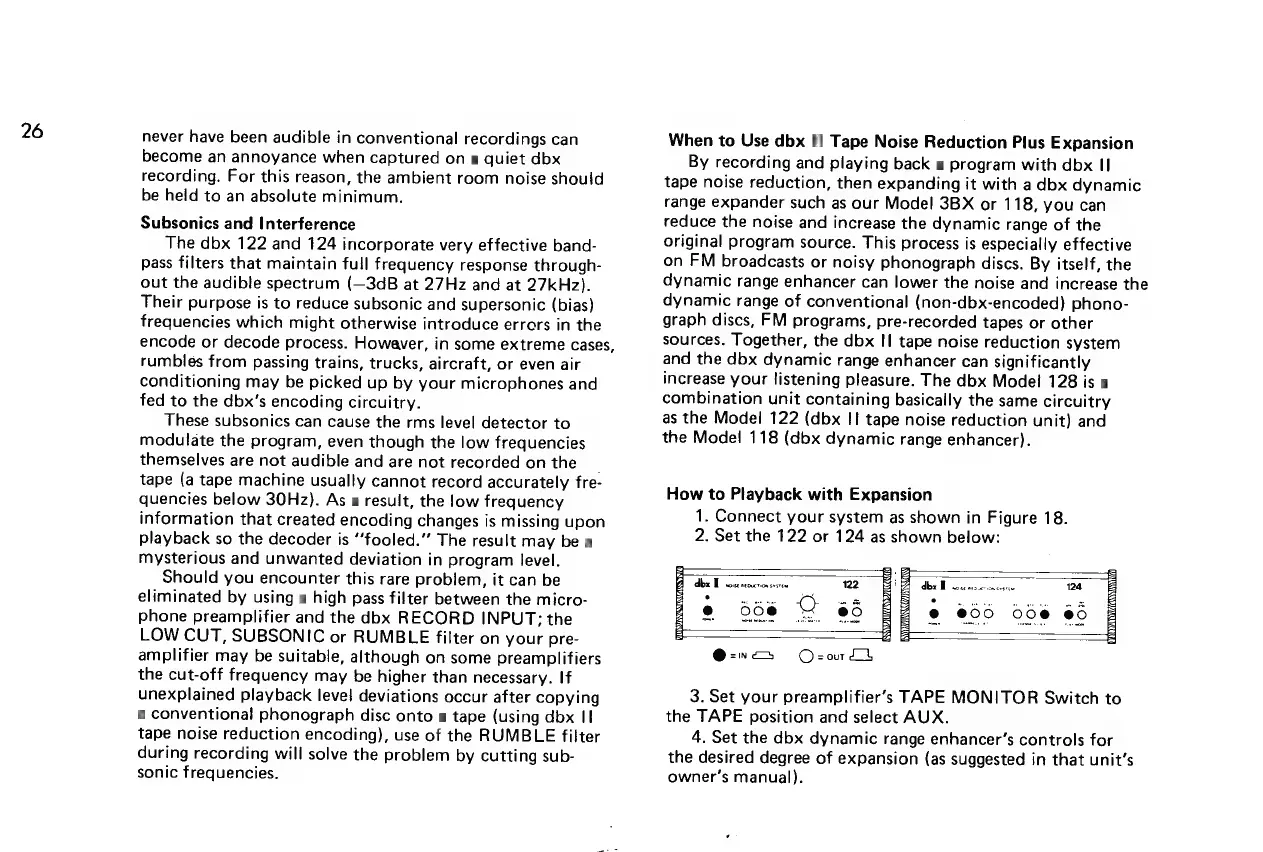
2.
Set
the
122
or
124
as
shown
below:
dbz
De
wcccs
i
dbx
BD
nscacc
mn
csrew
124
@
@00 008
80
i@e
oO:
oO:
@-.0
O-ourd
3.
Set
your
preamplifier’s
TAPE
MONITOR
Switch
to
the
TAPE
position
and
select
AUX.
4.
Set
the
dbx
dynamic
range
enhancer’s
controls
for
the
desired
degree
of
expansion
(as
suggested
in
that
unit's
owner’s
manual).

Related product manuals