EasyManua.ls Logo

dbx 122 - Page 35

dbx 122
45 pages
Print Icon
To Next Page IconTo Next Page
To Previous Page IconTo Previous Page
Loading...
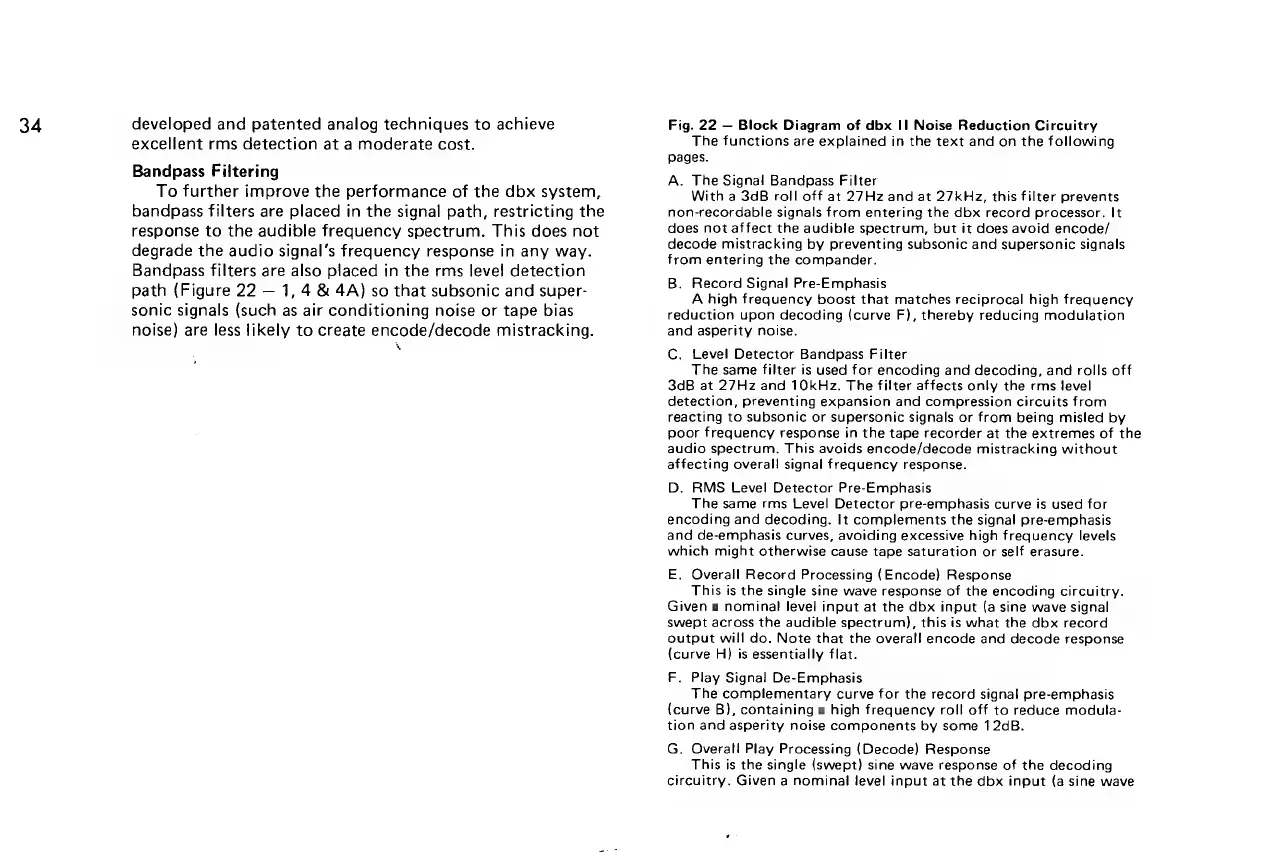
34
developed
and
patented
analog
techniques
to
achieve
excellent
rms
detection
at
a
moderate
cost.
Bandpass
Filtering
To
further
improve
the
performance
of
the
dbx
system,
bandpass
filters
are
placed
in
the
signal
path,
restricting
the
response
to
the
audible
frequency
spectrum.
This
does
not
degrade
the
audio
signal’s
frequency
response
in
any
way.
Bandpass
filters
are
also
placed
in
the
rms
leve!
detection
path
(Figure
22
1,
4
&
4A)
so
that
subsonic
and
super-
sonic
signals
(such
as
air
conditioning
noise
or
tape
bias
noise)
are
less
likely
to
create
encode/decode
mistracking.
\
2
Fig.
22
Block
Diagram
of
dbx
I!
Noise
Reduction
Circuitry
The
functions
are
explained
in
the
text
and
on
the
following
pages.
A.
The
Signal
Bandpass
Filter
With
a
3cB
roll
off
at
27Hz
and
at
27kHz,
this
filter
prevents
non-recordable
signals
from
entering
the
dbx
record
processor.
It
does
not
affect
the
audible
spectrum,
but
it
does
avoid
encode/
decode
mistracking
by
preventing
subsonic
and
supersonic
signals
from
entering
the
compander.
B.
Record
Signal
Pre-Emphasis
A
high
frequency
boost
that
matches
reciprocal
high
frequency
reduction
upon
decoding
(curve
F),
thereby
reducing
modulation
and
asperity
noise.
C.
Level
Detector
Bandpass
Filter
The
same
filter
is
used
for
encoding
and
decoding,
and
rolls
off
3dB
at
27Hz
and
10kHz.
The
filter
affects
only
the
rms
level
detection,
preventing
expansion
and
compression
circuits
from
reacting
to
subsonic
or
supersonic
signals
or
from
being
misled
by
poor
frequency
response
in
the
tape
recorder
at
the
extremes
of
the
audio
spectrum,
This
avoids
encode/decode
mistracking
without
affecting
overall
signal
frequency
response.
D.
RMS
Level
Detector
Pre-Emphasis
The
same
rms
Level
Detector
pre-emphasis
curve
is
used
for
encoding
and
decoding.
It
complements
the
signal
pre-emphasis
and
de-emphasis
curves,
avoiding
excessive
high
frequency
levels
which
might
otherwise
cause
tape
saturation
or
self
erasure.
E.
Overall
Record
Processing
(Encode)
Response
This
is
the
single
sine
wave
response
of
the
encoding
circuitry.
Given
a
nominal
level
input
at
the
dbx
input
(a
sine
wave
signal
swept
across
the
audible
spectrum),
this
is
what
the
dbx
record
output
will
do.
Note
that
the
overall
encode
and
decode
response
(curve
H)
is
essentially
flat.
F.
Play
Signal
De-Emphasis
The
complementary
curve
for the
record
signal
pre-emphasis
(curve
B),
containing
a
high
frequency
roll
off
to
reduce
modula-
tion
and
asperity
noise
components
by
some
12dB.
G.
Overall!
Play
Processing
(Decode)
Response
This
is
the
single
(swept)
sine
wave
response
of
the
decoding
circuitry.
Given
a
nominal
level
input
at
the
dbx
input
(a
sine
wave

Related product manuals