EasyManua.ls Logo

dbx 463X - Page 6

dbx 463X
31 pages
Print Icon
To Next Page IconTo Next Page
To Previous Page IconTo Previous Page
Loading...
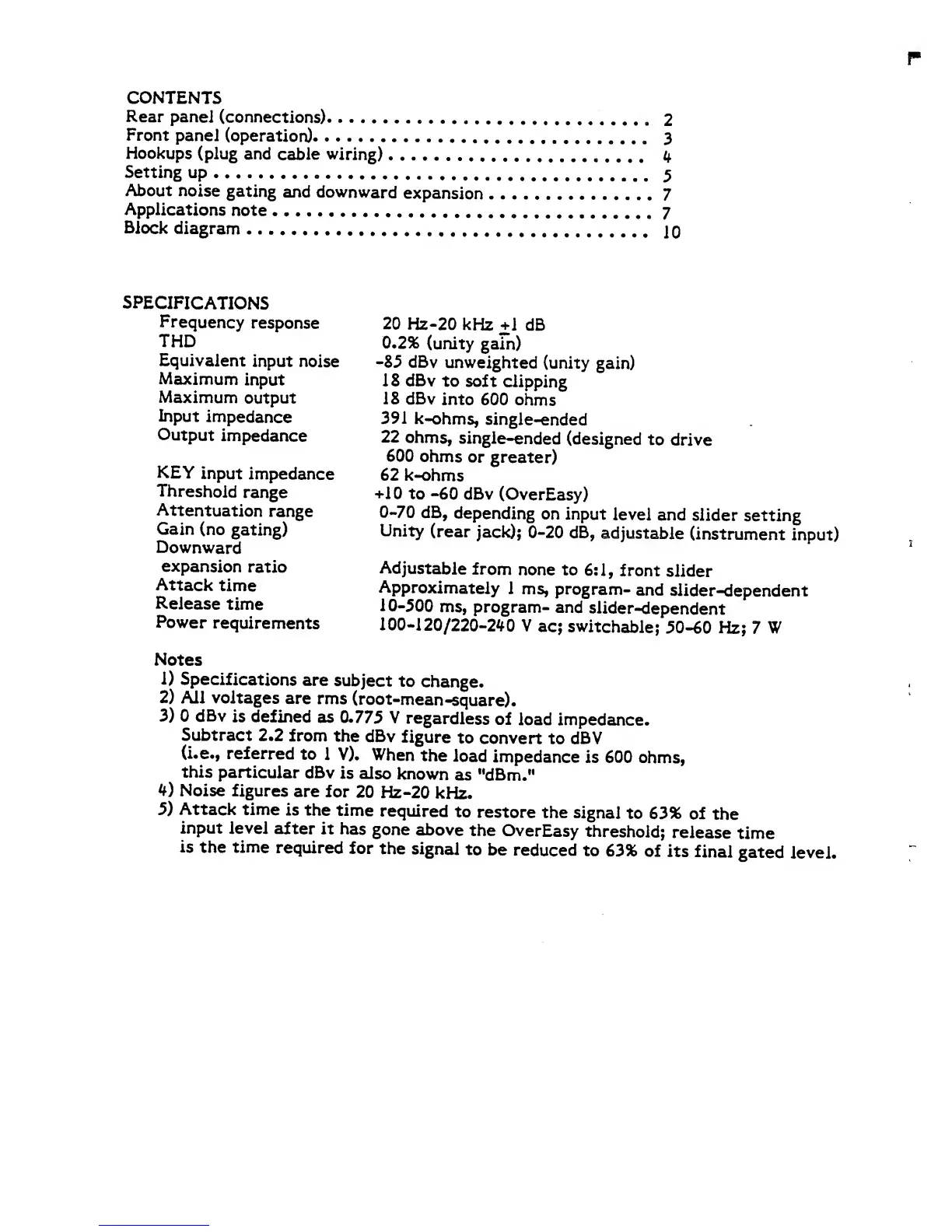
CONTENTS
Rear
panel
(connections)
2
Front
panel
(operation)
3
Hookups
(plug
and
cable wiring)
4
Setting
up
3
About
noise
gating
and
downward
expansion
7
Applications
note
7
Block
diagram
10
SPECIFICATIONS
Frequency
response
THD
Equivalent
input
noise
Maximum
input
Maximum
output
Input
impedance
Output
impedance
KEY
input
impedance
Threshold
range
Attentuation
range
Gain
(no
gating)
Downward
expansion
ratio
Attack
time
Reiease
time
Power
requirements
Notes
1)
Specifications
are
subject
to
change.
2)
All
voltages
are rms
(root-mean-square).
3)
0
dBv
is
defined
as
0.775
V
regardless
of
load
impedance.
Subtract
2.2
from
the
dBv
figure
to
convert
to
dBV
(i.e.,
referred
to
1 V).
When
the
load
impedance
is
600
ohms,
this
particular
dBv
is
also
known
as
"dBm."
4)
Noise
figures
are
for
20
Hz
-20
kHz.
5)
Attack time
is
the
time
required
to
restore
the
signal
to
63%
of
the
input
level
after
it
has
gone
above
the
OverEasy
threshold;
release
time
is
the time
required
for
the
signal
to
be
reduced
to
63%
of
its
final
gated
level.
20
Hz-20
kHz +1
dB
0.2%
(unity
gain)
-85
dBv
unweighted
(unity
gain)
1 8 dBv
to
soft clipping
18
dBv
into
600
ohms
391
k-ohms,
single-ended
22
ohms,
single-ended
(designed
to
drive
600
ohms
or
greater)
62
k-ohms
+1
0
to
-60
dBv
(OverEasy)
0-70
dB,
depending
on
input
level
and
slider
setting
Unity
(rear
jack);
0-20
dB,
adjustable
(instrument
input)
Adjustable
from
none to
6:1,
front
slider
Approximately
1
ms,
program-
and
slider-dependent
10-500
ms,
program-
and
slider-dependent
100-120/220-240
V
acj
switchable;
50-60
Hz;
7
W