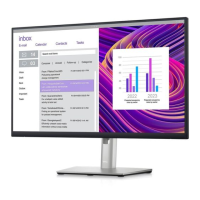
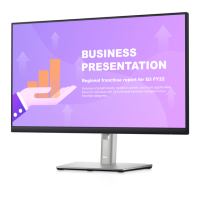
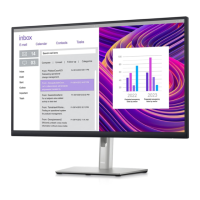
Need help?
Do you have a question about the Dell P2421DC and is the answer not in the manual?
The Dell 24 USB-C Monitor (P2421DC) is managed by the Dell Display Manager (DDM), a Windows application designed to enhance your interaction with the monitor. DDM allows for comprehensive control over various display settings, whether you're using a single monitor or a multi-monitor setup. Once installed, DDM runs automatically when your system starts, placing its icon in the notification tray for easy access. Hovering over this icon provides quick information about the monitors connected to your system.
The primary function of the Dell Display Manager is to provide a user-friendly interface for adjusting and optimizing your monitor's performance. It facilitates manual adjustments of displayed images, automates settings based on application usage, manages energy consumption, and enables image rotation, among other features available on selected Dell models.
A crucial aspect of DDM's functionality is its communication with your monitor via the DDC/CI (Display Data Channel/Command Interface) channel. For DDM to work correctly, DDC/CI must be enabled in your monitor's menu. This ensures that the software can send and receive commands to and from the display, allowing for seamless control.
Quick Settings Dialog: Clicking the DDM notification tray icon opens the Quick Settings dialog box. If multiple supported Dell monitors are connected, you can select a specific target monitor from a provided menu. This dialog allows for convenient adjustment of brightness and contrast levels. You can choose between "Manual Mode" for direct control or "Auto Mode" for application-based adjustments. The screen resolution can also be changed from this dialog. The Quick Settings dialog also provides access to DDM's advanced user interface for more in-depth configuration.
Quick DDM Access: For rapid interaction, DDM offers a quick key (Ctrl+Shift+D) to call up the DDM UI. In a multi-monitor setup, you can control individual monitors by selecting them from a dropdown box (the selected monitor will show the Dell logo) or by moving the DDM UI to the desired monitor. Pressing Ctrl+Shift+D will also bring up a mini UI under the mouse pointer for quick adjustments.
Setting Basic Display Functions: The "Basic" tab within DDM allows you to select "Manual Mode" to choose a preset display mode or "Auto Mode" to apply a preset mode based on the active application. An on-screen message will indicate any changes in the current preset mode. Brightness and Contrast can be directly adjusted from this tab. When multiple Dell monitors are connected, enabling "display matrix control" allows you to apply brightness, contrast, and color presets to all monitors simultaneously.
Assigning Preset Modes to Applications: The "Auto Mode" tab is a powerful feature that allows you to associate specific preset display modes with particular applications. When "Auto Mode" is enabled, DDM automatically switches to the corresponding preset mode when the associated application is activated. This can be configured to apply the same preset mode across all connected monitors or to vary between monitors. DDM comes pre-configured for many popular applications. You can add new applications by dragging them from your desktop, Windows Start Menu, or other locations onto the assignment list. It's important to note that preset mode assignments are not supported for batch files, scripts, loaders, or non-executable files like zip archives. You can also configure the "Game" preset mode to activate automatically when a Direct3D application runs in full-screen mode. To prevent an application from using a specific mode, you can assign a different preset mode to it.
Organizing Windows with Easy Arrange: The "Easy Arrange" tab helps you organize open windows efficiently. On supported Dell monitors, you can drag windows into predefined zones to arrange them in various layouts. You can cycle through more layouts using the ">" button or the Page Up/Page Down keys. To create a custom layout, arrange your open windows as desired and then click "Save." When dragging a window, the current layout is displayed, and active regions are highlighted, allowing you to drop the window into a specific region. To create a custom layout, size and position up to 10 windows on your desktop, then click the "Save" link in Easy Arrange. This saves the layout as a custom icon. This feature saves only the size and position of windows, not the applications themselves. To use a custom layout, select its icon. To delete a saved custom layout, close all desktop windows and click "Save" in Easy Arrange.
Enhanced Easy Arrange: DDM offers advanced Easy Arrange features. You can save and name up to 5 customized Easy Arrange patterns and configure x*y patterns. Pressing Ctrl+Shift+Home cycles through the last 5 most recently used (MRU) layouts. Holding down Ctrl while resizing an Easy Arrange layout allows you to adjust the size and number of cells. Newly formed patterns are saved into an Easy Arrange icon position. Holding Ctrl while clicking a modified layout icon restores it to the default layout. For portrait mode, Easy Arrange icons are presented when the monitor is rotated.
Managing Multiple Video Inputs: The "Input Manager" tab provides convenient ways to manage multiple video inputs connected to your Dell monitor, making it easy to switch between inputs when working with multiple computers. All available video input ports are listed, and you can assign custom names to each. Remember to save your changes after editing. You can define a shortcut key for quickly switching to your favorite input and another for toggling between two frequently used inputs. DDM can communicate with your monitor even when it's displaying video from another computer, allowing you to install DDM on your primary PC and control input switching from there, or install it on other connected PCs.
Restoring Application Positions: DDM helps restore application windows to their previous positions when you reconnect your computer to the monitor(s). This feature can be accessed by right-clicking the DDM icon in the notification tray. If you select "Auto-restore window layout," DDM tracks and remembers your application windows' positions, automatically placing them back into their original locations when you reconnect your PC to your monitor(s). If you want to revert to a favorite layout after moving windows, you can first "Save current window layout" and then "Restore saved window layout." DDM is capable of recognizing different monitor models or resolutions and applying appropriate window layouts. If you replace a monitor in a multi-monitor setup, you can save the window layout before replacement and restore it after the new monitor is installed. It's important to keep your applications running to benefit from this feature, as DDM does not launch applications.
Attach DDM to Active Window (Only Window 10): The DDM icon can be attached to the active window you are working on, providing easy access to several features. This allows users to quickly switch window positions, change color preset modes, and associate auto preset modes. A shortcut key trigger (Ctrl+Shift+Ins) on a running app window also activates the attached DDM menu. You can send the app window to the previous/next Easy Arrange cell or to the previous/next monitor.
Applying Energy Conservation Features: On supported Dell models, the "Options" tab offers "PowerNap" energy conservation features. You can choose to reduce the monitor's brightness to the minimum level or put the monitor to sleep when the screensaver is activated.
Troubleshooting: If DDM fails to work with your monitor, an icon will appear in your notification tray, indicating that you need to connect a supported Dell monitor. Clicking this icon will display a more detailed error message, stating that the program requires a supported Dell monitor and connection, along with a compatible display driver. DDM is designed to work exclusively with Dell-branded monitors.
If DDM cannot detect or communicate with a supported Dell monitor, consider the following troubleshooting steps:
DDM may not work with certain monitors, including Dell models older than 2013 and D-series monitors (refer to Dell Product Support for more information), gaming monitors using Nvidia-based G-sync technology, and virtual/wireless displays. For some early DP 1.2 monitors, it might be necessary to disable MST/DP 1.2 using the monitor OSD.
Updates: If your PC is connected to the Internet, DDM will prompt you when a newer version of the application is available. It is recommended to download and install the latest DDM application. You can also manually check for new versions by right-clicking the DDM icon while pressing and holding the 'shift' key, which will reveal options like "Check for new version..." in the context menu. This menu also includes options to refresh, save monitor asset reports, save diagnostic reports, and manage auto-load at startup and onscreen notifications.
 General
| 3D | No |
|---|---|
| Pixel pitch | 0.2058 x 0.2058 mm |
| Screen shape | Flat |
| Pixel density | 123 ppi |
| Response time | 8 ms |
| Backlight type | LED |
| Display diagonal | 23.8 \ |
| Display technology | LCD |
| Native aspect ratio | 16:9 |
| Vertical scan range | 49 - 75 Hz |
| Maximum refresh rate | 60 Hz |
| Response time (fast) | 5 ms |
| Horizontal scan range | 29 - 113 kHz |
| Supported video modes | 480i, 480p, 576i, 576p, 720p, 1080i, 1080p, 1440p |
| Viewable size, vertical | 296.35 mm |
| sRGB coverage (typical) | 99 % |
| Display number of colors | 16.78 million colors |
| Viewable size, horizontal | 526.85 mm |
| Display brightness (typical) | 300 cd/m² |
| Supported graphics resolutions | 640 x 480 (VGA), 720 x 400, 800 x 600 (SVGA), 1024 x 768 (XGA), 1152 x 864 (XGA+), 1280 x 1024 (SXGA), 1280 x 768 (WXGA), 1600 x 1200 (UXGA), 1680 x 1050 (WSXGA+), 1920 x 1080 (HD 1080), 1920 x 1200 (WUXGA), 2048 x 1080, 2560 x 1440 |
| Pivot angle | -90 - 90 ° |
| Tilt angle range | -5 - 21 ° |
| Panel mounting interface | 100 x 100 mm |
| HDMI version | 1.4 |
| USB hub version | 2.0 / 3.2 Gen 1 (3.1 Gen 1) |
| DisplayPort version | 1.2 |
| USB upstream port type | USB Type-C |
| VGA (D-Sub) ports quantity | 0 |
| USB Type-A downstream ports quantity | 4 |
| Input current | 2.5 A |
| AC input voltage | 120 - 230 V |
| AC input frequency | 50 - 60 Hz |
| Energy efficiency scale | A to G |
| Power consumption (max) | 127 W |
| Power consumption (off) | 0.2 W |
| Power consumption (standby) | 0.3 W |
| Power consumption (typical) | 18.5 W |
| Power consumption (PowerSave) | 17.7 W |
| Certification | NFPA 99, DisplayPort 1.2, HDCP 1.2, Mercury-free |
| Product color | Black |
| Market positioning | Business |
| Doesn't contain | BRF, PVC |
| Sustainability certificates | RoHS, ENERGY STAR |
| Storage temperature (T-T) | -20 - 60 °C |
| Operating temperature (T-T) | 0 - 40 °C |
| Storage relative humidity (H-H) | 10 - 90 % |
| Operating relative humidity (H-H) | 10 - 80 % |
| Cables included | DisplayPort, USB Type-C |
| Package depth | 617.98 mm |
| Package width | 165.1 mm |
| Package height | 393.95 mm |
| Package weight | 7690 g |
| Harmonized System (HS) code | 85285210 |
 Weight and Dimensions
| Bezel width (top) | 5.4 mm |
|---|---|
| Bezel width (side) | 5.5 mm |
| Depth (with stand) | 166 mm |
| Height (with stand) | 486.1 mm |
| Weight (with stand) | 5760 g |
| Bezel width (bottom) | 20.3 mm |
| Depth (without stand) | 42.7 mm |
| Width (without stand) | 537.8 mm |
| Height (without stand) | 322.1 mm |
| Weight (without stand) | 3770 g |

 To Next Page