rrw^i
Electrical System and Instruments
M:06:03
P
:
^*l
J
pwi
FW&\
In charging, the appearance of the green dot
means that the battery is sufficiently charged.
Charging can be stopped to prevent overcharging.
The hydrometer on some few batteries may be
clear or light yellow. This means the fluid level is
below the bottom of the rod and attached cage.
This may have been caused by excessive or
prolonged charging, a broken case, excessive
tipping or normal battery wearout. If a cranking
complaint exists and is caused by the battery,
replace it — do not charge, test or jump start the
battery!
It is important when observing the hydrometer that
the battery has a clean top to see the correct
indication.
A light may be required in some poorly-
lit areas.
BATTERY CHARGING
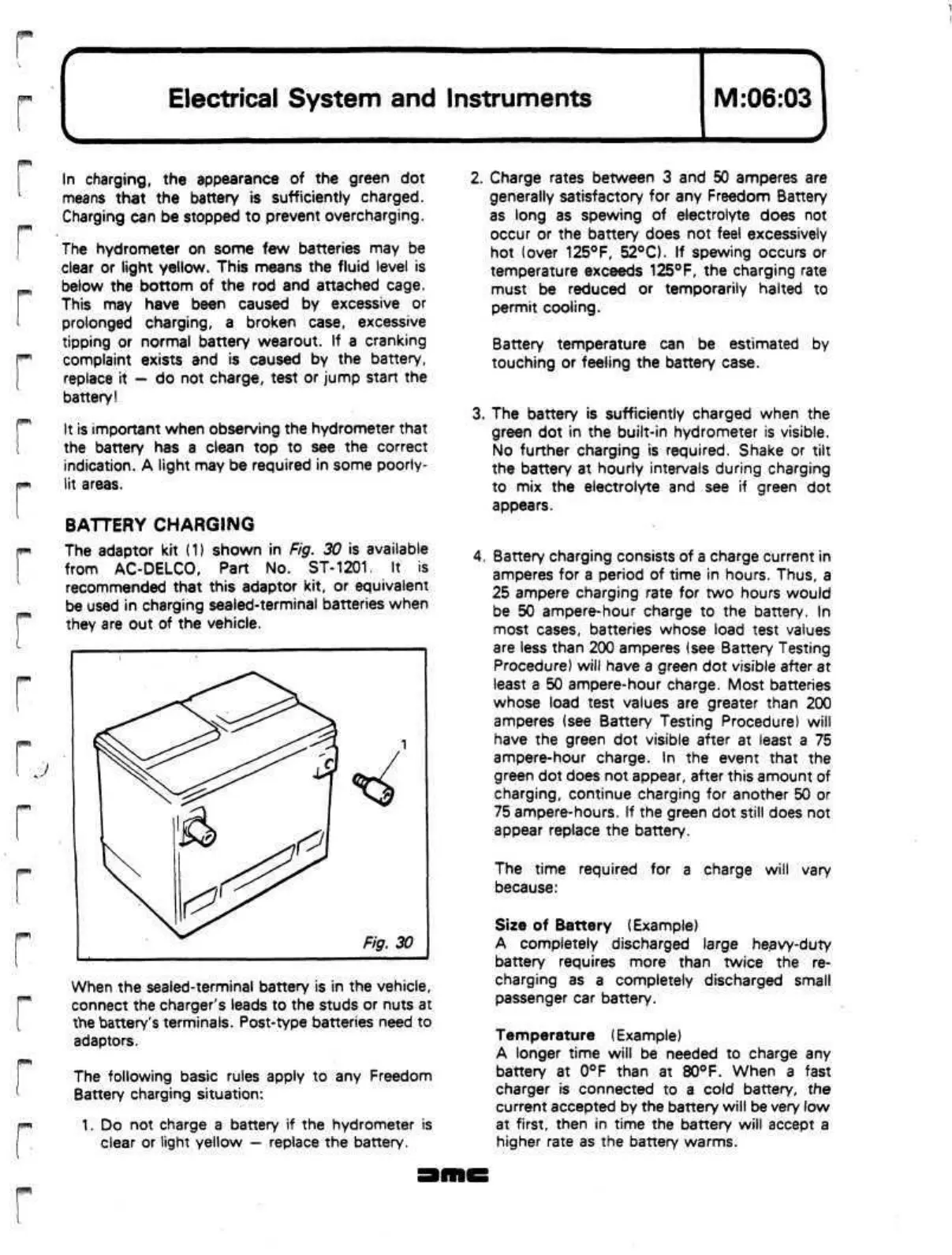
The adaptor kit (1) shown in Fig. 30 is available
from AC-DELCO, Part No.
ST-1201.
It is
recommended that this adaptor kit, or equivalent
be used in charging sealed-terminal batteries when
they are out of the vehicle.
When the sealed-terminal battery is in the vehicle,
connect the charger's leads to the studs or nuts at
the battery's terminals. Post-type batteries need to
adaptors.
The following basic rules apply to any Freedom
Battery charging situation:
1.
Do not charge a battery if the hydrometer is
clear or light yellow — replace the battery.
Charge rates between 3 and 50 amperes are
generally satisfactory for any Freedom Battery
as long as spewing of electrolyte does not
occur or the battery does not feel excessively
hot (over
125°F,
52°C). If spewing occurs or
temperature exceeds 125°F, the charging rate
must be reduced or temporarily halted to
permit cooling.
Battery temperature can be estimated by
touching or feeling the battery case.
The battery is sufficiently charged when the
green dot in the built-in hydrometer is visible.
No further charging is required. Shake or tilt
the battery at hourly intervals during charging
to mix the electrolyte and see if green dot
appears.
4.
Battery charging consists of a charge current in
amperes for a period of time in hours. Thus, a
25 ampere charging rate for two hours would
be 50 ampere-hour charge to the battery. In
most cases, batteries whose load test values
are less than 200 amperes (see Battery Testing
Procedure) will have a green dot visible after at
least a 50 ampere-hour charge. Most batteries
whose load test values are greater than 200
amperes (see Battery Testing Procedure) will
have the green dot visible after at least a 75
ampere-hour charge. In the event that the
green dot does not appear, after this amount of
charging,
continue charging for another 50 or
75 ampere-hours. If the green dot still does not
appear replace the battery.
The time required for a charge will vary
because:
Size of Battery (Example)
A completely discharged large heavy-duty
battery requires more than twice the
re-
charging as a completely discharged small
passenger car battery.
Temperature (Example)
A longer time will be needed to charge any
battery at
0°F
than at
80°F.
When a fast
charger is connected to a cold battery, the
current accepted by the battery will be very low
at first, then in time the battery will accept a
higher rate as the battery warms.


 To Next Page
 Loading...